
DTAC sees mobility data harvesting as boon for tourism
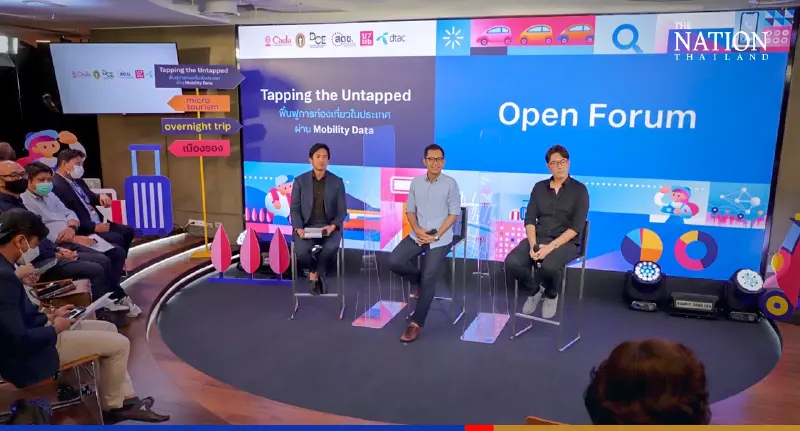


Mobility data is a key secret to long-term recovery and boosting Thailand's tourism industry following the Covid-19 pandemic, says a joint research by DTAC, ONDE, Chula, and Boonmee Lab.
Sharad Mehtora, CEO of Total Access Communication Plc (DTAC), told a press conference on Monday that the mobile operator's data harvesting will unlock the country's data-driven economy strategy.
It demonstrates how mobility data is used for public policymaking and addressing various social challenges, in this case, Thailand's tourism, which he describes as "one of the core engines driving our economy”.

He pointed out that there are several advantages to managing and exploring mobility data. It provides timely human context to other data and insight, as well as measures consumer activity over time, allowing analysts to respond to and predict trends with accuracy.
"With this insight data, it means that all parties in the tourism industry can seize an opportunity to reset their businesses in order to increase their strength, attract more tourists, and find more methods to create resilience and sustainable tourism," Mehrotra explained.
DTAC has collaborated with the National Digital Economy and Society Commission (ONDE), Chulalongkorn University, and Boonmee Lab to conduct a study of tourist behaviour from June 2020 to October 2021, using mobility data supported by DTAC, focusing on secondary provinces area.
It found that 6.4 million trips happened during that period. Some 67 per cent stayed at destinations overnight, while 35 per cent were day travellers.

Nattapong Punnoi, head of the Urban and Regional Planning Department at Chulalongkorn University's Faculty of Architecture, said that this in-depth data not only shows where people prefer to travel, but also how they travel, the time they spend there, and which local events or festivals they prefer to stay overnight and attend.
The findings also prompted the research team to develop three key policy recommendations for secondary province tourism promotion: micro-tourism, experience-based overnight tourism, and tourism clusters.
Micro-tourism will encourage local SME operators to create and integrate tourism activities into the production process of goods and services. Their target tourists are nearby neighbourhoods.
Overnight tourism based on experience aims to increase overnight stays, and a tourism cluster is a group of highlighted tourism attractions within a limited geographic space that is equipped with high-quality equipment and services.

"Mobile data lets you know who you are, what you have, and how to use what you already have to gain benefits; it is a cost-effective investment; it is a low-investment but high-impact return," Nattapong said.
He expected that more joint research into the use of mobility data would be conducted in order to find the best solutions to other social and economic issues.
ONDE’s secretary-general, Putchapong Nodthaisong, said that data is the foundation of the digital economy. Data in digital form provides numerous benefits that allow the government to address social issues more effectively, such as water irrigation, city road traffic, and disaster management.
DTAC's head of communications and sustainability, On-uma Rerkpattanapipat, said that the study was conducted because DTAC wants to find the best way to use data to benefit more than 10 million users in their database.
She insisted that all data would be used strictly under personal data protection in accordance with the Personal Data Protection Act.
The full report of the study will be published in October, she added.
Mobility data will assist researchers in fully understanding tourist movement patterns and concentration, advancing academic research methodology and finding solutions to other challenges, Mehrotra said.
