
Council of State clarifies referendum on MOU termination after House dissolution violates Constitution
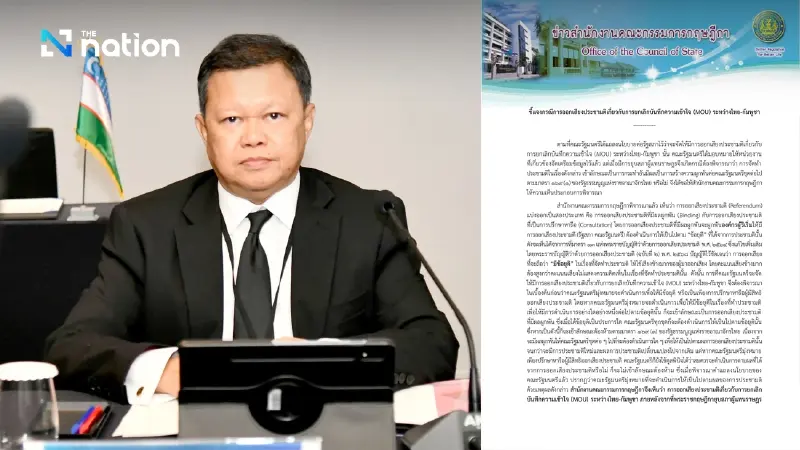


The Council of State confirms that a referendum on the Thai-Cambodian MOU following the House dissolution would violate Article 169 of the Constitution and is unconstitutional.
The Office of the Council of State on Tuesday (December 16) issued a statement addressing the situation surrounding a potential referendum on the termination of the Memorandum of Understanding (MOU) between Thailand and Cambodia. The statement clarified that while the Cabinet had instructed relevant agencies to prepare for the referendum, the dissolution of the House of Representatives raised constitutional concerns regarding whether such a referendum would legally bind future Cabinets.
The Council of State’s legal interpretation indicated that conducting a referendum on the MOU’s termination under these circumstances would violate Section 169(1) of the Constitution, which prohibits any act that imposes obligations on future Cabinets. This constitutional provision stipulates that any decision made in a referendum that binds the actions of the next government would be unconstitutional.
The Council of State elaborated that a referendum can either be binding or consultative. A binding referendum obligates the executive body to comply with its result, whereas a consultative referendum allows the government to consider the result without being bound by it. In this case, the referendum on the MOU would result in a decision that imposes obligations on future governments, thus rendering it unconstitutional under the current constitutional framework.
Furthermore, the Council of State mentioned that if the government wishes to proceed with such a referendum, detailed information about the benefits and drawbacks of the MOU and its termination should be disclosed, as this could significantly impact diplomatic relations and negotiations with Cambodia.
The Cabinet then reviewed the Council of State’s opinion and agreed that a referendum on the MOU’s termination, following the dissolution of the House of Representatives, would violate the Constitution, specifically Section 169(1). As a result, the Cabinet concluded that proceeding with the referendum was not possible under the current legal framework.
Thus, the referendum on the MOU’s termination after the dissolution of the House of Representatives is not legally permissible as it would conflict with constitutional guidelines.
