
Depa warns! Trump's tariff starts in August, Thailand must find new markets
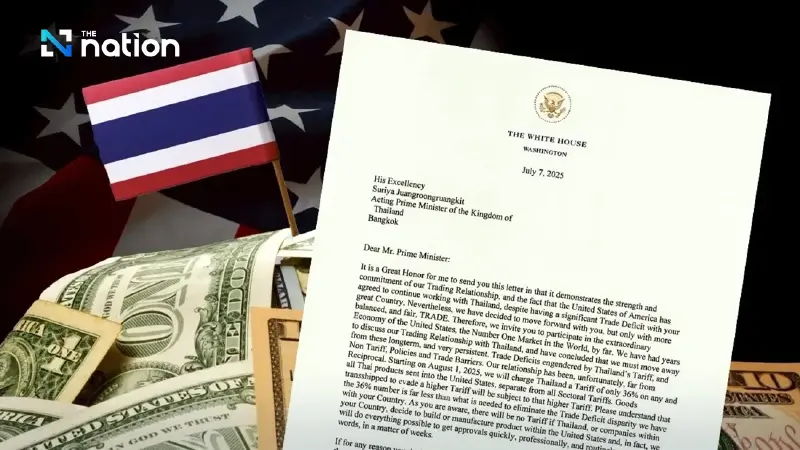


Depa warns that the US's 36% tariff on Thai imports, effective August 1, could impact exports. Measures such as opening new markets and enhancing digital trade are crucial for Thailand’s response.
Thailand is facing a significant challenge due to changes in the United States' import tax policy. Under President Donald Trump's leadership, the US has announced new import tariffs, imposing a 36% tax on goods imported from Thailand, effective August 1, 2025.
Nuttapon Nimmanphatcharin, Director-General of the Digital Economy Promotion Agency (depa), explained that this new tax measure is part of the US's "Taxing Everywhere" strategy. The strategy begins with a basic 10% import tax on all goods from all countries while imposing special rates on countries with a trade surplus with the US, such as Thailand, China, and Vietnam. Thailand has been assigned one of the highest rates in Asia, at 36%.

Thailand Must Accelerate Search for New Markets and Expand Digital Trade
Nuttapon stated that although Thailand has not been immediately affected by this new tax, failure to adapt within this quarter could inevitably impact the country's competitiveness and overall export performance. To cope with these challenges, Thailand must act swiftly on the following strategies:
• Open new markets, especially in the Middle East, Central Asia, and Africa.
• Develop export channels through digital platforms, such as PromptTrade and Trade Digitization systems.
• Support small and medium-sized enterprises (SMEs), particularly in agriculture and product processing, to access global markets more effectively.
"Spreading opportunities to grassroots groups is the key to reducing the risks posed by external pressures and creating a sustainable economy from the ground up," said Nuttapon.
Digital Tax Issue Unresolved – State Revenue Losses Exceed 70 Billion Annually
In addition to external import tax measures, Thailand is also facing internal pressure from the incomplete digital tax collection system. Currently, only 3 billion baht per month is collected from cross-border digital services VAT, while estimates suggest the government could collect up to 70 billion baht annually.
This represents a significant loss in government revenue, which remains a structural issue that urgently needs reform.
At the same time, Thailand's main export products, such as electronics, mobile phones, and semiconductors, are encountering friction from these new tax measures, particularly in the US market. Agricultural products like rice still have potential, but their export share remains small. In the latest quarter, rice ranked 9th among Thailand's export commodities.
GDP Could Decline by 2.5% if Exports Fail
If Thailand cannot quickly adapt to these challenges and if the new US tax measures significantly impact export volumes, the country’s GDP could shrink by as much as 2.5%. This decline would be insufficient to maintain the stability of Thailand’s long-term economic growth.
Depa notes that competition in the region is intensifying. Vietnam is increasingly seen as a new manufacturing base to replace China, with the export-to-GDP ratio reaching 90%. Meanwhile, Thailand has yet to establish a clear position in the global economic arena, whether in agricultural technology, processed industries, or advanced electronics.
Practical Solutions for Thailand's Economic Challenges
A viable solution is to rapidly develop the National Single Window system to automate exports, reduce costs, enhance transparency, and expand opportunities for small businesses to access foreign markets.
Another approach is to develop new products, such as processing rice into flour as a substitute for wheat flour in the Western food industry. This would create added value for basic agricultural products and open new markets with little competition.
