
Government Accepts Chamber's Four-Point Plan to Revive Thai-Cambodia Border Economy


Measures include delaying minimum wage rises, reducing social security contributions, and introducing tax relief to restore cross-border trade
- The Thai government has accepted a four-point proposal from the Thai Chamber of Commerce to revitalize the economy in seven provinces along the Thai-Cambodia border.
- The plan includes tax and fee relief measures, such as double tax deductions for business travel, reduced local taxes, and extended payment deadlines for affected businesses.
- Financial support measures are proposed, including a 5-billion-baht "Border Recovery Fund," low-interest emergency loans, and encouraging commercial banks to provide assistance.
- The proposal also addresses labor shortages by suggesting a delay in minimum wage increases, reduced social security contributions, and streamlining the process for importing and registering foreign workers.
The Thai government has accepted a comprehensive four-point proposal from the Thai Chamber of Commerce to revitalise the economy along the Thai-Cambodia border following recent unrest that disrupted business operations.
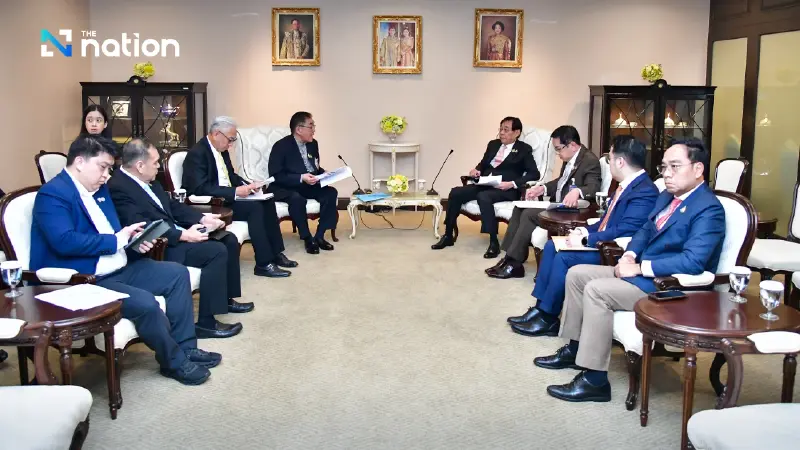
Deputy Prime Minister and Finance Minister Pichai Chunhavajira met with Chamber President Poj Aramwattananont and representatives from seven border provinces on Thursday morning at Government House to discuss relief measures for businesses affected by the border tensions.
Speaking after the meeting, Pichai confirmed that the government would expedite discussions with relevant agencies to implement the proposed measures, which focus on business recovery, economic stimulus, and tourism revival.
"We will coordinate with all relevant departments to find solutions for every issue raised," he said.
A key concern addressed was the critical labour shortage affecting border businesses.
Pichai indicated the government would review how to manage both documented and undocumented foreign workers currently in Thailand, whilst exploring options to bring in additional labour from neighbouring countries including Bangladesh.
"We need to determine whether workers with existing permits can continue their employment, and ensure undocumented workers are properly registered," he explained. "We're also looking at streamlining processes for importing workers from countries like Bangladesh."
The government has already approved several tax relief measures, including exemptions on personal income tax, corporate income tax, and withholding tax for affected businesses, alongside extensions for tax payment deadlines.

Additional financial support measures are being coordinated with commercial banks, building upon assistance already provided by state financial institutions.
The Thai Chamber of Commerce presented a detailed proposal encompassing four main areas:
Tax and Fee Relief Measures
- Allow companies organising conferences or study tours in the seven border provinces to claim double tax deductions on actual expenses
- Request 90% reduction in local taxes including land and building tax, and signage tax
- Introduce special tax measures including penalty waivers for businesses filing returns 25% above or below net profit due to unrest
- Extend tax filing and payment deadlines by 3-6 months
- Reduce withholding tax from 3% to 1% for one year
Financial Liquidity Support
- Encourage commercial banks to offer assistance similar to existing state financial institution programmes
- Introduce emergency low-interest loans of up to 50,000 baht per household at maximum 1% annual interest, with 12-month payment holidays
- Establish a 5-billion-baht "Border Recovery Fund"
- Economic and Tourism Stimulus
- Provide budget support for government and private sector conference and study tour activities in the seven provinces
- Encourage government agencies nationwide to prioritise the border provinces for meetings and events

Labour and Employment Measures
- Delay minimum wage increases to 400 baht daily for hotels and service businesses in affected areas
- Reduce employer and employee social security contributions to 0.5% for one year
- Streamline foreign worker import processes and reduce associated costs
- Establish provincial labour coordination centres for urgent worker placement
- Allow Cambodian workers to return using pink identity cards as initial documentation
- Provide two-month registration windows for undocumented foreign workers
- Reduce worker registration fees by 50% or more under new MOU arrangements
Chamber President Poj Aramwattananont expressed optimism that the situation was improving, enabling the private sector to focus on economic recovery.
"We believe these measures are appropriate and achievable for the government to implement," he said.
The proposals specifically target the seven border provinces most affected by the recent tensions, with the government expected to coordinate with security agencies to assess regional stability before accelerating recovery efforts.
The comprehensive package represents a significant intervention to restore business confidence and economic activity in a strategically important border region that serves as a crucial trade corridor between Thailand and Cambodia.
