
Thai economy faces 'chronic disease', structural reform needed
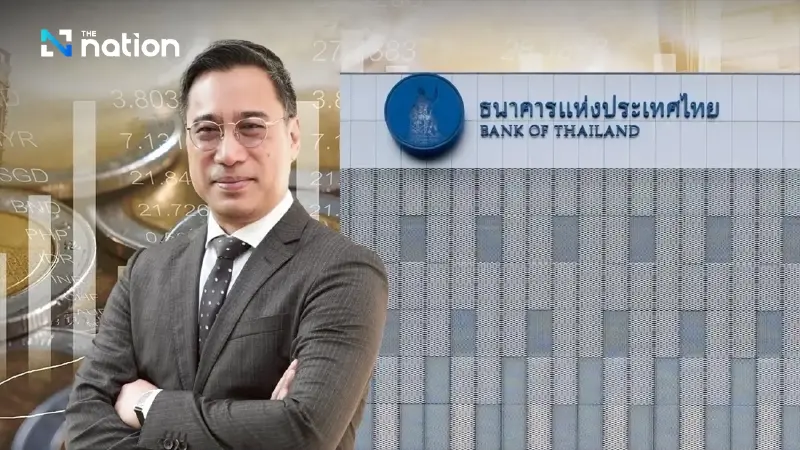


The Bank of Thailand (BOT) Governor highlights that Thailand's economy is facing deep-rooted structural issues, likening them to a "chronic disease" with declining growth potential, high inequality, and rising household debt.
To address these issues, economic reform should focus on long-term structural changes rather than short-term stimulus measures that only provide temporary relief.
Sethaput Suthiwartnarueput shared his thoughts in an exclusive interview on Deep Talk with Krungthep Turakij before his term ends on September 30, 2025. Reflecting on his five-year tenure, Sethaput described the period as both "long" and "challenging."
When asked about his satisfaction with his performance, Sethaput emphasized that it is up to the public and relevant stakeholders to evaluate his work.
However, when it comes to his personal satisfaction, he expressed that he is "satisfied" with the dedication and attention he and BOT have given to addressing challenges, working tirelessly within existing limitations.
Throughout his tenure, Sethaput mentioned that decisions made by BOT were often complex, considering the long-term picture, public welfare, and potential side effects, which might not have been immediately evident.
For example, the Monetary Policy Committee (MPC) refrained from raising interest rates in the past due to concerns over uneven growth, but this led to a continuous rise in household debt.
"Not everything we did was right, and some things didn’t turn out as expected. But BOTis ready to adjust what isn’t working,” Sethaput said.
“We acknowledge that our communication could have been clearer, which may have caused confusion among the public about the reasoning behind our decisions. The central bank is committed to improving communication going forward.”
Message for the next BOT governor
Sethaput stressed that he will communicate and hand over responsibilities to the new governor systematically over several months. Through the media, his key message is clear: “expect pressure to focus on short-term issues.”
He noted that while handling short-term matters is normal, the priority must not shift away from long-term concerns and structural reforms.
Sethaput painted a picture of Thailand’s economy and challenges: although official economic indicators remain strong, most citizens do not feel the benefits. Many struggle with insufficient salaries, high debt levels, and businesses continue to face liquidity problems, while bank lending remains tightly controlled.
These conditions highlight a disconnect between economic data and the lived experience of the public, who still face significant financial difficulties.
Economy faces deep-rooted short- and long-term challenges
These factors highlight Thailand’s persistent structural and long-term economic challenges:
- Declining growth potential: Thailand’s economic growth capacity has been weakening, and after each crisis or shock, recoveries have consistently returned growth to lower levels than before. This continuous decline reflects a fundamental long-term problem that cannot be solved through short-term stimulus alone, as such measures may temporarily revive the economy but will eventually see it revert to its previous state. Addressing this is the first essential challenge.
- High inequality: Thailand faces deeper inequality than many realise, not only in income but also in wealth and household assets, with numerous households suffering from negative net assets.
In addition to these structural issues, the Thai economy continues to face multiple short-term pressures, including a slow recovery, especially in household incomes, which remain sluggish following the severe impacts of COVID-19 compared with other countries.
Thailand grapples with stubborn legacy debt
Thailand’s economy continues to face high household debt, a “stubborn legacy” issue. Before COVID-19, household debt had been rising steadily. At the time, debt-driven consumption masked underlying fragility, giving the economy an illusion of strength—a trend that concerned MPC, as persistently low interest rates contributed to the ongoing increase in household debt.
The Thai economy is also exposed to external and domestic pressures, including import tariffs, which weigh on economic growth prospects.
BOT’s role goes beyond interest rates
When the public thinks of monetary policy, interest rates often come to mind, but BOT has a broader mandate encompassing various measures, including monetary tools, structural policies, and other interventions.
Past measures include lowering policy rates to a historic low of 0.50% during COVID-19, issuing emergency financial decrees to inject liquidity and credit, and establishing an asset warehouse.
These initiatives helped revive lending, particularly to SMEs, and programmes such as “You Fight, We Help” assist households in restructuring legacy debts.
The BOT’s responsibilities extend beyond stimulating growth; it ensures stability across three main areas: financial system stability, price stability, and payment system stability.
“Stability” does not mean freezing everything—it must be balanced with growth, as without growth, stability cannot be sustained, Sethaput said.
Under a flexible inflation-targeting framework, the MPC focuses on three priorities: economic growth, inflation, and financial stability.
Balancing stability with growth
Maintaining a balance between stability and growth is not an exact science—it depends on the situation. For example, during the COVID-19 crisis, MPC lowered interest rates to a historic low of 0.50% to stimulate the economy.
However, during a period of high inflation, which peaked at 7.9%, BOT faced criticism for being “slow to raise rates” or “behind the curve” compared to other central banks that swiftly and aggressively raised rates.
Nevertheless, BOT opted for a gradual approach, increasing rates by 0.25% at a time until they reached 2.5%. This decision was based on the fact that Thailand’s economic recovery was slower than that of other countries.
The Thai approach was to "release the accelerator," not "slam the brakes," aiming to return interest rates to a “neutral rate”—one that neither stimulates nor restricts excessively—to avoid pushing inflation too high while also supporting ongoing recovery.
Outlook-dependent monetary policy
The MPC’s approach to monetary policy, especially in relation to interest rates, is "outlook dependent." This forward-looking strategy contrasts with a "data-dependent" approach, which focuses on short-term economic data.
However, economic data often comes with a delay and can be “noisy,” presenting additional uncertainty for policymaking.
By adopting an outlook-dependent approach, the MPC reduces the risk of being “behind the curve.” This strategy allows them to filter out disruptive signals and base their decisions on a more stable outlook, ultimately ensuring more reliable decision-making and greater certainty for the market.
Current interest rates support economic growth
The current interest rate remains "accommodative," meaning it is conducive to economic growth. With the rate set at 1.5%, which is below the neutral rate, it is designed to support economic recovery and expansion.
While Sethaput cannot directly comment on future rate movements, given his upcoming departure from the role, he explained that the current rate is deemed appropriate for both the current situation and future trends.
If the MPC were to consider reducing rates further, it would be based on a significant change in the economic outlook, but current forecasts for this year and next remain largely unchanged, making further rate cuts unlikely in the near term.
BOT not in an ivory tower
In response to questions about whether BOT is out of touch with the public, Sethaput confirmed that the Bank is not "in an ivory tower." The central bank has consistently monitored and listened to public feedback through surveys and continuous engagement with businesses across the country.
This engagement takes place before any interest rate decisions are made to ensure that the central bank’s analysis and decisions are based not just on economic data, but also on the real-world challenges that people are facing.
"We understand that the public is still struggling and may feel that measures are not enough. The issues, particularly household debt, are not easy to resolve and must be addressed in a comprehensive manner," said Sethaput.
