
Thai Business Leaders Unveil 'Reinvent Thailand' Blueprint to Combat Global Headwinds


JSCCIB warns slowing global growth and strong baht are jeopardising Thai economy; urges rapid policy execution and proposes Sovereign Wealth Fund to curb volatility
- Thailand's leading business lobby has introduced the "Reinvent Thailand" blueprint as a framework to revive the economy amid threats from a global slowdown and a strong baht that is harming exports and tourism.
- The plan proposes key structural reforms, including establishing a Sovereign Wealth Fund to manage currency volatility and increasing the Regional Value Content (RVC) in manufacturing to protect competitiveness.
- The blueprint also addresses major domestic challenges, establishing a "Zero Corruption" committee to tackle graft and calling for a review of proposed labor law amendments that risk increasing business costs.
Thailand's leading business lobby, the Joint Standing Committee on Commerce, Industry and Banking (JSCCIB), has raised the alarm over mounting pressures on the Thai economy, citing a slowdown in global growth and a persistently strong baht that is damaging exports and tourism.
Following its monthly meeting on Wednesday, the JSCCIB urged the government to implement its economic policies with speed and conviction, simultaneously submitting its "Reinvent Thailand" blueprint—a flexible framework designed to revive the economy and introduce structural changes to mitigate long-term risks.
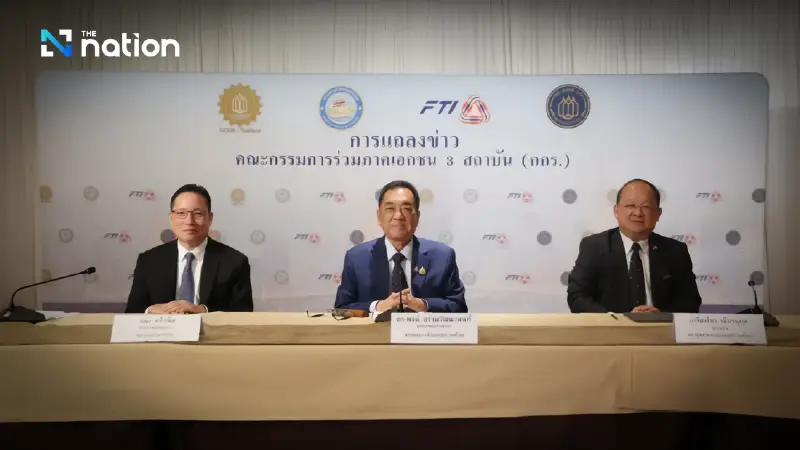
The meeting was chaired by Poj Aramwattananont, chairman of the Thai Chamber of Commerce, and attended by Kriengkrai Thiennukul, chairman of the Federation of Thai Industries (FTI), and Payong Srivanich, chairman of the Thai Bankers’ Association.
Three Drivers and Economic Outlook
The Committee expressed gratitude that many of its earlier proposals have been adopted by the government, stressing the importance of tangible results to build market confidence.
They also confirmed their readiness to support the administration in the lead-up to the next general election to ensure economic measures are not disrupted.
The JSCCIB noted that the recent period of elevated global export activity, which had previously boosted Thailand, is now subsiding. Global economic growth is forecast to decelerate in the final quarter and throughout the next year.
While the OECD projects global GDP growth of 3.3% for 2025, the outlook for 2026 is a further slowdown to 2.9%, largely due to tariff increases impacting spending and employment.
For Thailand specifically, the UNDP estimates that the country's exports to the U.S. market will contract by 12.7%.
Amid this global fragility, the strong baht—driven largely by the current account surplus, bond inflows, and interest rate differentials—continues to be problematic.
The JSCCIB is particularly concerned about the lack of granular data to properly assess the impact of off-system transactions, such as the rising gold trade, cryptocurrency dealings, and undocumented foreign worker remittances, which are increasingly swelling the central bank's "Errors & Omissions" category in the balance of payments.
Structural Solutions Proposed
To address these currency risks, the JSCCIB called for relevant government agencies to collaborate on data linkage, urgently clarifying and analysing the true effect of these transactions on the real economy.
Long-term structural measures were also proposed, including the establishment of a Sovereign Wealth Fund to act as a systematic mechanism for managing capital movement volatility, especially given the predicted long-term weakness of the U.S. dollar.
The Committee maintained its 2024 export growth projection at 2%–3%, with the strong baht remaining the biggest headwind. However, they suggested that if the currency could be allowed to weaken and stabilise in the final quarter, export figures could improve.
Furthermore, the JSCCIB warned that Thailand must urgently increase its Regional Value Content (RVC), ideally to 40%.
Failure to do so could jeopardise the competitiveness of Thai goods in the U.S. market and threaten the jobs of some 400,000 workers, necessitating stronger domestic raw material use and robust upstream industries.
Forecast and Policy Pressure
The JSCCIB reaffirmed its 2025 economic growth forecast of 1.8%–2.2%. They indicated that growth could hit 2.5%—matching the previous year—if the government achieves several 'Quick Big Win' targets:
- Expediting the disbursement of approximately one-third of the 2026 budget by year-end.
- Attracting 34 million foreign tourists.
- Implementing stimulus measures such as the "Khon La Krueng Plus" [Co-payment scheme] subsidy, SME support, and the "Made In Thailand" campaign.
Focus on Governance and Labour Costs
The JSCCIB also underlined two other key concerns:
1. Corruption: Corruption remains a severe impediment to economic growth and investment confidence. The Committee highlighted persistent policy-level and local corruption, including opaque government project spending and illicit fees charged by officials for permits or contracts.
To combat this, the JSCCIB has formed a dedicated "Zero Corruption: JSCCIB Will Not Tolerate" working committee, partnering with anti-corruption watchdogs to systematically propose governance reforms across eight key areas.
2. Labour Law Review: The Committee voiced strong concerns over proposed amendments to the Labour Protection Act currently before the House of Representatives. The JSCCIB argued that certain clauses risk increasing employment costs for employers and impacting the overall economy.
Citing a lack of comprehensive consultation, the business leaders requested the draft Act be reviewed, with the private sector included in the legislative committee to ensure fairness for both employers and employees and to protect the nation's economic competitiveness.
