
Finance Ministry launches ‘Clear Debt, Move Forward’ to help 3.4 million Thais clear small debts
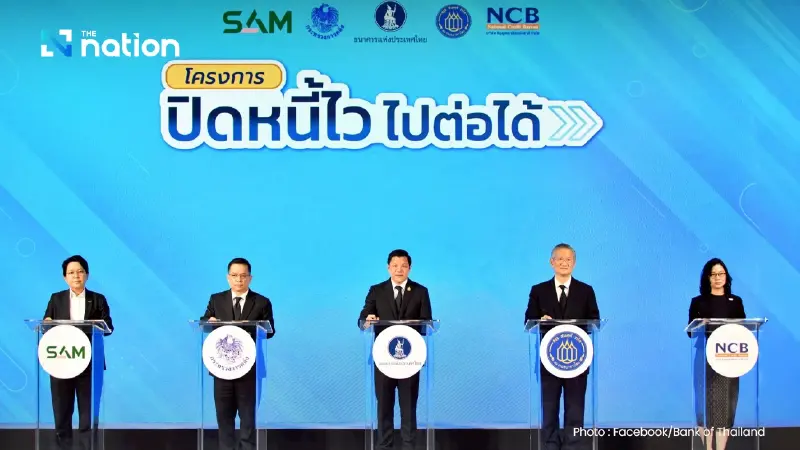


The Finance Ministry, BOT and Thai Bankers Association have introduced a debt relief scheme for NPLs under 100,000 baht, aiming to help 3.4 million Thais rebuild their financial stability.
The Finance Ministry, the Bank of Thailand (BOT), and the Thai Bankers Association have jointly launched the “Clear Debt, Move Forward” programme to help small individual debtors with non-performing loans (NPLs) of less than 100,000 baht. The initiative aims to support over 3.4 million people across 4.7 million accounts, representing a combined debt value of 120 billion baht.
Deputy Prime Minister and Finance Minister Ekniti Nitithanprapas said that failing to address household debt seriously would not only hold back Thailand’s economic recovery but also drag down millions of lives.

“Household debt isn’t just numbers on a bank statement — it’s about people’s livelihoods, families, and the long-term stability of our economy. If we don’t help Thais get back on their feet, sustainable recovery will remain out of reach,” he said.
The Clear Debt, Move Forward project is part of the government’s “Quick Big Win” economic plan, focusing on short-term stimulus with long-term results. It serves as the second pillar of the strategy, aimed at systematically easing debt burdens and giving financially distressed citizens a second chance.
Ekniti emphasised that the programme goes beyond short-term debt restructuring:
“This is not just about reducing debt or extending payments — it’s about saving lives and reviving economic hope. People must be given the chance to start again, and this can only happen through collective effort.”
The project will not use government budget funds. Instead, it will be financed by around 20 billion baht remaining from the “You Fight, We Help” scheme, which will now be redirected to assist Thais still struggling with small-scale debts.
Expanding debt relief to support the agricultural sector
In addition to the small-debtor debt relief programme, the Finance Ministry is preparing to launch a parallel scheme for the agricultural sector, which faces different debt conditions — particularly seasonal debts affected by floods, droughts, and fluctuating crop prices.
The agricultural debt scheme will be implemented through the Bank for Agriculture and Agricultural Cooperatives (BAAC), which plans to establish an in-house Asset Management Company (AMC) to manage debt restructuring tailored to farmers’ needs. Agricultural debt, which differs in nature from typical household debt, will be handled under this smaller-scale programme, with total funding under 10 billion baht, yet expected to benefit over one million farmers. The project is targeted to begin in early 2026.
Regarding flood-related disasters that directly impact repayment ability — especially in farming communities — the Finance Ministry noted that Thailand spends tens of billions of baht annually on post-flood relief. However, if those funds were redirected toward infrastructure investments, such as dam construction and large-scale water management systems, the country could achieve more sustainable, long-term solutions.
To that end, the Finance Ministry is advancing a plan for water infrastructure investment in the Chao Phraya River Basin, shifting from reactive relief spending to proactive prevention and sustainable management. The project may utilise soft loans from international sources and seek technical assistance from foreign experts to ensure compliance with environmental and sustainability standards, with the ultimate goal of helping Thai communities achieve long-term resilience and stability.
Household debt is a structural problem
Vitai Ratanakorn, Governor of the Bank of Thailand (BOT), stated that Thailand’s household debt problem is not merely a short-term economic issue but a deep-rooted structural problem that has long affected the living standards of a large portion of the population and significantly hindered sustainable economic growth.

Although household debt has slightly declined from over 90% of GDP to around 87%, Vitai noted that the figure remains high compared to other countries in the region and continues to exert pressure on both the economy and ordinary citizens.
“Household debt is a national issue. If left unresolved, it will weigh down Thailand’s long-term growth. Most importantly, it directly impacts people’s lives,” Vitai said.
Recognising this, the BOT has worked closely with the government to design targeted, precise debt relief measures, focusing on small borrowers with non-performing loans (NPLs). These borrowers typically have relatively low debt balances but exist in very large numbers.
The central bank has therefore chosen debtors with balances under 100,000 baht as the primary target group for the pilot project. Although the individual debt amount is small, this group accounts for 4.7 million accounts, or 3.4 million people, representing over 60% of all NPL accounts in the system.
“The goal of this project is not only to stabilise the financial system but also to help people rebuild their economic lives. It’s about helping the system and the people at the same time,” Vitai explained.
This initiative aligns with the BOT’s approach of addressing microeconomic and social challenges, in addition to its traditional role in monetary policy, to ensure that citizens experience genuine improvements in their well-being.
Phase 1: Debt relief for 1.9 million accounts
Out of the 4.7 million accounts, the first phase will prioritise 1.9 million accounts — 1.6 million from commercial banks and non-bank subsidiaries, and another 330,000 from state-owned banks.
The cornerstone of the programme is a major shift in the role of Sukhumvit Asset Management (SAM) — a wholly owned subsidiary of the Financial Institutions Development Fund under the BOT. Traditionally, SAM handled commercial non-performing assets from financial institutions, but under this scheme, it will be transformed into a “Social AMC” — a non-profit asset management company focused on helping people regain financial stability.
“Once debts from commercial banks are transferred to SAM, the company will restructure them under the most lenient conditions ever, to truly help borrowers escape the debt trap,” Vitai said.
Debt restructuring conditions under the ‘Clear Debt, Move Forward’ programme
- Waiver of all interest – both normal and overdue interest will be completely cancelled.
- Waiver of all fees – all outstanding fees will be written off.
- Significant reduction of principal – to ease the repayment burden and make it manageable.
Borrowers will then have two options:
- Single payment: Those able to settle their debt in full immediately will have their case marked as “fully closed”, and their credit bureau status will be restored to code 11 (normal debtor).
- Instalment plan: Borrowers may choose to repay within three years, interest-free, with their credit status restored once payment is complete.
Debt transfers to SAM are expected to begin officially on January 1, 2026, after which borrowers can start making payments immediately through their original financial institutions. By the following month, when SAM’s system is fully operational, repayments can be made directly via SAM’s channels.
Vitai affirmed that the BOT remains committed to tackling household debt at its root, helping debtors recover financially while strengthening the foundations of Thailand’s economy for sustainable growth.
Solving household debt — a national mission
Chartsiri Sophonpanich, President of Bangkok Bank and representative of the Thai Bankers’ Association (TBA), said this marks an important step in the collaboration between the government and Thailand’s financial sector to drive the project “Resolving Non-Performing Loans (NPLs) through Asset Management Companies (AMCs)”, aimed at helping small-scale borrowers recover financially and start anew.
In recent years, Thailand has faced persistently high household debt levels, especially unsecured debt, which has burdened millions of households. Many debtors have been unable to meet repayment schedules, resulting in restricted access to new credit, limited economic opportunities, and diminished quality of life — all of which have undermined both household stability and the broader financial system.
The TBA and its member banks recognise that addressing household debt is a shared national responsibility, aligning with the “Reinvent Thailand” initiative — a coordinated effort between the financial sector, the government, the Finance Ministry, the National Economic and Social Development Council (NESDC), and the Bank of Thailand (BOT). This initiative builds upon the “You Fight, We Help” scheme, which supported borrowers in retaining essential assets such as homes and cars, and now extends assistance to unsecured debtors through AMC mechanisms.
The project’s objective is clear — to support debtors who remain capable and willing to repay by giving them a chance to start again, reduce their debt burden, restore their credit bureau records, and reintegrate into the formal financial system.
The scheme operates under principles of Responsible Lending and Market Conduct, ensuring fairness, inclusivity, and transparency without imposing financial burdens on the state.
This approach reflects the TBA’s sustainability strategy, which aims to foster a socially responsible financial ecosystem built upon five key principles: Responsible borrowing, Fair competition, Adherence to shared rules, Equity and justice, and Leaving no one behind.
