
Thailand and South Korea Eye 'Quantum Leap' in Economic Partnership
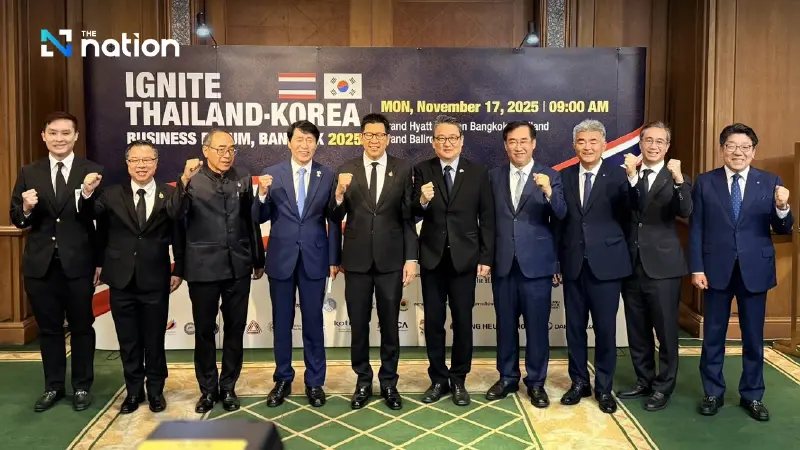


Deputy PM highlights strategic industries from semiconductors to wellness as bilateral cooperation deepens
- The partnership will focus on three strategic sectors: combining Thailand's food production with South Korea's smart farming technology, developing modern industries like EVs and semiconductors, and creating joint wellness and medical tourism packages.
- A key goal is to attract a "third wave" of South Korean investment into Thailand, targeting high-tech industries such as semiconductors, advanced electronics, AI, and biotechnology.
- The collaboration is being formalized through a Comprehensive Economic Partnership Agreement (CEPA) to deepen cooperation in goods, services, investment, and digital commerce.
- Both countries aim to address shared economic challenges, such as supporting SMEs, by integrating them into new industrial supply chains created through the partnership.
Deputy PM highlights strategic industries from semiconductors to wellness as bilateral cooperation deepens.
Thailand and South Korea possess the potential to achieve transformative economic growth through enhanced cooperation across strategic sectors, Deputy Prime Minister and Finance Minister Ekniti Nitithanprapas declared at the IGNITE Thailand-Korea Business Forum in Bangkok on Monday.
Speaking at the forum, Ekniti emphasised that both nations share remarkably similar economic development trajectories and face comparable challenges, creating unprecedented opportunities for collaboration that could propel their economies forward dramatically.

The Deputy Prime Minister outlined three key industries ripe for joint development:
Food, Smart Farming and Processing: Thailand ranks amongst the world's largest food exporters, whilst South Korea possesses cutting-edge smart farming technology. Combined efforts would significantly elevate food safety standards, production capabilities and processing quality.
Modern Industries: This encompasses electric vehicles, artificial intelligence, automation systems, robotics and semiconductors—sectors where South Korea leads globally. Thailand aims to develop its chip industry as a future growth engine under its New S-Curve plan.
Services, Wellness, Medical and Tourism: Thailand excels in medical services, wellness and spa offerings, whilst South Korea dominates in cosmetics and aesthetic surgery. Joint healthcare-tourism packages could substantially boost revenues for both nations.
Ekniti noted that cultural synergies, including K-Pop and T-Pop trends, as well as global artists like BLACKPINK with Thai members, reflect the soft power both countries can leverage together.

Shared Economic Challenges
The Deputy Prime Minister highlighted that both nations confront similar geopolitical risks and trade remedy measures from trading partners, necessitating greater reliance on regional markets whilst strengthening competitiveness in strategic industries.
South Korea has implemented measures to address export volatility, whilst Thailand employs its "Khon La Khrueng Plus" policy to reduce living costs and enhance citizens' digital skills through upskilling and reskilling programmes.
Ekniti stressed that over 80-90% of Thai SMEs lack liquidity and require integration into larger industrial supply chains.
Thailand-Korea cooperation could help new industry supply chains "take root in SMEs", which form the backbone of Thailand's economy.
Both countries face similar household debt challenges stemming from easier digital credit access.
Thailand addresses this through AMC debt restructuring, improved access to formal credit systems, and promoting savings and investment, whilst South Korea pursues comparable financial discipline measures.
Financial Strategy Parallels
The nations share similar fiscal policy approaches, having weathered comparable crises—Thailand's 1997 Asian Financial Crisis and South Korea's "Kimchi Crisis". South Korea's rapid recovery offers valuable lessons for Thailand.
Both employ financial instruments for infrastructure development, including infrastructure funds, public-private partnerships, and stock market listings to channel capital into future industries, reflecting remarkably similar fiscal strategies.

Korean Perspective: Advancing CEPA
Lee Hack Young, Deputy Speaker of South Korea's National Assembly, affirmed that bilateral cooperation has shown "clearly progressive development" in recent discussions.
Lee identified both nations as "crucial regional leaders" capable of delivering tangible economic cooperation, particularly through the Comprehensive Economic Partnership Agreement (CEPA).
This modern economic framework would encompass goods, services, investment, digital commerce and creative industries, enabling businesses from both countries to compete confidently on the global stage.
He emphasised that Thailand and Korea must advance cooperation with "people at the centre", spanning culture, digital sectors and the creative economy to strengthen the region and create opportunities for future generations.

Investment Wave Continues
Narit Therdsteerasukdi, Secretary-General of Thailand's Board of Investment, revealed that major Korean corporations including Samsung, LG, POSCO and Hanwha have invested in Thailand for over 40 years, continuously expanding their operations.
He described Korean investment as occurring in waves: the first comprised large corporations, the second brought supply chain partners and SMEs, and now Thailand seeks to attract a third wave focusing on technology and new industries the country wishes to promote—including semiconductors, advanced electronics, PCB manufacturing, electric vehicles, batteries, digital technology and AI.
Narit noted that biotechnology represents another area of Korean expertise, with several major firms currently in investment discussions beyond the established names.

Yuthasak Supasorn, chairman of the Industrial Estate Authority of Thailand, noted that the forum drew more than 100 Korean business representatives—an invaluable opportunity to spotlight Thailand’s industrial strengths, comprehensive government support, and diverse investment prospects.
To help secure Korean investment, Yuthasak stressed that clarity, stability, and consistency in government policy are top priorities for investors.
Thailand, he said, is well-positioned to meet these expectations, backed by its extensive infrastructure: over 70 high-quality industrial estates nationwide, efficient logistics networks, a skilled labor force, and a robust automotive supply chain.
