
Beyond K-Pop: ASEAN and Korean Media Unite to Shape Regional Future
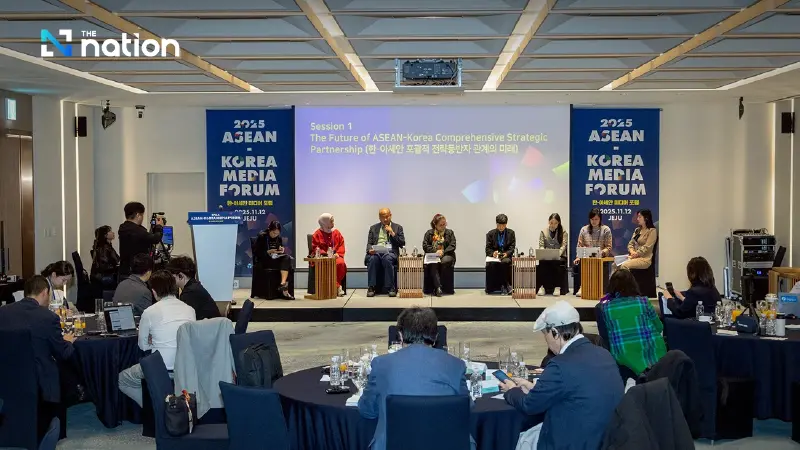


Journalists from both regions tackle misinformation, cultural exchange, and diplomatic blind spots at first forum since pandemic
- Journalists from ASEAN and Korea convened at a media forum, the first in six years, to discuss the media's role in strengthening the regions' new Comprehensive Strategic Partnership.
- The forum emphasized moving beyond surface-level cultural exchange to tackle difficult issues like misinformation, diplomatic blind spots, and the need for more nuanced reporting on the diverse ASEAN region.
- Discussions highlighted the need for a reciprocal, "two-way street" relationship, with media collaboration focusing on broader cooperation in technology, sustainability, and using cultural influence for social awareness.
Journalists from both regions tackle misinformation, cultural exchange, and diplomatic blind spots at first forum since pandemic.
When a Cambodian journalist described Korean culture as a "sharp weapon" rather than a bridge, the room fell silent.
Hong Raksmey wasn't criticising the Korean Wave – he was challenging both ASEAN and Korean media to confront uncomfortable truths hiding behind the glossy surface of cultural diplomacy.
The provocative moment came during the ASEAN-Korea Media Forum, held in Jeju on 12 November, marking the first such gathering in six years.
Against the backdrop of a newly elevated Comprehensive Strategic Partnership (CSP) – the highest tier of cooperation between the regions – journalists from across Southeast Asia and Korea engaged in remarkably candid discussions about the media's role in shaping regional narratives.
"ASEAN is no longer seen by Koreans as a distant region," declared Nam Jeong-ho, Executive Director of the Korea Press Foundation, in his opening remarks. "Workers from ASEAN play essential roles throughout Korean society, and marriages between citizens of both regions are increasing rapidly."

The numbers support his assertion. ASEAN has become Korea's second-largest export market after China, with trade growing 1.5 times over the past decade – outpacing Korea's expansion with the European Union.
Last year, 9.6 million Koreans visited ASEAN countries, whilst 2.5 million ASEAN nationals travelled to Korea. Today, 36% of registered foreigners and 42% of international students in Korea hail from ASEAN nations.
Yet as Kim Jae-shin, Secretary General of the ASEAN-Korea Centre, noted, the physical proximity hasn't necessarily translated into deeper understanding.
"Through this Forum, we aim to bring together the perspectives and insights of journalists from both regions to reflect on the future of ASEAN-Korea relations," he said.

The Coverage Gap
Moon Jae-yeon from The Korea Times put her finger on a critical problem: Korean journalists often lack sufficient understanding of ASEAN's diverse cultures, histories, and political stances.
She proposed a two-tiered coverage strategy – addressing ASEAN as a regional bloc on policy issues whilst simultaneously covering specific cooperation with individual member states.
"ASEAN's focus on connectivity and people-to-people approach provides a critical counterpoint to Korea's tendency to view international politics through a 'grand theory' lens, which often fixates on great power politics and Korean Peninsula security," Moon observed.
The Cambodian journalist Raksmey brought this abstraction into stark relief when discussing the online scam crisis that has ensnared Korean nationals in forced labour operations.
He argued that Korean media coverage, whilst prompting government action, sometimes portrayed Cambodia as dangerous whilst ignoring the deeper human stories of victims tricked by fake job offers.
His proposed solutions were telling: use Korea's powerful storytelling capabilities – drama and film – to humanise victims; initiate joint Cambodian-Korean media projects for balanced reporting; and enlist K-pop stars in digital campaigns warning young people about online scams.
"This is where culture becomes a sharp weapon for raising awareness and responsibility," Raksmey said, reframing the conversation beyond feel-good cultural exchange.

The Two-Way Street
If the first session exposed gaps in diplomatic understanding, the second – focused on K-Culture as a bridge – revealed even more complex dynamics.
Nguyen My Ha from Vietnam News stressed that cultural exchange must be genuinely reciprocal. Whilst K-pop and Korean dramas have influenced Vietnamese food and fashion (kimchi is now widely sold in Vietnam), misunderstandings persist.
Korean supervisors in Vietnamese factories are sometimes perceived as overly strict – a clash between Korean directness and the Vietnamese practice of using humour to cope with stress.
"Vietnamese workers and brides are embraced in Korean society, where they integrate their culture, language, and food, contributing value to the workforce and raising the next generation of Koreans," Ha noted, reminding the audience that historical ties between the nations date back to the 13th century.
Yerica Lai from The Jakarta Post highlighted K-pop's surprising evolution into a space for civic engagement.
Highly organised fan communities in Thailand, Myanmar, and Indonesia channel their influence to support democratic causes. Indonesian BTS fans, for instance, have organised tree-planting campaigns and raised 1.4 billion rupiah for disaster relief.
"Media coverage of these movements legitimises civic participation and shows that activism can take the form of digital fandom organising," Lai said.
Benson Ang from The Straits Times pointed to a unique feature of K-pop concerts in Singapore: the consistent use of Korean-to-English translators.
"This creates an equal barrier of entry for everyone, resulting in racially diverse audiences that include various minority groups, fostering a sense of community," he observed.

Digital Divides and AI Challenges
The forum also tackled emerging challenges around artificial intelligence and misinformation. Cecilia Suerte Felipe from the Philippine Presidential Communication Office noted that Korea is well-positioned to guide ASEAN in utilising AI and technology.
Moon Jae-yeon offered a nuanced response: whilst technology is available, the cultural literacy built through exposure to social media – as seen in Korea – is critical for sorting out misinformed sources and disinformation.
Brunei's Rasidah Hj Abu Bakar confirmed that cooperation with Korea involves support for e-government and joint research on AI-based services, including education programmes and an AI radio project.
Promoting ASEAN Culture
When discussion turned to promoting ASEAN culture in Korea, the responses were pragmatic. Singapore's Ang attributed limited consumption largely to language difficulties, noting that even within ASEAN, countries don't frequently consume one another's media.
"Every country needs to take responsibility for promoting its own culture," he said.
Cambodia's Raksmey agreed, noting that his country is focusing on promoting traditional dance and music rather than attempting to compete with K-pop talent.
From the Filipino perspective, Suerte Felipe emphasised sustainability as a key pillar of cooperation.
Korea's support for climate resilience, cleaner energy (solar, wind, hydrogen), and biodiversity conservation projects demonstrate the partnership's breadth beyond cultural ties.
Korea is one of the Philippines' biggest trading partners, with the Philippines-Korea Free Trade Agreement opening new opportunities.
Thailand's Nongluck Ajanapanya from The Nation stressed the media's vital role as both storytellers and stakeholders.
She cited concrete examples: a June 2025 memorandum of understanding on carbon neutrality capacity building in the electrical and electronics industry, and a September 2025 environmental forum where Thai and Korean students collaborated on solutions for air pollution.
"Media plays a crucial role in translating complex concepts like carbon neutrality and digital transformation into public understanding," Nongluck said.

Building Beyond the Wave
As the forum concluded, participants acknowledged that cultural phenomena like K-pop aren't permanent. To ensure lasting connection, the focus must move beyond simple enjoyment of cultural products towards genuine two-way understanding.
Rasidah from Brunei captured this sentiment: "Media's role is crucial in showing the human impact of cooperation through local stories, moving beyond policies and numbers."
Praysith Thammavongsa from Vientiane Times in Laos added that the Comprehensive Strategic Partnership "goes beyond diplomacy and trade, centring on understanding, communication, and shared identity."
For Nam Jeong-ho, the forum's ultimate purpose was clear: "Only with deeper understanding can we ensure accurate reporting and healthy relationships."
He reminded attendees that in the West, people from both regions are simply classified as "Asians."
"Korea's development can help elevate perceptions of Asian people, including ASEAN nationals, and as ASEAN prospers, Koreans too receive greater respect abroad," he said. "We are partners walking together towards Asia's shared future."

The candid exchanges in Jeju suggest that both ASEAN and Korean media are ready to move beyond surface-level cultural celebration towards the more difficult work of mutual understanding – confronting biases, addressing sensitive issues, and building narratives that reflect the complexity of a partnership now elevated to its highest strategic tier.
Whether that means humanising scam victims, recognising the political power of fan communities, or simply learning to cover ASEAN nations as distinct entities rather than a monolithic bloc, the journalists gathered in Jeju demonstrated that the media's role in the Comprehensive Strategic Partnership extends far beyond promoting tourism and trade statistics.
