TPSO warns Trump tariffs may hit Thai exports in full in 2026, with overall shipments seen at -3.1% to +1.1% as US and China demand cools
Thailand’s exports in 2026 could slow sharply — or even contract — as the full-year impact of US tariff policy begins to bite, with weaker momentum also expected in shipments to China, the Trade Policy and Strategy Office (TPSO) said.
TPSO forecasts Thailand’s 2026 exports in a range of -3.1% to +1.1%, warning that the fading of last year’s front-loading effect and a clearer full-year impact from US tariff measures are key downside risks.
Thailand’s economy is also expected to expand only modestly. Citing International Monetary Fund (IMF) and World Bank projections, TPSO said Thailand’s 2026 GDP growth is estimated at 1.6–1.7%, reflecting rising external and domestic challenges.
Nantapong Jiralertpong, Director-General of the Trade Policy and Strategy Office (TPSO), said risks include high household debt weighing on domestic purchasing power, a limited labour market recovery, a slowing global economy, and weaker growth in key partner markets — the US, China and Europe — which would directly hit Thai manufacturing and exports. He also cited geopolitical uncertainty as a driver of higher energy costs and supply-chain disruption.
Support factors — but bigger downside risks
TPSO said some factors could still support exports, including looser monetary policy among major trading partners, global concerns over food security amid climate volatility supporting demand for Thai agriculture and food, and the technology cycle (AI and EV) lifting demand for electronics where Thailand is a key production base.
It also pointed to supply-chain diversification, with production shifting to Thailand to avoid tariff barriers — benefiting products linked to Chinese investment such as solar cells and PCBs — and the expansion of new markets including India, the Middle East and CLMV.
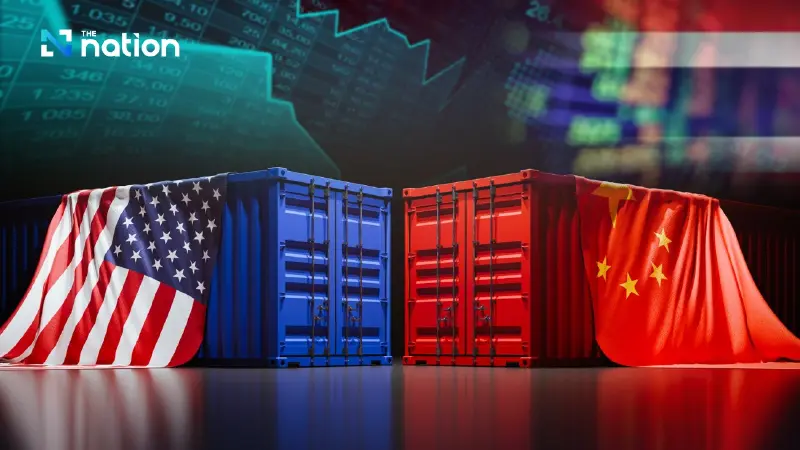
On the risk side, TPSO highlighted rising protectionism — especially US tariff policy — as a key threat expected to show more clearly in 2026. It also flagged “payback” from inventory drawdowns after last year’s front-loading, weaker demand in major markets due to inflation and domestic economic strains, baht volatility with a risk of appreciation hurting price competitiveness, and lower global crude prices pressuring exports tied to oil-related products such as chemicals and plastic pellets.
United States: Still Thailand’s key market, but export growth is expected to slow sharply to 8.9% in 2026, down from an estimated 30.6% in 2025, as tariffs lift consumer prices and weigh on purchasing power. TPSO said the One Big Beautiful Bill Act could still support investment — especially in AI — boosting demand for electronics and computer parts. Pet food remains a standout, with Thailand holding 31% market share in the US. Air-conditioners face risk from product-specific tariffs.
China: Export growth to China is forecast at 1.2% in 2026, down from 13.6% in 2025, due to China’s structural issues, the property-sector crisis and self-reliance policies that reduce imports of intermediate goods. Vulnerable Thai products include chemicals and plastic pellets, while fresh fruit faces tougher price competition and stricter safety standards, including from Vietnam. TPSO said opportunities remain in premium chilled/frozen shrimp — with China Thailand’s top market (42% share) — and palm oil as China diversifies away from soybean oil.
ASEAN and CLMV: Exports to Vietnam and Indonesia are expected to grow 1.5% and 2.2% respectively, supported by their roles as electronics production bases. Cambodia is seen as the highest-risk market, with exports forecast to plunge 40.8%, driven by the risk of US action on transshipment and pressure from cheap Chinese goods. Laos is forecast to grow 11.3%, making it a standout.
Europe: Sustainability standards are expected to be an increasingly decisive factor. TPSO said Europe is likely to slow, with exports to Germany and the UK expected to contract 1.4% and 2.4%. The Netherlands, a key gateway into Europe, is expected to expand 4.1%. High-potential products include food — especially processed chicken and meat — supported by Thailand’s recognised food-safety standards. Exporters were urged to prepare for ESG-related measures such as EUDR and CBAM.
New and high-potential markets (India, Middle East, Africa): India is forecast to grow 5.4%, supported by a growing middle class and production relocation, with opportunities in palm oil and chemicals — though competition in rice is a risk as India resumes exports. The Middle East, especially the UAE, is forecast to grow 8.3%, driven by non-oil investment and new-city construction, creating openings for construction materials and air-conditioners. South Africa is forecast to contract 1.6%, with Thai rice at risk from higher prices versus India and Vietnam amid weak purchasing power.
TPSO said businesses should reduce reliance on a single market, diversify towards new high-potential markets such as India and the Middle East, and upgrade production to sustainability (ESG) standards to clear non-tariff barriers. It added that the government should accelerate negotiations for new FTAs to strengthen long-term competitiveness.