
Ratings agencies watch Thai debt near 70% ceiling
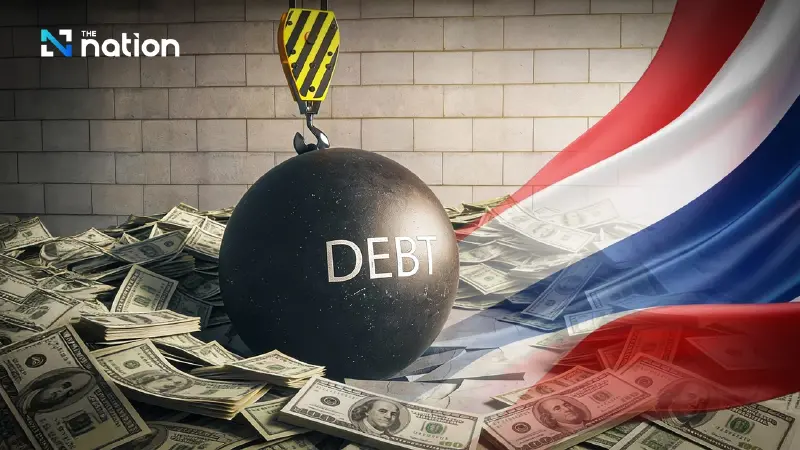


Thailand’s debt is edging towards the 70% ceiling as rating agencies turn cautious. The finance ministry says its new fiscal plan aims to defend the rating.
Global credit rating agencies delivered mixed signals on Thailand in 2025, as the economy faced volatility from global headwinds and domestic political uncertainty — putting the next finance minister under pressure to prevent a sovereign downgrade as public debt moves closer to the 70% ceiling.
A Public Debt Management Office (PDMO) briefing said most agencies began the year with a stable view, with Japan-based R&I maintaining an A- rating and a stable outlook, and JCR keeping an A rating with a stable outlook.
The tone shifted after the United States announced “reciprocal” tariffs in April, adding uncertainty to global trade and growth. Around the same period, Moody’s kept Thailand’s rating at Baa1 but revised its outlook to negative, citing heightened external risks and volatility.
S&P Global Ratings maintained Thailand’s BBB+ rating with a stable outlook through the first half of the year, pointing to tourism and investment in the Eastern Economic Corridor (EEC) as key drivers. In September, Fitch Ratings kept Thailand at BBB+ but also moved to a negative outlook, citing rising fiscal risks, political uncertainty and concerns that fiscal consolidation could be delayed. Fitch also flagged weaker-than-expected tourism recovery and high household debt, while projecting general government debt around 59.4% of GDP.
The PDMO said a key turning point came after the new government’s economic team, led by Deputy Prime Minister and Finance Minister Ekniti Nitithanprapas, prioritised restoring fiscal credibility. On 13 November 2025, the State Fiscal and Financial Policy Committee approved a revised medium-term fiscal plan for fiscal years 2027–2030 (B.E. 2570–2573), designed to reassure markets and ratings agencies.
Following that, S&P again affirmed BBB+ with a stable outlook, citing three main factors: clearer fiscal policy and a commitment to consolidation; strong external buffers, including sizeable foreign reserves and a current account surplus (projected to average about 2.5% of GDP over 2025–2028); and growth support from tourism and public investment, including EEC and infrastructure projects.
Ekniti has said S&P’s stable outlook reflected confidence in Thailand’s updated medium-term plan, including an intention to reduce the fiscal deficit from around 4–5% of GDP to no more than 3% by 2030 (B.E. 2573), and to keep public debt below 70% of GDP.
The revised framework also tightens fiscal rules, including setting aside at least 4% of annual expenditure for principal repayment, reducing the share of debt commitments beyond the budget law to 5%, and capping quasi-fiscal schemes under Section 28 at 32% of annual expenditure.
Economist Dr Athiphat Muthitacharoen of Chulalongkorn University warned Thailand’s fiscal position has weakened as debt climbs closer to the 70% ceiling and large deficits become entrenched. He said any finance minister will face a difficult task persuading rating agencies that Thailand can stick to its consolidation path — and persuading coalition partners that costly handout-style policies may not be sustainable if the country wants to avoid higher borrowing costs.
He also cautioned that a sovereign downgrade could raise funding costs across the economy, pushing up borrowing expenses for both the government and private sector via higher bond yields.
