
Supachai warns globalisation is shifting—Thailand must build strength at home
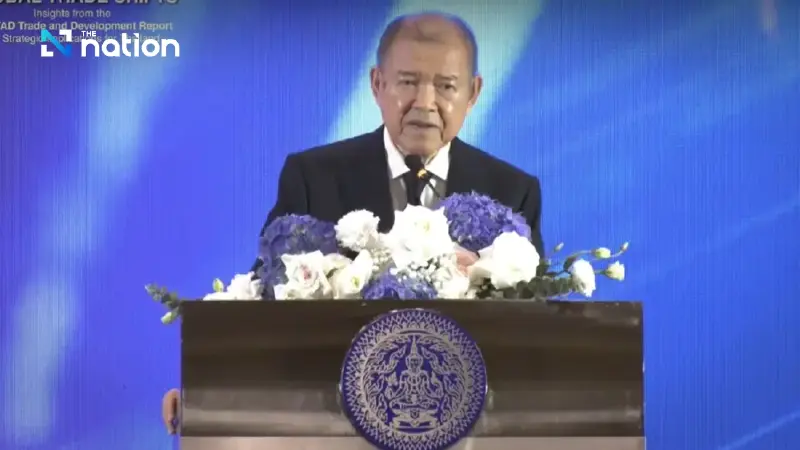


Former UNCTAD chief Supachai Panitchpakdi says globalisation is not ending but changing direction, urging Thailand to reduce reliance on the global economy and strengthen domestic fundamentals as world growth risks slowing.
Seminar unpacks TDR 2025 as global shocks reach Thailand
Former UNCTAD chief Dr Supachai Panitchpakdi warned on Monday that globalisation is not ending but “changing direction”, urging Thailand to rely less on the global economy and urgently strengthen domestic fundamentals as trade becomes more risk-driven worldwide.
His remarks came at an international academic seminar hosted by the International Institute for Trade and Development (ITD) with the Ministry of Commerce, the Ministry of Foreign Affairs, UNCTAD and the Harvard Alumni Association of Thailand, which drew more than 150 participants to unpack the Trade and Development Report 2025 (TDR 2025) and discuss how Thailand should recalibrate its trade strategy amid fast-moving global change.
More than 150 participants from the public and private sectors, academia and international organisations attended, reflecting growing concern that global economic shifts are increasingly spilling over to Thailand.
‘Not the end of globalisation—just a change in direction’
Delivering a keynote titled “Beyond globalisation: Rethinking trade, finance and development”, Dr Supachai—former UNCTAD secretary-general and former WTO director-general, as well as a former deputy prime minister and commerce minister—said the world has entered an “abnormal” period, with risks intensifying across trade, finance, technology and geopolitics.
He argued that what is happening is not the end of globalisation, but a shift in how the global economy operates. Trade is moving away from full liberalisation towards a risk-reduction approach, as countries diversify supply chains and increasingly trade with partners they consider more reliable.
Digital links deepen even as trade becomes more risk-driven
While many see the world splitting into blocs, Dr Supachai said the world is also becoming more connected through digital technology. The digital economy links trade, services and data continuously, he said, warning that future free trade agreements should go beyond tariffs and address digital issues seriously so developing countries are not left behind.
Temporary drivers supported growth—2026 may be tougher
Dr Supachai cautioned against complacency despite global growth holding up last year, saying much of it was driven by temporary factors. These included a rush to import and export ahead of new tariff measures, large-scale AI investment by global technology firms such as Nvidia, Microsoft and Alphabet, and economic stimulus measures in some countries, including Germany.
He said these supports may not be repeated in 2026, while the effects of trade restrictions, tariffs and environmental rules are likely to become clearer—raising the risk of a global slowdown.
Thailand urged to rely less on the world economy, strengthen fundamentals
For Thailand, Dr Supachai said the key lesson from TDR 2025 is that the country should not depend on the global economy alone and must build resilience from within.
He called for stronger domestic foundations, including investment in education and public health, careful fiscal management to preserve crisis-response capacity, a clearer industrial policy—especially in technology and modern agriculture—and diversification of markets and trading partners to avoid excessive reliance on any one country.
Trade must be more inclusive; finance risks distorting commodities
Dr Supachai said TDR 2025 stresses that future global trade should not benefit only large corporations, but should open opportunities for small businesses and developing countries to move up the value chain. He added that trade success should be judged not only by export figures, but also by whether it reduces inequality and supports sustainable income growth.
He also warned that finance is playing a larger role in trade markets, particularly commodities and food, which can be used for speculation and distort prices—undermining food security. He suggested Asian countries deepen regional financial cooperation and strengthen domestic financial institutions to help exporters, especially smaller ones, manage volatility.
A push for a ‘fairer’ globalisation
Dr Supachai concluded that the world may not return to the old model of globalisation, but could move towards a fairer version if trade is anchored in development. For Thailand, he said, the priority is to strengthen domestic fundamentals while adapting proactively on the global stage to avoid being left behind by the next wave of global economic change.
