
Anutin convenes agencies, business to brace for Middle East spillover
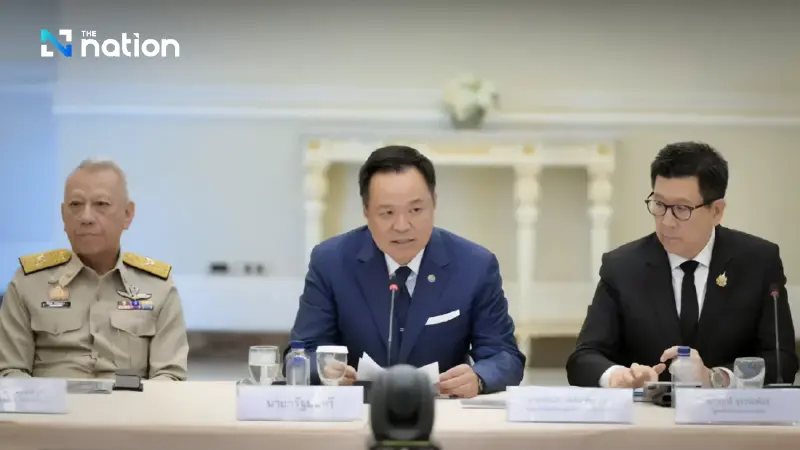


PM Anutin meets economic and security agencies plus business leaders as NESDC warns a prolonged Middle East war could drive oil to US$115–125 a barrel and cut Thailand’s 2026 GDP growth to 1.3%.
- Prime Minister Anutin Charnvirakul convened a meeting with government agencies and private sector leaders to prepare for economic and security impacts stemming from the conflict in the Middle East.
- The primary concerns are rising energy and transport costs, with a worst-case scenario projecting that a prolonged conflict could slash Thailand’s 2026 GDP growth to 1.3%.
- The government is monitoring five key channels of impact (energy, trade, tourism, finance, and labour) and has prepared measures such as using the Oil Fuel Fund and assisting Thai workers in the region.
- Beyond managing risks, the government also aims to identify and seize opportunities arising from the situation, such as attracting investment and tourism that may be diverted to Asia.
Anutin calls meeting with agencies and business to prepare for spillover
Prime Minister and Interior Minister Anutin Charnvirakul held a meeting at Government House on March 2, 2026, bringing together key economic and security agencies and private-sector representatives to prepare for spillover from the fighting in the Middle East—after the National Economic and Social Development Council (NESDC) warned that a prolonged conflict could push oil prices sharply higher and drag Thailand’s 2026 GDP growth down to 1.3%.
The meeting included private-sector organisations such as the Federation of Thai Industries, the Thai Chamber of Commerce, and the Thai Bankers’ Association, to review the overall situation, assess potential impacts, and hear proposals from the business sector.
Government says impact manageable for now, aims to “create opportunities”
Anutin said the government had invited all relevant agencies and the private sector to ensure a shared understanding of the situation, the challenges it could create, and the response options. He said Thailand has been affected to some extent, but the impact remains at a level where the government can move quickly to prevent it from escalating.
“In every crisis there is opportunity,” Anutin said, adding that the government had briefed business leaders—including the heads of the Federation of Thai Industries, the Thai Chamber of Commerce, and the Thai Bankers’ Association—while seeking their recommendations on how the government should support the private sector.
Uncertainty could lift transport and energy costs, officials say
In an overall assessment presented at the meeting, the NESDC and the Ministry of Finance said the situation remains uncertain. If it persists, it could raise costs across the board, particularly freight and transport costs and global oil prices, which would likely stay elevated for a period—despite significant spare production capacity still available in the global oil market.
Anutin said Thailand had also been informed that OPEC producers had increased oil output. He added that Thailand’s energy security remained manageable, with energy and fuel reserves at levels intended to avoid hardship for the public.
Thailand ready to assist citizens and workers, including possible evacuation
On support for Thai citizens and workers in the region, Anutin said the Ministry of Foreign Affairs had coordinated with Thai embassies to facilitate assistance, keep people safe, and allow them to continue daily life if they do not wish to return to Thailand.
If people do want to return, he said the government would help “in every possible way”, coordinating with the Ministry of Transport and the armed forces. If urgent action is required, aircraft would be arranged to bring people home.
Finance minister flags five channels of impact
Deputy Prime Minister and Finance Minister Ekniti Nitithanprapas said the meeting discussed impacts “in every dimension”, along with short-term measures and longer-term strategies for a changing world. He said impacts are being monitored through five channels:
1) Energy
Ekniti said Thailand must closely monitor oil shipments through the Strait of Hormuz, which accounts for about 20% of global oil shipments. Conflict tends to push energy prices higher, but the latest assessment is that oil prices rose by about 5% in the short term before easing slightly, with surplus supply still significant—limiting the rise.
He said Thailand has multiple mechanisms to cushion short-term impacts, particularly the Oil Fuel Fund. Thailand also has about 60 days of oil reserves, which he said should help the government prevent short-term impacts from reaching the public, while providing time to look for new markets as reported by the Ministry of Energy.
2) Trade in goods and services
Direct impacts on goods trade are limited, he said, because Thailand exports less than 10% to the Middle East and imports about 8%, with imports largely oil. The main concern is indirect effects, such as higher freight rates and transport costs if shipping is disrupted. Ekniti said the prime minister had tasked the Ministry of Commerce with discussing preparedness with the private sector.
3) Tourism
Ekniti said direct impacts are limited because tourists from the Middle East account for around 4%. However, he said the situation could present longer-term opportunities for airlines and travel, as travellers may shift towards Asia, ASEAN and Thailand, which he said should be considered in the next phase of strategy.
4) Money and capital markets
He said investors typically move into safe-haven assets during war, particularly gold, though the impact so far has been limited, with gold rising less than 2%, alongside flows into the US dollar. He added that the Ministry of Finance and the Bank of Thailand reported Thailand’s international reserves remain high at nearly US$300 billion, which he said can absorb risks in financial markets. Commercial banks were also described as strong, with relatively high capital against risk-weighted assets.
5) Labour
He said the Ministry of Labour and the Ministry of Foreign Affairs are responsible for closely monitoring and supporting Thais in the Middle East.
Strategy for a changing world: investment, tourism, medical hub, food security, neutrality
Ekniti said that beyond managing the five channels, the prime minister also instructed agencies to develop longer-term strategies to seize opportunities arising from shifting geopolitics—covering potential investment flows into Southeast Asia and Thailand, tourism, Thailand’s ambition to strengthen its role as a medical hub, food security, and positioning Thailand as a neutral player to capture economic opportunities.
He added the government has “enough ammunition” to manage oil-price pressures, with the Oil Fuel Fund as the key tool, noting the fund’s status remains positive. He said the stock market had fallen slightly—about 40 points—in line with global trends.
On inflation, Ekniti said Thailand’s inflation in January 2026 was still negative, so higher oil prices would not necessarily translate into high inflation, and could be managed. He also said the Middle East situation has weakened the baht, after earlier pressure from a strong baht, while insisting Thailand’s overall stability remains solid.
Commerce minister warns of indirect logistics hit; rolls out six measures
Commerce Minister Suphajee Suthumpun said direct impacts on trade remain limited because trade volumes with the two countries are small. She said exports to Israel account for 0.2% of Thailand’s total exports, while exports to Iran account for 0.02%. However, she said the wider Middle East region accounts for around 4–5% of trade, and must be closely monitored.
She said the main risk lies in indirect impacts, particularly logistics and freight. Any disruption could affect exports to Europe if routes are closed, forcing ships to detour and increasing voyage distances—pushing freight rates higher.
Suphajee said the ministry’s six main measures are:
- Managing consumer prices to prevent unjustified price hikes.
- Securing reserve raw materials, working with the private sector to find alternatives, especially for energy inputs imported from the Middle East.
- Advisory centre for businesses, with exporters able to call hotline 1169.
- Logistics coordination with shipping providers to manage delivery bottlenecks.
- Proactive commercial diplomacy, instructing commercial attachés—especially in affected areas—to report developments closely.
- Inflation analysis, jointly with the NESDC, to assess impacts on inflation and cost of living.
Labour ministry sets up urgent monitoring centre for Thai workers
Labour Minister Trinuch Thienthong said the Ministry of Labour has set up an urgent centre to monitor the situation and support Thai workers in Middle Eastern countries. She said reports indicate the main group of workers are in Israel, with nearly 6,000 people.
She said Thai workers in Israel and Iraq remain concerned, while Thai workers in other Middle Eastern countries remain under watch and continue working as normal. Trinuch also said the Israeli government has consistently taken good care of Thai workers, and the number of people requesting to return is low—about 10 from Israel and 40–50 from Iran.
She said the ministry will continue to monitor the situation and assess impacts to ensure Thai workers receive maximum protection of rights and safety amid the current geopolitical conflict.
NESDC: worst case sees oil at US$115–125, GDP growth cut to 1.3%
NESDC Secretary-General Danucha Pichayanan said the NESDC is assessing impacts under two likely scenarios, focusing on oil prices as a key production cost that affects Thailand’s economic growth.
- Scenario 1: If the conflict remains limited and ends within one month, oil prices could rise to US$95–105 per barrel, cutting Thailand’s 2026 GDP growth from 2% to 1.6%.
- Scenario 2 (worst case): If the conflict becomes prolonged and the Strait of Hormuz is closed—disrupting oil transport and supply chains—oil prices could rise to US$115–125 per barrel, cutting Thailand’s 2026 GDP growth from 2% to 1.3%.
