
Thailand Warns Middle East Crisis Could Slash GDP Growth to 1.3%
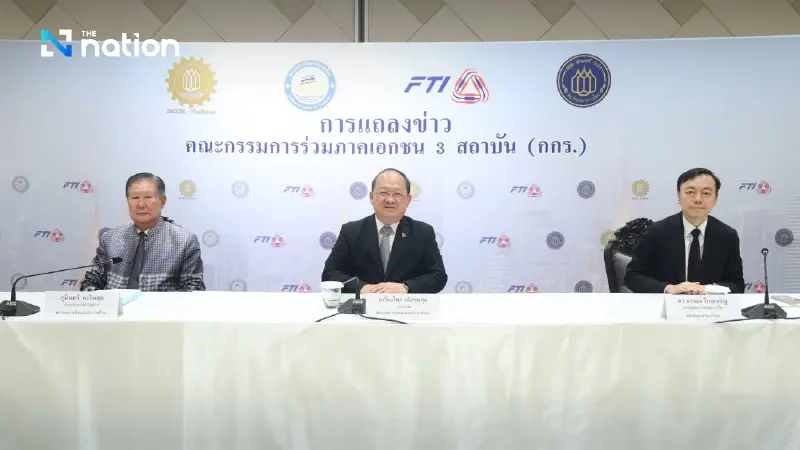


Thai private sector body JSCCIB cautions that a prolonged Iran conflict could drag 2026 GDP below its 1.6%–2.0% forecast, while surging freight costs and US tariff uncertainty add further pressure
- A prolonged Middle East conflict could slash Thailand's 2026 GDP growth to as low as 1.3%, falling below the current forecast of 1.6%–2.0%.
- The economic downturn is threatened by soaring energy prices, particularly for LNG, which would directly increase electricity and industrial costs.
- Disrupted shipping lanes have led to a sharp rise in freight surcharges and war-risk insurance premiums, negatively impacting Thai exporters.
- The crisis is projected to cause a 10% decline in tourist arrivals from the Middle East, a loss of approximately 70,000–80,000 visitors.
- This economic pressure is compounded by additional headwinds, including uncertainty over potential new US tariffs on Thai exports.
Thai private sector body JSCCIB cautions that a prolonged Iran conflict could drag 2026 GDP below its 1.6%–2.0% forecast, while surging freight costs and US tariff uncertainty add further pressure.
Thailand's Joint Standing Committee on Commerce, Industry and Banking (JSCCIB) warned on Wednesday that escalating conflict in the Middle East poses a significant downside risk to the country's economic outlook, as soaring energy prices, disrupted shipping lanes, and a weakening tourism pipeline threaten to undermine growth.
Speaking at the committee's monthly press conference, Federation of Thai Industries (FTI) chairman Kriengkrai Thiennukul said that if the conflict proves protracted, Thailand's GDP growth in 2026 could slow to between 1.3% and 1.6% — below the National Economic and Social Development Council's (NESDC) 2.0% central forecast and the lower end of JSCCIB's own 1.6%–2.0% projection. The committee said it would keep its forecast range under review.
"We hope the situation resolves within a month," Kriengkrai said. "But we must prepare for all scenarios."
Energy reserves adequate, but volatility looms
Thailand currently holds approximately 60 days of fuel reserves, which Kriengkrai described as sufficient for continuous supply management without any need for panic buying.
He urged the public to avoid stockpiling after reports emerged of long queues at petrol stations in several provinces.
Oil imports are being diversified away from Middle Eastern suppliers towards West African and American sources.

Kriengkrai noted that oil prices have not spiked as sharply as during the Russia-Ukraine conflict, partly because global supply currently exceeds demand.
Crude oil is expected to stay below $100 per barrel in the near term, though LNG prices have jumped from around $10 to $25 per MMBtu and could approach $30 — a development that would directly push up electricity and industrial costs.

Inflation manageable, rate cut still on the table
Yunyong Thaicharoen, senior executive vice president of the Thai Bankers' Association, said the Bank of Thailand had estimated that a sustained $10 per barrel rise in global oil prices would add approximately 0.4–0.5 percentage points to headline inflation.
He noted that energy accounts for around 13% of Thailand's consumer price index basket, and that secondary pass-through to broader prices could occur — though weak domestic demand provides a natural buffer.
JSCCIB maintained its 2026 inflation forecast at 0.2%–0.7%, up from -0.1% recorded in 2025.
On monetary policy, Yanyong offered a personal view that the Bank of Thailand's Monetary Policy Committee — which cut the policy rate to 1.00% last week, before the conflict escalated — could consider additional easing if growth projections deteriorate materially.
He pointed to the government's oil fund, which currently carries a positive balance, as a tool that can be drawn down to cushion short-term price shocks without triggering sharp adjustments.

Freight costs climbing; exporters advised to wait
Phumin Harinsut, vice chairman of the Thai Chamber of Commerce flagged a sharp rise in shipping surcharges as major carriers react to the conflict.
MSC, the world's largest container line, has introduced surcharges of $2,000 for 20-foot containers and $3,000 for 40-foot containers on affected routes, with refrigerated units carrying an additional premium of roughly $4,500. War-risk insurance premiums have also increased substantially.
He advised exporters with cargo destined for Middle Eastern ports to hold shipments temporarily rather than pay elevated surcharges to destinations that may remain inaccessible. He added that the disruption is a global one — container shortages and re-routing ripple across all major trade lanes, not just those serving the region directly.
Thailand's direct trade exposure to Iran is minimal, at roughly 0.02% of total exports. Exports to the broader Middle East account for approximately 4% of the total.

Tourism to take a near-term hit
The Middle East contributed around 700,000–800,000 tourist arrivals to Thailand in 2025, or about 4% of the total. JSCCIB estimated that the conflict could reduce that figure by roughly 70,000–80,000 visitors in 2026, a decline of around 10%, as airlines suspend routes through the region.
Kriengkrai said Thailand would seek to offset losses by accelerating outreach to alternative markets, particularly China.
He also suggested positioning Thailand as a neutral, Switzerland-like hub for investment, food security, and medical tourism — sectors that tend to attract interest precisely when geopolitical tensions rise elsewhere.

US tariff uncertainty adds to headwinds
Separately, Kriengkrai highlighted the renewed threat from US trade measures after the Supreme Court struck down the administration's reciprocal tariff framework as unconstitutional.
President Trump has invoked Section 122 to impose a 10% universal tariff, with a stated intention to raise it to 15% — the statutory ceiling under that provision — before it expires in approximately 150 days around late July.
Thailand's trade surplus with the United States widened sharply to $72 billion in 2025, up from $45 billion in 2024, pushing the country from eleventh to seventh on Washington's list of largest surplus partners.
JSCCIB said it had met with Finance Ministry officials on 2 March to develop a negotiating strategy, and expressed confidence that a clear presentation of trade data could support productive dialogue.
JSCCIB maintained its 2026 export growth forecast at -1.5% to -0.5%.

Calls for stable government, structural reform
Kriengkrai urged the incoming cabinet — expected to be announced shortly following the recent general election — to move quickly on the budget process, manage short-term energy cost burdens on households and businesses, and accelerate structural reforms including workforce upskilling and reskilling. He stressed that clear, accurate public communication was essential to prevent panic and artificial demand spikes.
