
Thai fuel prices remain below several Asean peers after hike
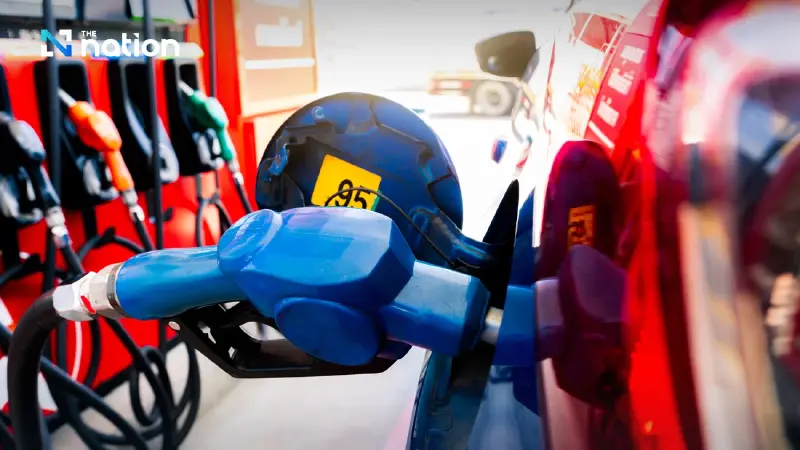


Thailand’s 6-baht-per-litre fuel price increase still leaves local pump prices below several Asean countries, while officials say the move was needed to ease pressure on the Oil Fuel Fund after a sharp jump in global oil prices.
Thailand’s fuel prices on Thursday were still lower than those in several Asean nations despite the across-the-board increase of 6 baht for all types of fuel in the morning, which the Oil Fuel Fund Office on Thursday said was needed to reflect sharp global oil price rises following the Iran war.
Following the increase, a comparison of retail fuel prices across 10 Asean countries, excluding Timor-Leste, found that Thailand’s Gasohol 95 and regular diesel prices were still lower than those in five and seven Asean countries respectively.
New retail fuel prices
- Gasohol 95: 41.05 baht per litre
- Gasohol E20: 36.05 baht per litre
- Gasohol E85: 32.79 baht per litre
- Gasohol 91: 40.68 baht per litre
- Premium Gasohol 95: 52.04 baht per litre (up 8 baht)
- Petrol 95: 49.64 baht per litre
- Diesel: 38.94 baht per litre
- Premium Diesel: 54.64 baht per litre (up 8 baht)
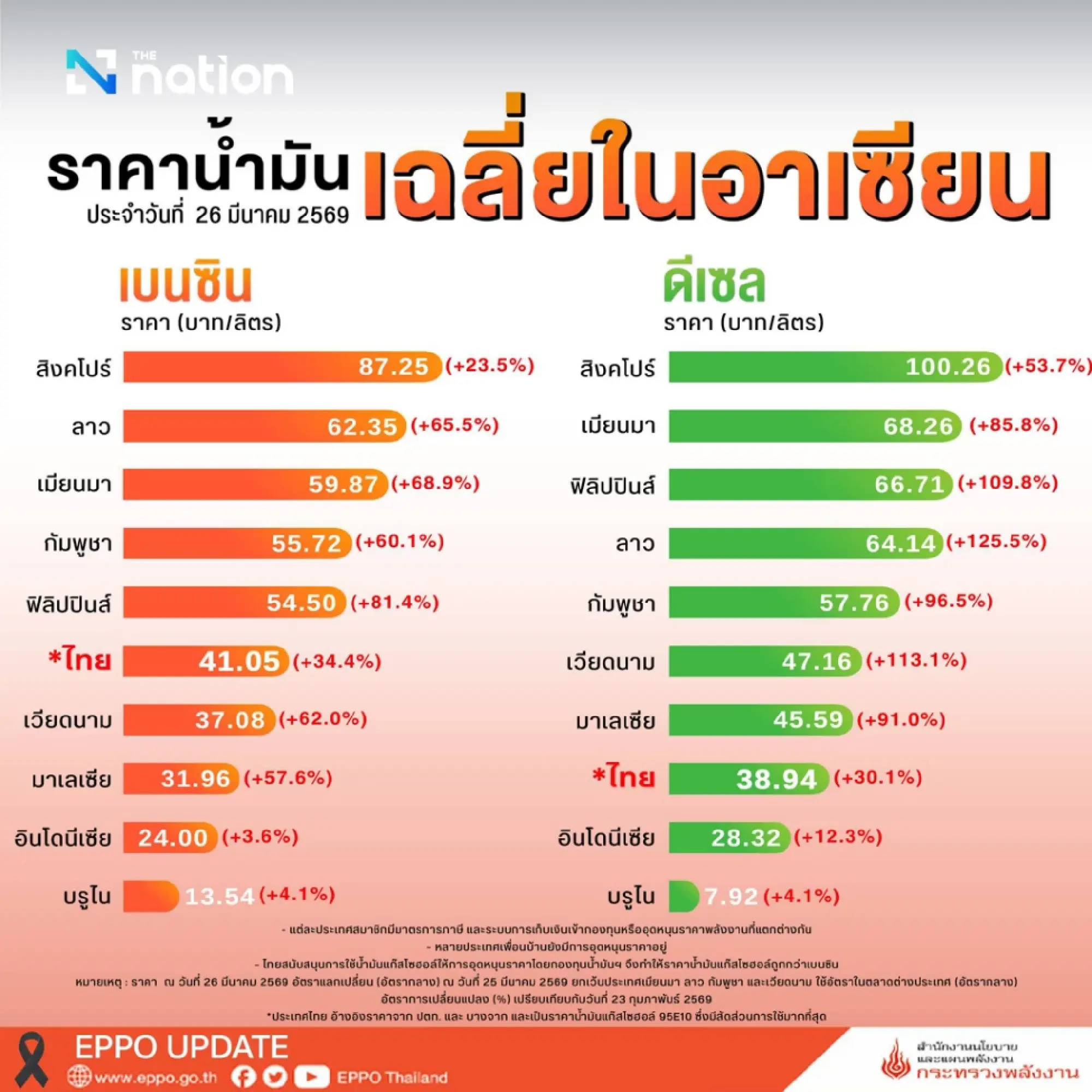

How Thailand compares in Asean
Gasohol 95
- Singapore: 87.90 baht per litre
- Laos: 62.35 baht per litre
- Myanmar: 59.87 baht per litre
- Cambodia: 55.72 baht per litre
- Philippines: 54.50 baht per litre
- Thailand: 41.05 baht per litre
- Vietnam: 37.08 baht per litre
- Malaysia: 31.96 baht per litre
- Indonesia: 24 baht per litre
- Brunei: 13.54 baht per litre
Diesel
- Singapore: 100.26 baht per litre
- Myanmar: 68.26 baht per litre
- Philippines: 66.71 baht per litre
- Laos: 64.14 baht per litre
- Cambodia: 57.76 baht per litre
- Vietnam: 47.16 baht per litre
- Malaysia: 45.59 baht per litre
- Thailand: 38.94 baht per litre
- Indonesia: 28.32 baht per litre
- Brunei: 7.92 baht per litre
Oil fund cites global market shock
Pornchai Jirakulpaisan, director of the Policy and Planning Bureau at the Oil Fuel Fund Office, said the fuel price increase stemmed from the prolonged unrest in the Middle East, which has remained unresolved despite proposals for negotiations.
He said global oil prices climbed sharply from US$198 per barrel on March 17 to US$242 per barrel on March 23, pushing up retail fuel costs in countries worldwide, including Thailand.
The surge has also placed severe pressure on the Oil Fuel Fund, which is now running a deficit of more than 35 billion baht, with cash outflows of about 2 billion baht a day.
Pornchai said the Oil Fuel Fund Administration Committee (OFFAC) had weighed multiple factors before deciding to cut subsidies for both diesel and petrol, resulting in the 6-baht-per-litre increase in retail prices.
He added that neighbouring countries were moving in the same direction, noting that Malaysia had raised fuel prices by as much as 7 baht per litre, while Thai fuel prices remained below those in several nearby markets.


Why the rise was not phased in
Addressing questions over why the increase was not introduced in stages, Pornchai said global oil prices had surged within just two to three days, immediately increasing the fund’s burden and making a 6-baht adjustment necessary to preserve liquidity.
He said the fund was still helping to support prices for some fuels, particularly diesel, which remains the economy’s main fuel, as well as Gasohol E10 and E20, in order to ease the burden on the public.
Pornchai insisted the fund continued to serve its role in maintaining price stability and was not intended to benefit any particular party. He also urged the public to conserve energy.
Outlook remains uncertain
Pornchai said it was not yet possible to guarantee how much fuel prices might rise in future, as this would depend on global market conditions, costs and pricing trends in neighbouring countries. He said the situation would be assessed on a daily basis.
On proposals to cut fuel excise tax, he said the issue would need to be considered at the policy and legal levels, although coordination with the Finance Ministry had continued.
He also said the late-night announcement of the price increase followed the standard calculation process based on the Singapore market, which closes at around 7pm, before the figures are used to calculate Thailand’s domestic price structure and concluded in an evening meeting. He denied that the timing had anything to do with benefiting anyone or enabling stockpiling.
Pornchai added that ahead of the Songkran festival, it was not possible to confirm whether prices could rise as high as 70 baht per litre, as that would depend on global oil prices, although he said the latest restructuring should help improve the fund’s stability in the period ahead.

Commerce launches nationwide checks
Meanwhile, Kanittha Kangsuanich, inspector-general and deputy spokesperson for the Ministry of Commerce, said the ministry had ordered inspections in 76 provinces.
Nearly 3,000 locations have already been checked, with 17 petrol stations found to have broken the law, mostly for failing to display prices.
Authorities have also received 385 complaints. Some have already been found to involve actual violations, while more than 200 cases remain under investigation. If wrongdoing is confirmed, legal action will be taken immediately.
