
Thailand eyes bus fare rise but freezes rates through Songkran
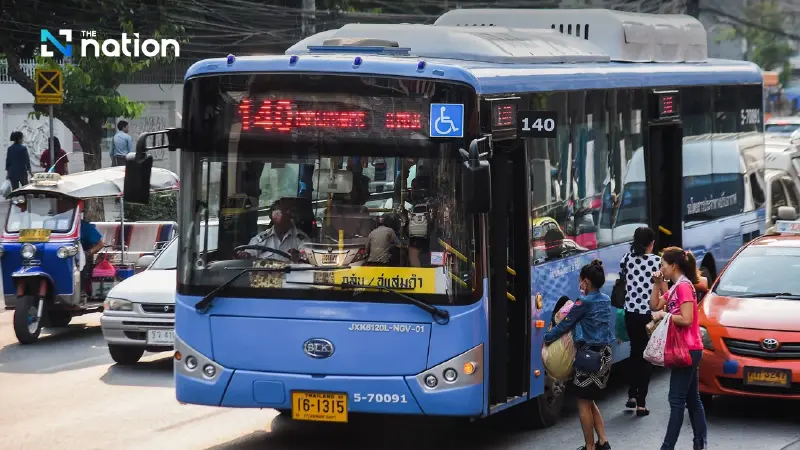


Thailand’s Department of Land Transport is preparing to seek approval for a gradual rise in public bus fares to help operators cope with soaring fuel costs, while keeping fares unchanged until April 19 through state compensation during the Songkran travel period.
Thailand is preparing to seek approval for a gradual increase in public bus fares to help operators cope with soaring fuel costs, but fares will remain unchanged until April 19 under a state compensation plan to ease the burden on travellers during Songkran.
Sorapong Paitoonpong, director-general of the Department of Land Transport (DLT), said the department had prepared details to submit to Deputy Prime Minister and Transport Minister Phiphat Ratchakitprakarn for consideration, as higher oil prices continue to drive up transport costs.
Gradual fare increase proposed
Sorapong said the proposed fare adjustment would be introduced on a step-by-step basis to limit the impact on passengers.
Under the plan, fares would rise by 5 satang per kilometre, equivalent to an extra 5 baht for a 100-kilometre journey, 10 baht for 200 kilometres, 15 baht for 300 kilometres and 20 baht for 400 kilometres.
He said the aim was to allow operators to survive the fuel price crisis while ensuring the increase would be gradual and would not place too heavy a burden on the public.
Freight charges also under scrutiny
For truck operators, the department is also preparing standard price-control measures to prevent unjustified increases in freight charges during periods of high oil prices.

Sorapong said the benchmark would be based on the K factor, or escalation factor, used by the Department of Highways.
He said the measure was intended to ensure that if oil prices rose by a certain percentage, freight charges would increase only in line with a standard formula, rather than being raised excessively. If oil prices later fell, transport charges would also have to come down in line with the same benchmark.
Fares frozen until April 19
Despite the planned fare increase proposal, the DLT and the Transport Company Limited, or BorKorSor, will keep public bus fares unchanged until April 19 to help reduce travel costs during the 2026 Songkran holiday.
To support operators during the fare freeze, the department plans to use money from the Road Safety Fund to compensate them for the gap between the current fare and the higher rate that would otherwise apply.
Sorapong said this would be the first time the fund had been used in this way.
State subsidy aimed at easing travel costs
The move is also intended to encourage people to use public transport instead of private cars, which officials believe would help reduce road accidents during the holiday period.
In an initial assessment, the department estimated that the compensation required would be about 20 baht per seat.
Based on peak passenger traffic of around 150,000 to 180,000 people a day, the subsidy could reach as much as 3 million baht per day. On normal travel days, the budget required would be lower.
