
Thailand clears THB1-2 rise in bottled palm oil prices amid cost surge
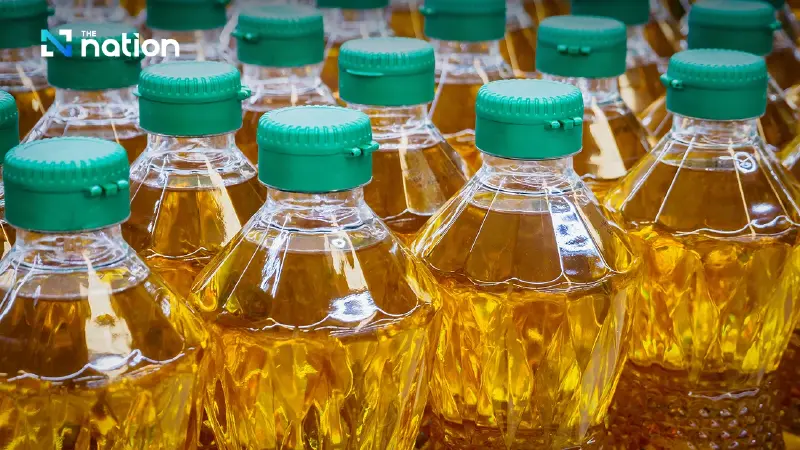


Two producers won approval to raise 1-litre bottled palm oil prices by up to THB2, with the retail cap kept at no more than 50 baht a bottle.
- The Department of Internal Trade has approved a THB1-2 price increase for one-litre bottles of palm oil, with the final price capped at THB50 per bottle.
- This approval was granted to two of the four producers who had requested a price hike to offset higher production costs.
- The decision was made in response to a surge in producers' costs, which include increased expenses for labour, fertiliser, fuel, and transportation.
Wittayakorn Maneenetr, Director-General of the Department of Internal Trade under the Ministry of Commerce, said after the third 2026 meeting of the Subcommittee on Palm Oil Balance Management that the panel had discussed the rise in global energy prices caused by tensions in the Middle East, which has led the government to consider increasing the share of palm oil used in the energy sector by adjusting the biodiesel blend from B5 to B7 and B20 to support domestic energy demand.
As demand in the energy sector rises, concerns have emerged over the proportion available for export, prompting the introduction of a measure requiring advance permission for palm oil exports from April 7, 2026.
He insisted, however, that the measure is not a suspension of exports, but merely a mechanism for tracking data in advance so that domestic palm oil volumes can be managed more efficiently.
So far, no obstacles to exports have been found.
The latest figures show that the use of palm oil has risen from 70,000 tonnes per month to 100,000 tonnes per month.
Normal exports in April are usually around 130,000 tonnes.
At present, exporters have already applied to ship 90,000 tonnes, while the latest palm oil stock, as of April 20, 2026, stood at 290,000 tonnes.
“I can confirm that palm output is sufficient for domestic industrial use, exports and domestic consumption.
At the same time, data from the Office of Agricultural Economics estimate that overall palm output has declined because of weather conditions, with output at 1.88 million tonnes in March, 2.24 million tonnes in April and 2.5 million tonnes in May,” Wittayakorn said.
As for farmers’ concerns after prices declined, palm prices as of April 20, 2026, in the three main producing provinces, Surat Thani, Krabi and Chumphon, with oil content at 18%, averaged THB6.60-7.20 per kilogramme.
One key factor behind the fall in prices was volatility in global oil prices, including the price of crude palm oil (CPO) in the Malaysian market, which had previously climbed to more than THB39 per kilogramme before dropping to around THB36-36.4 per kilogramme at present.
This has affected the domestic price structure as well as the exchange rate.
It was also found that domestic oil use has been highly volatile, having once peaked at around 90 million litres per day before dropping to only around 20 million litres per day during some periods, forcing crushing plant operators to keep adjusting their raw material purchasing plans.
Over the past three to four weeks, however, palm prices have also remained under pressure from several factors, including global market conditions and rising production costs.
Wittayakorn said that, of the four producers of one-litre bottled palm oil that had sought price increases because of higher production costs, the Department of Internal Trade had approved two to raise prices by THB1-2 a bottle, but not beyond THB50 per bottle.
Manas Phuttharat, president of the Federation of Thai oil palm growers, said production costs had risen sharply, including labour, fertiliser, fuel and transport costs.
Current production costs stand at THB7-8 per kilogramme, while purchase prices do not reflect those costs.
In some areas, such as the Central region, farmers have been able to sell palm fruit for only about THB6 per kilogramme.
He also raised questions about the transparency of factories’ purchasing prices, saying they had been cut continuously by 20-40 satang a day, creating concerns over fairness in the system.
He called on the relevant agencies, particularly the Department of Internal Trade, to examine pricing mechanisms and factory purchasing practices to ensure fairness for farmers and to prevent them from having to shoulder the burden of market volatility alone.
If farmers are able to sell their produce at appropriate prices, it would help circulate income in local communities and benefit the grassroots economy as a whole.
On April 22, 2026, oil palm growers will submit a letter seeking fairness to Suphajee Suthumpun, Deputy Prime Minister and Minister of Commerce.
Meanwhile, Suthatsa Sangsamran, a specialist policy and plan analyst at the Department of Energy Business, said there is currently a plan to increase the number of service stations offering B20 from 100 to 200.
