
Thailand weighs three war scenarios as GDP and inflation risks rise
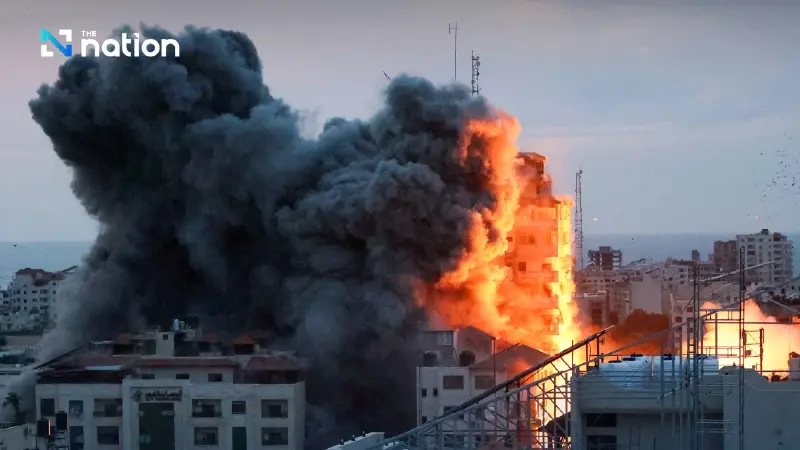


NESDC outlines three Middle East war scenarios, from a 2026 resolution to wider escalation, with Thailand’s GDP and inflation outlook at risk
Thailand’s economic outlook is under increasing strain as uncertainty surrounding the Middle East conflict continues, with authorities warning that a prolonged war could extend into 2027, dragging down growth and pushing inflation higher.
Government sources said agencies responsible for monitoring and assessing economic impacts have revised down growth projections used in drafting the fiscal 2027 budget, reflecting escalating geopolitical risks.
The Office of the National Economic and Social Development Council (NESDC) has lowered its GDP growth forecast to 1.4%, down from an earlier estimate of 2%, closely in line with the Bank of Thailand’s revised projection of 1.5%. Inflation for 2026 is now expected to range between 2.5% and 3.5%.
At a recent meeting of four key economic agencies tasked with preparing the fiscal framework for 2027, the NESDC presented three possible scenarios based on evolving developments in the Middle East conflict and their potential impact on Thailand’s economy.

Scenario 1: Conflict ends in first half of 2026
In the most optimistic scenario, negotiations between the opposing sides lead to a resolution within the first half of 2026, bringing an end to military clashes.
Energy and transport infrastructure would gradually recover, allowing supply conditions to normalise. As a result, global energy and commodity prices would begin to decline steadily in the second half of 2026.
Under this scenario:
- Dubai crude oil is projected to average US$90 per barrel in 2026 and US$75 in 2027
- Inflation would stand at 2.9% in 2026, easing to 1% in 2027
- GDP growth is forecast at 1.4% in 2026, rising to 2.2% in 2027
Scenario 2: Prolonged conflict leads to stagflation
In a more adverse scenario, the conflict drags on and is expected to end only in the second half of 2026.
Exports of energy and commodities from the Middle East would remain constrained, keeping energy prices elevated throughout 2026.
This would disrupt global supply chains and push several economies into stagflation, characterised by weak growth combined with high inflation.
Rising global inflation pressures could prompt central banks to maintain tight monetary policies, further weighing on economic activity.
Under this scenario:
- Dubai crude oil is projected to average US$110 per barrel in 2026 and US$95 in 2027
- Inflation would rise to 4.6% in 2026, before easing to 1.5% in 2027
- GDP growth would slow to 0.8% in 2026, recovering slightly to 2.0% in 2027
Scenario 3: Escalation triggers global recession risk
In the worst-case scenario, the conflict expands across the Middle East and continues throughout 2026, with resolution only emerging in the first half of 2027.
Negotiations would remain inconclusive during 2026, while ongoing attacks and destruction of critical infrastructure would further disrupt energy and commodity exports.
Energy prices would stay elevated through the first half of 2027, while recovery in infrastructure and supply chains would be slow even after the conflict ends.
This scenario raises the risk of a global recession, as prolonged supply disruptions and high energy costs weigh on economic activity worldwide.
Under this scenario:
- Dubai crude oil is projected to average US$115 per barrel in 2026 and US$110 in 2027
- Inflation would rise to 4.9% in 2026, easing to 1.8% in 2027
- GDP growth would slow to 0.7% in 2026, and only reach 1.4% in 2027
Support factors for Thailand’s economy (2026–2027)
Despite the risks, the NESDC identified several factors that could support Thailand’s economic expansion:
- Export recovery in line with improving global trade conditions, particularly if geopolitical tensions ease
- Stronger domestic demand, including consumption and private investment, supported by export recovery
- Tourism rebound, as global travel conditions normalise following the end of the conflict
- Continued private investment growth, especially in digital sectors, supporting manufacturing and electronics exports, alongside strong investment promotion approvals
- Higher government spending, driven by an expanded fiscal 2026 budget framework
Key risks and constraints (2026–2027)
The NESDC also highlighted multiple risks that could weigh on Thailand’s economy:
- US trade protection measures, which could constrain exports, particularly in automotive parts, steel and aluminium
- High household and corporate debt, especially among vulnerable households and SMEs, limiting consumption and investment
- Geopolitical uncertainty, particularly in the Middle East, which could push up energy and commodity prices and disrupt global supply chains
- Global economic slowdown and financial market volatility, driven by geopolitical tensions and trade restrictions among major economies
- Agricultural risks, including the potential onset of a Super El Niño, which could reduce rainfall during the planting season and lead to fertiliser shortages
- Persistently high debt levels, including public debt, which could limit fiscal policy flexibility
- Escalating geopolitical tensions, which could further impact global trade, economic trends and commodity prices
- Financial market volatility, amid tighter monetary conditions and rising borrowing costs affecting investor decisions
- Climate variability, increasing risks to agriculture and raising the likelihood of natural disasters
