
Somkid Urges ‘New Deal’ to Capture Global Investment
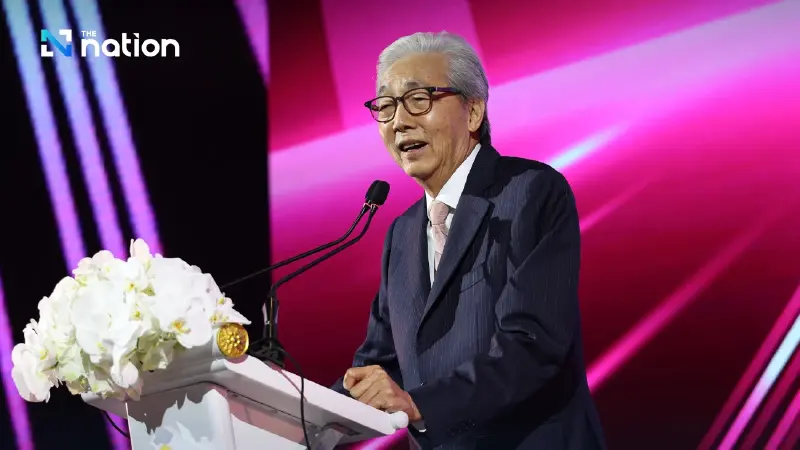


Former deputy premier urges Thailand to ride a ‘second wave’ of global investment with a bold ‘New Deal’ rather than repeat costly short-term fixes
- Former deputy premier Somkid Jatusripitak is urging Thailand to adopt a bold "New Deal" to capitalize on a "second wave" of global investment, rather than continuing with costly short-term subsidies.
- He argues that geopolitical tensions are driving capital away from China and other regions, creating a significant opportunity for Thailand to attract foreign direct investment, particularly from places like Taiwan.
- The proposed "New Deal" involves a public program of structural reforms and shifting investment evaluation criteria from raw value to "contribution," such as creating skilled jobs and technology transfer.
- Somkid recommends using existing high-level economic commissions with countries like China and Japan more aggressively to direct this new investment towards solving Thailand's structural problems.
Former deputy premier urges Thailand to ride a ‘second wave’ of global investment with a bold ‘New Deal’ rather than repeat costly short-term fixes.
Thailand is sitting atop a “large bomb", Dr Somkid Jatusripitak told an audience of Triam Udom alumni on Tuesday evening — and simultaneously on the cusp of its most promising investment cycle in four decades.
The former deputy prime minister delivered a candid diagnosis of the country’s structural weaknesses while arguing that global geopolitical upheaval had, paradoxically, placed Thailand in an enviable position for foreign direct investment.
“Do not lose heart,” he said. “In every crisis there is always an opportunity — you just have to see it.”

A Crisis of Compounding Problems
Dr Somkid catalogued Thailand’s predicament bluntly: GDP growth had been sliding for years, not months; poverty remained high; wages had stagnated; and inequality was widening visibly – mid-range restaurants emptying while upmarket ones stayed full.
Onto those structural problems had landed a fresh wave of external shocks: conflict in the Middle East, rising oil prices, inflation, and the uncertainty of US trade policy.
He was sharply critical of the government’s habit of borrowing to subsidise end-user prices rather than tackling the source of costs.
Fuel price structures, oil taxation, and the pricing policies of state-linked energy companies – in which the Treasury holds a majority stake – all warranted urgent scrutiny, he said.
“If this drags on for another one or two years, where will the money come from? Once the debt ceiling is hit, that’s it.”

The Second Wave
Yet Dr Somkid’s central argument was not one of despair.
He drew a direct parallel with the late 1980s, when a surging Japanese yen unleashed a wave of manufacturing investment into Thailand that seeded the country’s industrial base.
“I feel the same feeling now,” he said. “Capital is beginning to flow in again – from diverse countries, diverse sectors – including industries that six or seven years ago refused to come. Now they are arriving on their own.”
He attributed the shift to investors seeking alternatives to China, the Middle East, Europe, and Latin America amid escalating geopolitical tensions.
Taiwan, he added, was a particularly significant near-term source: pointing to signals that the United States might suspend arms sales to Taipei and that Washington would not back Taiwanese independence, he said the island’s businesses would now accelerate their search for regional safe havens.
“After today, Taiwan cannot sleep — and those who had been considering Thailand are now certain.”
He urged the government to use its existing bilateral mechanisms — high-level joint economic commissions with China and Japan — far more aggressively to direct this capital towards Thailand’s structural needs rather than leaving it to arrive haphazardly.
BOI evaluation criteria should shift from measuring raw investment value to assessing “contribution”: whether incoming firms create skilled jobs, transfer technology, reduce rural poverty, and provide affordable access to tools such as artificial intelligence for small businesses.

A ‘New Deal’ — and a Call to the Next Generation
Dr Somkid called on the government to announce what he termed a “New Deal for a new future”: a numbered, publicly declared programme of structural reforms signalling a decisive break from Thailand’s circular policymaking.
He invoked South Korea’s transformation — from political turmoil into a disciplined civic democracy whose organised civil society had removed four presidents — as a benchmark for what Thailand’s citizens and elite graduates could aspire to achieve.
Speaking directly to the alumni, he urged Triam Udom’s graduates to enter politics and public service rather than confining their talents to their own professions.
“If you are groomed to be responsible for yourselves and for society, that is the real contribution,” he said. “Thailand will flourish according to how many of its best people are in positions where they can genuinely shape the country.”

Survival First
The economic caution in Dr Somkid’s remarks was reinforced by Kobsak Pootrakool, president of Bangkok Bank, who spoke in the panel discussion.
Kobsak said the central question for 2025 was not how fast Thailand could grow but whether it could navigate the year intact. Bangkok Bank was forecasting GDP growth of 1.5 to 2 per cent, he said, though the figure remained hostage to trade deal developments.
“Those who try to sprint this year are the ones who will not survive,” he warned.
Kobsak echoed Dr Somkid’s view that the investment inflow was Thailand’s most significant upside scenario, arguing it could push long-term growth back towards 3 to 4 per cent if properly captured.
He also backed the case for redirecting subsidy spending into structural energy reform — solar capacity and electric vehicles — rather than continuing to prop up oil prices.
“That is an investment, not a subsidy,” he said. “At least you get something back.”
