
Thailand and China sign five agreements to build future industries
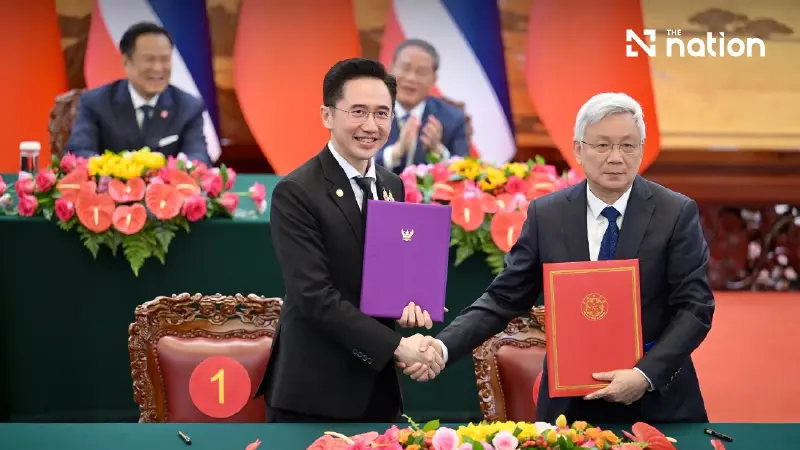


The agreements span nuclear fusion, BeiDou applications, deep-tech talent, Chang'e-7 payloads and joint research funding.
- The agreements focus on developing strategic technologies, including nuclear fusion for clean energy and joint development for the Chang'e-7 lunar mission to help Thailand enter the global space industry.
- China's BeiDou Navigation Satellite System will be applied in Thailand to improve logistics, smart farming, and disaster management, creating opportunities for local startups.
- The partnership will expand scholarships and academic exchanges to develop deep-tech talent and establish joint research funding for agriculture, medicine, and sustainability with a focus on commercial use.
Prof Yodchanan Wongsawat, Minister of Higher Education, Science, Research and Innovation, said that during a visit to Beijing as part of the prime minister’s delegation, he represented the Thai government in signing five memoranda of understanding (MOUs) on science and innovation with Chinese agencies.
The agreements mark an important step towards linking Thailand’s science, technology and innovation ecosystem with China in tangible ways.
They aim to develop “strategic technologies” to strengthen the country’s competitiveness, create future industries and open new opportunities for Thai people.
Paving the way for nuclear fusion and future energy talent
Yodchanan saidd the first agreement, with China’s Ministry of Science and Technology, focuses on developing nuclear fusion technology as a clean energy source for the future.
It will give Thai researchers, engineers and students access to China’s cutting-edge research equipment to develop advanced energy skills, meet the needs of global industry and lay the foundations for safe, clean energy that could help reduce energy costs and environmental impacts over the long term.
BeiDou to support logistics, smart farming and start-ups
Under the agreement with China’s National Development and Reform Commission (NDRC), the BeiDou Navigation Satellite System will be applied in Thailand to improve accuracy in transport and logistics, reduce route management costs, and support disaster management.
Its application will also be extended to smart farming, while creating opportunities for Thai start-ups and entrepreneurs to develop applications and digital services using geospatial data.
Expanding scholarships and developing deep-tech talent
An agreement with China’s Ministry of Education will expand scholarship opportunities and exchanges involving students, researchers and university lecturers, particularly in deep-tech fields where Thailand faces a shortage of personnel.
It will also strengthen cooperation networks between universities in the two countries to develop the workforce needed for future industries.
Opening the way to the global space industry
Another key agreement involves cooperation with the China National Space Administration, giving Thai researchers opportunities to jointly develop scientific instruments, or payloads, for the Chang'e-7 lunar exploration mission.
The cooperation will strengthen Thai researchers’ capabilities, help move Thailand’s electronics industry towards space-grade manufacturing standards and increase opportunities to enter the global space industry supply chain.
Joint research funding and commercial applications
Meanwhile, the Ministry of Higher Education, Science, Research and Innovation (MHESI) also signed an agreement with the Chinese Academy of Sciences (CAS) to support joint research funding in agriculture, medicine and technologies for sustainability.
The cooperation aims to move research into practical use by adding value to agricultural products, developing medical devices that are more accessible to the public and building international cooperation networks for Thai researchers and the Thai private sector.
Yodchanan said the goal of the five agreements was to ensure that research and technology have tangible economic and social impacts, leading to new industries, quality employment and long-term improvements in Thai people’s quality of life.
“Research and technology must make an impact and be put to genuine commercial use, rather than simply remain on the shelf,” he said.
