
Cabinet greenlights removal of red-whiskered bulbul from protected wildlife list
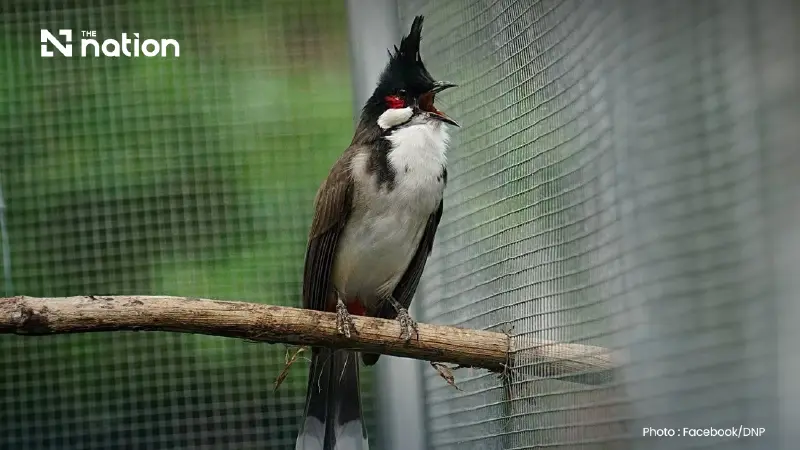


Thailand’s Cabinet has approved in principle a draft regulation to remove the red-whiskered bulbul from the protected wildlife list, paving the way for responsible commercial breeding while maintaining ecological monitoring.
The Cabinet on Tuesday approved in principle a major amendment to Thailand’s natural resources regulations, paving the way for the red-whiskered bulbul to be officially removed from the protected wildlife list and promoted as a new economic species.
The policy is aimed at supporting commercial breeding in line with current economic and social conditions.

Deputy Government Spokesperson Lalida Persvivatana said after the Cabinet meeting that the key substance of the legal amendment is to remove the red-whiskered bulbul (Pycnonotus jocosus), widely known in Thai as nok krong hua juk, from the list of protected non-aquatic wild birds, where it is currently listed as item No 576.
The bird’s existing legal status has created restrictions on possession. Breeders and traders have been required to go through complex permit procedures and comply with strict conditions.

The legal adjustment is expected to deliver results in three main areas:
- Increasing the population through breeding: Reducing legal complications is expected to encourage people to breed the birds instead of hunting or capturing them from the wild.
- Promoting the bird as an economic species: The policy aims to create added value and income circulation in the grassroots economy among breeder groups.
- Preserving community culture: The move will support local traditions, particularly in southern Thailand, where the keeping of songbirds for singing competitions has long been part of community life.

Although the red-whiskered bulbul will be removed from the protected wildlife list, the process does not mean ecological oversight will be neglected.
The Wildlife Conservation and Protection Committee has set a clear operational framework, assigning the Department of National Parks, Wildlife and Plant Conservation as the main agency responsible for continuously monitoring the status and population of the bird in the wild.
If statistical data indicate that the wild population is declining, or that the species is at risk of distribution loss that could lead to extinction, the government has the authority to bring the matter back for review and relist the red-whiskered bulbul as protected wildlife.
Earlier, the Ministry of Natural Resources and Environment conducted a public hearing on the draft ministerial regulation through the central legal system and the Department of National Parks, Wildlife and Plant Conservation’s platform from February 11-25, 2026.
Most opinions were in favour of the proposed legal amendment, while relevant government agencies had no objection in principle.
“This status change is a balance between driving the community economy and conserving natural resources sustainably. The government is ready to promote responsible breeding while protecting the ecosystem, in order to prevent any further illegal capture from the wild,” Lalida said.

The red-whiskered bulbul, or crested bulbul, is a passerine bird native to Asia. It is a member of the bulbul family. It is a resident frugivore found mainly in tropical Asia. It has been introduced in many tropical areas of the world where populations have established themselves. It has a loud three or four note call, feeds on fruits and small insects and perches conspicuously on trees. It is common in hill forests and urban gardens.
