
Asia’s ports emerge as key gateways to US$1.4tn maritime transition
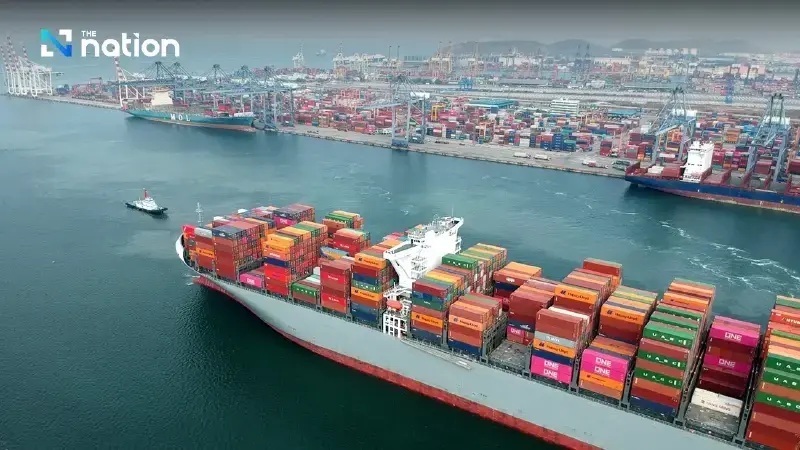


Asian ports could become major gateways to the blue economy as shipping decarbonisation drives up to US$1.4 trillion in investment and climate risks reshape infrastructure.
- The maritime industry's US$1 trillion to US$1.4 trillion transition to net-zero emissions requires the vast majority (87%) of investment to be in land-side infrastructure, making ports the central players.
- Asia is uniquely positioned to lead this transition as the region already dominates the global port infrastructure market, accounting for 45% of the market and handling 60% of global container traffic.
- During this transition, ports will evolve from simple cargo gateways into strategic hubs for clean energy production, alternative fuel storage and supply, and vessel retrofitting.
Ports across Asia are emerging as critical gateways to the future blue economy as the maritime industry faces mounting pressure to decarbonise, strengthen climate resilience and protect the natural ecosystems and communities on which global trade depends.
The ocean economy is valued at between US$2.6 trillion and US$5.1 trillion, while more than 80% of global trade by volume is carried by sea, according to the World Economic Forum (WEF).
That makes ports far more than places where ships load and unload cargo. They are increasingly becoming strategic hubs for energy, logistics, industry and investment as the global economy moves towards cleaner and more resilient supply chains.
Asia-Pacific dominates growing port infrastructure market
The global port infrastructure market is forecast to expand by almost 70%, from US$164.5 billion in 2023 to US$278.3 billion by 2032.
Asia-Pacific already accounts for around 45% of the market, supported by the region’s position as a major global manufacturing and trading hub.
Ports in developing Asian economies handled around 60% of global container port traffic in 2024, highlighting the region’s central role in international supply chains.
India illustrates the scale of the expansion. Container volumes through its ports have almost doubled over the past decade, while the country’s Sagarmala programme provides a policy framework for further development of ports, logistics and maritime infrastructure.
For Asia, the challenge is therefore not simply to build more capacity, but to ensure new infrastructure is designed for a low-carbon and climate-resilient future.
Climate risks put ports under pressure
Rapid expansion comes as ports face increasing threats from climate change and environmental degradation.
The World Economic Forum’s Global Risks Report 2026 ranks extreme weather, biodiversity loss and ecosystem collapse, and critical changes to Earth systems among the most serious long-term threats facing the global economy.
Ports are directly exposed because they are located on coastlines and waterways vulnerable to sea-level rise, storms, flooding and other extreme events.
In Europe, the proportion of port operational challenges linked to climate change rose from 41% in 2018 to 69% in 2025. Many major Asian ports are also considered highly exposed to sea-level rise, storms and flooding.
Yet the climate challenge also creates commercial opportunities.
Future-proofing ports to support the energy transition could unlock more than US$54 billion in cumulative business value by 2030, according to the WEF.
Decarbonisation demands massive investment
One of the biggest forces reshaping the industry is the International Maritime Organization’s target of achieving net-zero greenhouse gas emissions from international shipping by around 2050.
Meeting that goal will require the shipping industry to shift towards alternative fuels including green methanol, green ammonia and synthetic e-fuels.
Ports will need new infrastructure to produce, store and supply these fuels, while shipyards will have to upgrade existing vessels and build fleets capable of using new energy systems.
The scale of the challenge is substantial.
Global ship retrofit capacity was estimated at around 465 vessels a year in 2025, while peak demand could exceed 1,000 conversions annually.
The infrastructure investment required to meet the maritime sector’s 2050 transition is estimated at US$1 trillion to US$1.4 trillion, with around 87% directed towards land-side infrastructure and the remaining 13% towards ships.
Ports will therefore require new and upgraded bunkering facilities, energy infrastructure and shipyard capacity, alongside broader changes to logistics and industrial systems.
People and nature become strategic assets
The transition is not solely about machinery, fuels and physical infrastructure.
The maritime sector already directly employs around 30 million people and indirectly supports another 90 million jobs.
A shift towards scalable zero-emission marine fuels could create as many as 4 million additional jobs across the energy supply chain by 2050, according to the WEF.
This will create demand for new skills both at sea and onshore, particularly in the safe production, storage, handling and use of alternative fuels.
At the same time, the concept of resilient port development is expanding to include nature and local communities as strategic assets.
Nature-based solutions and nature-inclusive design can be integrated with water management, coastal protection and circular waste systems, helping ports reduce emissions while strengthening protection against climate hazards.
The approach recognises that wetlands, coastal ecosystems and other natural systems can themselves function as infrastructure, reducing risks while generating environmental and community benefits.
Ports shift from logistics hubs to blue-economy platforms
The blue-economy transition could fundamentally change the role of ports.
Instead of operating mainly as cargo gateways, they could become hubs for clean-energy production, alternative-fuel storage, vessel retrofits, green industrial clusters and environmentally responsible coastal development.
However, the WEF warns that port ecosystems are highly interconnected but often institutionally fragmented.
Different operators, governments, shipping companies, industrial businesses and communities may recognise the same risks while lacking shared responsibility or coordinated investment.
This can lead to delayed or duplicated projects and prevent resilience measures from being implemented across an entire port ecosystem.
Stronger collaboration between government, industry and communities will therefore be essential if ports are to transform at the required scale.
Asia has opportunity to take global lead
Asia is particularly well placed to lead this transition because of the scale and pace of its port and industrial development.
Investment decisions being made now will determine the design and competitiveness of maritime infrastructure for decades.
If Asian economies incorporate decarbonisation, climate resilience, nature protection and community needs into projects from the beginning, their ports could become more than the region’s trading gateways.
They could serve as strategic platforms for a competitive and sustainable blue economy, supporting industrial growth while protecting coastal environments and creating new jobs.
The WEF argues that the maritime fuel transition presents a rare opportunity to upgrade existing infrastructure and build new projects around a more resilient model.
For Asia, that means the coming wave of port investment could determine whether the region simply handles more global trade or becomes a leader in the next generation of low-carbon maritime infrastructure.
Source: World Economic Forum
