
Thai firms rethink Cambodia strategy after year of tensions
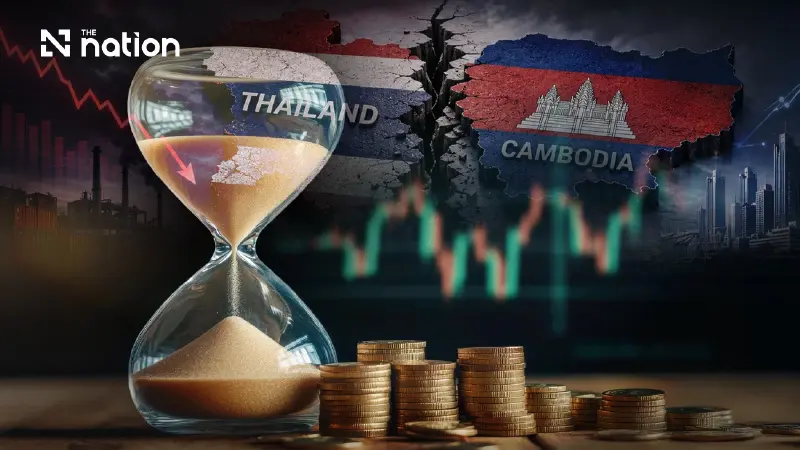


Thai companies are freezing expansion, seeking new markets or weighing exits as prolonged tensions continue to disrupt business in Cambodia
- Due to a year of tensions, Thai companies are freezing new investments, reducing their market presence, or exiting Cambodia altogether.
- In response to local hostility, some firms are delaying factory openings, rebranding products with a Cambodian identity, or minimizing the visibility of their Thai branding.
- Major brands across sectors have been impacted, with Major Cineplex ceasing operations and companies like Carabao Group and PTT Oil and Retail reporting sharp declines in sales.
- Some businesses, like the maker of Mama noodles, are shifting focus to new overseas markets to offset losses, while Thai banks are maintaining current services but have halted all expansion plans.
Thai companies are rethinking their future in Cambodia after a year of tensions disrupted sales, delayed investment and forced some of the country’s best-known brands to look elsewhere for growth.
Some businesses have frozen new projects, while others are preparing to reduce their exposure or leave the market altogether as uncertainty continues with no clear sign of an early resolution.
The impact has spread across consumer goods, food, beverages, energy, entertainment and banking, with companies adopting markedly different strategies depending on their financial position and long-term prospects.
Factories delayed and Thai branding scaled back
A source in the beverage industry said one company had invested several billion baht in a Cambodian manufacturing plant but had been unable to begin production.
The opening, originally scheduled for late 2025, has been postponed because of the prolonged tensions.
Another essential-goods producer has prepared to suspend operations temporarily before restarting production under a Cambodian identity rather than a Thai brand.
“The factory has to close and stop producing under a Thai brand. It will instead manufacture products under a Cambodian brand,” the source said.
Several Thai companies have already withdrawn. Major Cineplex Group ended operations at Major Platinum Cineplex Cambodia in February 2026, bringing its 12-year presence in the country to a close.
At the end of 2025, the cinema operator had six branches and 33 screens in Cambodia.
Carabao Group, meanwhile, reported that overseas revenue fell by 518 million baht, or 40% year on year, in the first quarter of 2026. Weakness in Cambodia and other CLMV markets was among the main factors, prompting the company to revise its distribution and marketing strategy.
Thai products face rising hostility
Consumer-goods businesses have also encountered online campaigns targeting Cambodian retailers that continue to sell Thai products.
One industry source said influencers had produced hostile content against shops and distributors handling Thai goods, with strongly identified Thai brands facing the greatest pressure.
“The more hate content influencers create, the more engagement they receive,” the source said. “Distributors carrying crates of Thai products into markets can face intense criticism.”
Some businesses have responded by sharply reducing their marketing activity, shrinking logos on packaging and, in some cases, covering brand names to make their Thai identity less visible.
Mama looks to larger overseas markets
Thai President Foods, the producer of Mama instant noodles, is seeking new overseas markets to offset the decline in Cambodia.

President Pun Paniangvait said Cambodia had generated sales worth about 1 billion baht for the company, but the year-long tensions had caused a substantial impact.
The company is now considering renewed expansion in large existing markets such as China and India, while also targeting countries with high instant-noodle consumption, including South Korea and Vietnam.
In South Korea, Mama plans to use a strategy similar to that adopted by Korean noodle brands entering Thailand, highlighting distinctive Thai flavours such as green curry, tom yum goong, creamy tom yum and spicy basil.
The company also plans to promote larger packs and products under the Mama OK range.
In Vietnam, it has held discussions with Thai retail groups, including Central and Big C, over potential distribution channels.
However, further overseas expansion will depend on production capacity.
Thai President Foods currently operates 35 noodle-production machines, but only four are equipped to manufacture larger packs and Mama OK products. These lines once accounted for 2% of sales but now represent about 20%.
The company is investing several hundred million baht in three additional machines to raise output by about 10%. The first has already begun operating, while the second is scheduled to be installed and begin production in June 2027.
Mistine cuts back its visibility
Cambodia has also been an important market for Mistine, generating more than 300 million baht in sales for products such as facial cleansers, skincare lotions, roll-on deodorants and powder.

Better Way (Thailand) managing director Danai Derojanawong said the beauty market had been growing significantly before the conflict disrupted business.
Mistine has since reduced the intensity of its marketing and brand-building activities.
Myanmar has presented a different challenge, he added. While Thai brands have not faced the same hostility there, domestic instability has disrupted logistics and supply chains, at times preventing raw materials from reaching production facilities.
A restaurant-industry source said one Thai company had recently expanded a franchise into Cambodia but could no longer travel there to oversee operations. It had also held no discussions with its partner about the future direction of the business.
OR considers restructuring or withdrawal
PTT Oil and Retail Business Plc, or OR, is also reassessing its Cambodian operation after fuel sales fell 72.8% year on year to 46 million litres in the first quarter of 2026.
Sales had already dropped to 54 million litres in the fourth quarter of 2025, far below the more than 150 million litres sold per quarter before border clashes began in July last year.
OR chief executive officer ML Peekthong Thongyai previously outlined a broader review of the company’s overseas investment strategy.
Over the next five years, OR plans to move away from expanding mainly through the number of markets in which it operates and instead assess the quality, profitability and long-term viability of each investment.
For Cambodia, the company has adopted a three-stage approach: conducting a full financial and risk assessment, reducing costs and restructuring the business if recovery remains possible, and considering an orderly exit if the operation is no longer viable.
Cambodia accounts for only 2-3% of OR’s total revenue, but the decision is expected to reflect its broader focus on investment quality and proactive risk management.
OR currently operates 91 PTT Stations, 136 Café Amazon outlets, 44 7-Eleven and Jiffy convenience stores, and five fuel terminals in Cambodia.
Thai banks hold their ground but halt expansion
Thai banks with branches or representative offices in Cambodia have so far chosen to maintain existing services rather than withdraw.
SCB X deputy chief executive officer and chief financial officer Dr Arak Sutivong said the situation remained unresolved, leaving no room for new investment or the revival of previously suspended projects.
The bank continues to operate its Cambodian branches normally but is not expanding or increasing business activity.
“We remain open as usual and have not closed, but we are not doing anything more. We are maintaining operations at the existing level,” he said.
The operation is focused mainly on supporting existing Thai and Cambodian customers rather than attracting new clients.
SCB X is also closely monitoring safety concerns and country-level risks before considering any further investment.
Group Chairman of KASIKORN Business Technology Group Ruangroj Poonpol said the bank was also operating normally and had not closed any offices or branches.
Its Cambodian business accounts for less than 1% of the group’s overall operations and therefore has no significant effect on the bank’s total performance.
However, many Thai customers have delayed or suspended investment plans in Cambodia, limiting the bank’s ability to expand because its growth depends heavily on its customers’ economic and investment activity.
Kasikornbank’s presence in Cambodia remains a representative office, primarily responsible for assisting existing customers and monitoring developments.
Source: Bangkokbiznews
