
High interest rates affecting housing sales to middle-income segment


Thailand's property industry is expected to see slow growth this year as high interest rates have reduced demand from Thai buyers, according to seven executives from the country's major developers on Friday.
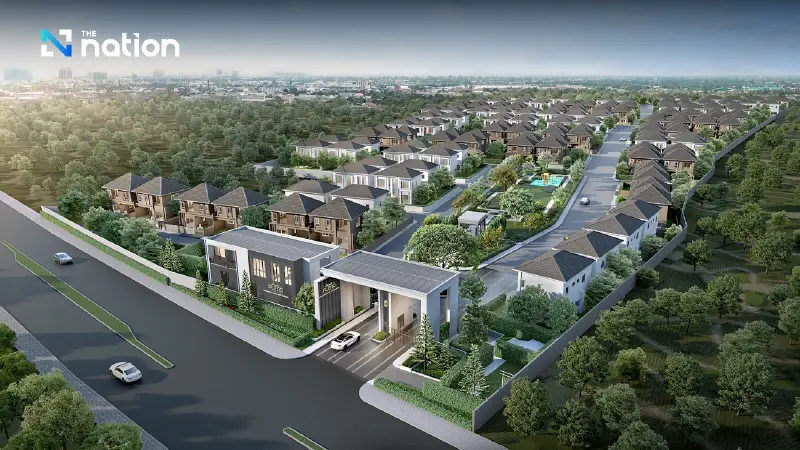
They made their comments while announcing their partnership for the joint development of real estate projects on Thai Chamber of Commerce Road in Nonthaburi province, which is expected to become a new potential premium residential area on the outskirts of the capital.
A report released on Friday by the Real Estate Information Centre of the Government Housing Bank showed that the house purchase index showed demand in the first three months of the year fell from 44.5 in the previous quarter to 39.2.
The main reason for the decrease was the high interest rates and an economic slowdown with 90% household debt, which has made most Thais cautious about their spending, particularly large purchases such as houses or cars.
Though the middle-income group, which makes up the majority of the housing market, has declined, executives from Property Perfect, SC Asset, Sansiri, AP Thailand, Pruksa Real Estate, Central Pattana, and Proud Real Estate said there was still room for developers to expand.
Mongkut Techolarn, SC Asset's chief operating officer for property development and low-rise projects, acknowledged that the number of houses priced below 3 million baht was seeing a sharp decline.

However, the demand for houses priced above 5 million baht continues to grow significantly.
The trend indicates that the company should focus on the upper middle class segment this year, he noted.
He said the company would continue to monitor the middle-income market, as it expected demand to gradually recover over the rest of the year.
According to Krungsri Research, residential property sales would see gradual recovery between 2024 and 2026, increasing by 2-3% per year and averaging approximately 83,000 units per year. The number of new units would increase by 3-4% per year (or 96,000 units per year), but this would still fall short of the annual average of 110,000 new units coming into the market from 2017 to 2019. The majority of new supply will come from major developers who are financially secure and will be involved in projects with a limited number of units.

As major developers will be competing for the same upper-premium segment, Wongsakorn Prasitvipat, managing director of Property Perfect, believes location, values, and sustainability will be key factors in winning over buyers.
However, he believes that rather than competing with one another, it is preferable to seek out opportunities to collaborate with other developers, citing the most recent joint development on Thai Chamber of Commerce Road as an example.
Instead of developing in separate areas, having several developers in the same area and sharing the cost of infrastructure and facilities would undoubtedly help to create a large premium high-quality residential community, he said.
As a result, it would attract potential buyers, benefiting all developers in the area, he noted.

By bringing together several developers, it was possible to attract additional partners and improve all housing projects in the area, he said and cited as example Property Perfect’s collaboration with seven other developers that made it possible to work with B.Grimm to provide sustainable energy solutions to their residents. This includes solar cell installations and setting up charging stations.
This partnership enhances all developers' values while meeting consumers' sustainability and energy efficiency demands, he added.
