
BTS Group’s Keree vows to take “Baan Chao Thai” nationwide, pivoting to detached houses as brand opens its first sales gallery


The chairman reaffirms his zero-down-payment model at the D:CODE Sri Nakarin gallery launch, promising provincial buyers detached homes at rents they already pay
- BTS Group's "Baan Chao Thai" affordable housing initiative plans a nationwide expansion, pivoting from condominiums in Bangkok to detached houses in the provinces due to lower land costs.
- The project is built on a zero-down-payment model, allowing buyers to pay a monthly fee comparable to rent during construction, which converts into a mortgage upon completion with support from the Government Housing Bank.
- The brand has launched its first sales gallery for the D:CODE Sri Nakarin project, the initial development under the "Baan Chao Thai" concept, with a second, larger site also announced.
- The initiative targets renters paying 5,000-8,000 baht monthly, aiming to make homeownership accessible by eliminating the dual burden of paying rent while saving for a down payment.
The chairman reaffirms his zero-down-payment model at the D:CODE Sri Nakarin gallery launch, promising provincial buyers detached homes at rents they already pay.
Keree Kanjanapas, chairman of BTS Group Holdings, used the first-day opening of the sales gallery for Baan Chao Thai — the group’s flagship affordable-housing initiative — on Sunday to lay out an ambitious expansion roadmap that stretches well beyond Bangkok.
He pledged that the brand would eventually bring its zero-down-payment residential model to every province in Thailand, and that outside the capital the units would take the form of detached houses rather than high-rise condominiums.
“We will go wherever there are people who dream of owning a home,” Keree told reporters at the D:CODE Sri Nakarin gallery in the Samut Prakan corridor, roughly 300 metres from the Yellow Line’s Sri Iam station.

The project, which covers up to 42 rai (around 16.6 acres) and comprises no more than 24 mid-rise buildings with a total of approximately 4,150 units, is the first site to go public under the Baan Chao Thai concept.
A second, considerably larger development — D:Craft Khlong Luang in Pathum Thani province, offering up to 7,500 units to be phased over time — has also been announced.
The pivot to detached houses in the provinces is driven by straightforward economics.
Land costs outside Bangkok are low enough, Keree argued, to deliver standalone homes at price points that match the target buyer’s existing rental outgoings.

The group’s primary audience is renters currently paying between 5,000 and 8,000 baht a month — workers who, under the conventional route to homeownership, would have to shoulder both their rent and a down-payment instalment simultaneously, a dual burden Keree described as the single biggest obstacle keeping young Thais from building equity.
The mechanism that makes the model work is deceptively simple.
During the construction period — estimated at roughly two years — buyers pay only a monthly occupancy fee comparable to a market rent.
No booking deposit is required, and no down-payment instalments are due.
Once the building is completed and the unit transferred, the Government Housing Bank of Thailand (GHB) steps in to provide a mortgage, converting what was effectively a rental payment into a loan repayment with no change in the resident’s monthly cash outflow.
Keree was unambiguous about the boldness of the pledge: “No deposit, no down-payment — I dare say it because I believe we can deliver.”

Dr Mahatana Ampornpisit, managing director of GHB, confirmed that the bank is fully prepared to support the scheme across its nationwide branch network should the brand expand provincially as planned.
He noted that standard credit-bureau checks and the bank’s normal lending criteria would still apply — the project is a social initiative, but it is not exempt from prudent underwriting.
Estimated monthly repayments, he said, would start at around 5,700 baht at one site and 6,700 baht at the other, depending on unit size and the prevailing interest rate at the time of transfer.
As a rough benchmark, the repayment rate works out to between 3,000 and 4,000 baht per million baht of loan.

Quality was a recurring theme throughout the media briefing.
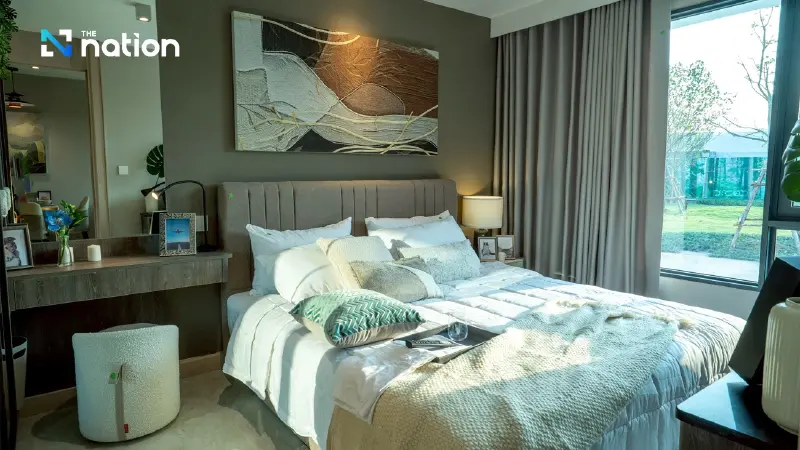
Associate Professor Dr Akekapong Treetrong, chairman of Ideal One and the project’s lead designer, explained that every unit has been conceived around an “Inside Out” philosophy: interior liveability is designed first, with the exterior following.
Given that urban residents spend up to 22 hours a day inside their homes, the priority is comfort, air circulation, and sightlines to the outdoors.
Furnishings — more than 20 items per unit, including genuine-leather sofas, chosen personally by Keree — are included in the sale price, not offered as extras.

The largest unit type, at 60 square metres with three bedrooms and two bathrooms, is, in Akekapong’s words, “essentially a house.”
The development also introduces a handful of technology-forward touches. A robot-dog security system is planned to patrol common areas, with the aim of lowering long-term maintenance costs.
Entry to both the estate and individual buildings will be managed via a single smart card. Three of the 24 buildings — roughly 500 units in total — have been designated as pet-friendly zones, complete with dedicated gardens.
Parking provision stands at between 30 and 35 per cent of total units, and common-area service charges are set at 35 to 40 baht per square metre per month.
Demand for the first phase has already far outstripped supply.
More than 6,000 people registered interest before the gallery opened, well in excess of the units available.
To ensure fairness, allocation will be decided by lottery.
Each Thai national ID number entitles the holder to express interest in one unit at one of the two sites only.

Registration closes on 20 February via baan-chaothai.com, and construction is expected to begin around September 2026, with completion targeted for late December 2028.
Keree was careful to frame Baan Chao Thai as neither a charity nor a loss-leader.
“We are a listed company — we have to make a profit,” he acknowledged. “But a reasonable profit. This project is driven by sincerity, not marketing.”
The economics are sustained, he explained, by bulk procurement: ordering furnishings and materials in the tens of thousands of units at a time brings per-unit costs well below retail.
If the provincial expansion proceeds as outlined, it would represent one of the most ambitious attempts in a generation to shift Thailand’s housing affordability problem from rhetoric to bricks.
