
Amata chief bets big on ASEAN — but warns against putting all eggs in one basket
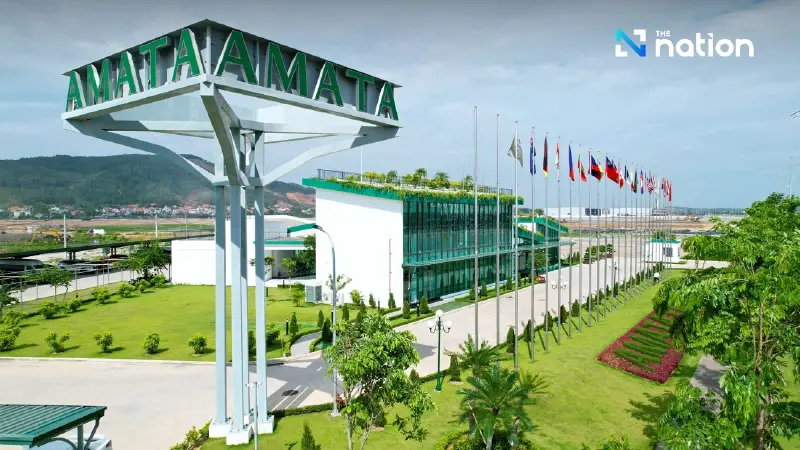


Thailand's leading industrial park developer posts record profit and eyes 2,800 rai in land sales for 2026, even as global volatility demands a diversified regional strategy
- Amata's chief advocates for a diversified regional strategy, warning against over-reliance on a single market due to global unpredictability.
- The company is "betting big" on ASEAN by targeting 2,800 rai in land sales for 2026 and investing 10 billion baht to expand its industrial parks.
- This diversification strategy is driven by expansion from its base in Thailand into Vietnam and, most recently, Laos.
- The strategy is already yielding results, with Amata's Vietnam operations reporting a fivefold increase in net profit for 2025.
- Despite global risks, Amata's confidence is backed by a record net profit of 3.15 billion baht in 2025, fueled by investment shifts to Southeast Asia.
Thailand's leading industrial park developer posts record profit and eyes 2,800 rai in land sales for 2026, even as global volatility demands a diversified regional strategy.
Vikrom Kromadit has built industrial cities across three countries, hosted more than 350,000 workers within his company’s gates, and counted Fortune Global 500 firms among his tenants.
Yet even as Amata Corporation PCL announced its strongest financial performance on record, the founder and chairman was in no mood for complacency. The world, he cautioned, is simply too unpredictable to rely on a single market, a single country, or a single strategy.
“This is the goal and the policy: to not put all our eggs in one basket,” Vikrom told reporters at a press conference in Bangkok on Tuesday, encapsulating both a personal philosophy and a corporate mandate that has driven Amata’s expansion from Thailand into Vietnam and, most recently, Laos.
His remarks came as the company unveiled a record consolidated net profit of 3.15 billion baht (approximately USD 100 million) for 2025 — a 28 per cent jump over the previous year — along with a sweeping organisational restructuring designed to prepare Amata for the next wave of foreign direct investment flowing into South-East Asia.

ASEAN’s moment — and Thailand’s edge
Vikrom’s confidence in the region’s trajectory is well-founded. A confluence of geopolitical realignments — particularly the ongoing US–China trade tensions and the broader “China Plus One” manufacturing diversification trend — has accelerated the flow of capital into South-East Asia. Amata’s industrial estates, he argued, are ideally placed to capture it.
“ASEAN is emerging as a new investment hub, especially for high-tech, digital, and future industries, requiring both robust infrastructure and a comprehensive business ecosystem,” he said. “We are also seeing more companies coming to us to set up R&D as well as manufacturing as they make strategic decisions to diversify their footprint.”
For Thailand specifically, Vikrom pointed to advantages that go beyond balance sheets.
The country’s geographic location shields it from typhoons and major seismic activity — risks that affect competitors elsewhere in the region. Its diplomatic record — spanning nearly 900 years of neutrality — has left it on good terms with Washington, Beijing, and Moscow alike, making it a genuinely neutral staging ground for multinational capital.
And then there is, in the chairman’s own words, the intangible: “the smile and sincerity” of the Thai people.
The company’s 2026 targets reflect that optimism. Amata is aiming for total land sales of 2,800 rai across its three markets, with Thailand accounting for 1,650 rai, predominantly within the Eastern Economic Corridor (EEC), where demand for high-tech and digital supply-chain facilities is growing strongly.

Vietnam’s fivefold profit surge, and the Laos frontier
The diversification strategy is already delivering. Vietnam, where Amata has operated for 31 years across five provinces, saw its net profit grow fivefold in 2025 compared with 2024.
The operation is expected to sell 550 rai this year, serving a broad range of Asian manufacturers — particularly those in electronics, environmentally friendly industries, and light manufacturing — that are expanding or relocating production capacity.

The newest pillar of this multi-country approach is Laos, where Amata’s Naxaythong project covers 20,000 rai with potential to expand to 60,000 rai.
Situated just 40 kilometres from the Chinese border and 15 minutes from the Laos–China High-Speed Rail, the site is positioned as a logistics and agricultural processing hub. Incentives are striking: a 30-year corporate income tax exemption and a flat personal income tax rate of just 5 per cent. Sales of 600 rai are targeted for 2026.
Laos also hands Amata an unexpected green credential. With roughly 95 per cent of the country’s electricity generated from hydroelectric sources, the company is able to market the location as a near-zero-carbon manufacturing base — an increasingly critical selling point for multinationals managing their Scope 3 emissions.

Record numbers, despite a revenue dip
The 2025 financial results require a degree of unpacking. Total revenue fell 3 per cent to 14.5 billion baht, largely because some customers delayed land transfers amid the confusion that followed the US government’s early-2025 tariff announcements.
Yet the net profit rose sharply, with the net margin expanding from 16 per cent to 22 per cent, as the industrial estate segment’s contribution to total revenue rose from 34 per cent to 45 per cent.
Chief Financial Officer Dendao Komolmas described the year as a “New High” for the company — a milestone that, she noted, was achieved through operational discipline rather than simply volume.
The debt-to-equity ratio improved from 1.33 to 1.29, while the backlog — land sold but not yet transferred or recognised as revenue — stood at 21.1 billion baht at year-end, providing a solid foundation for future earnings.
“Thanks to that strong financial position, we are able to allocate 10 billion baht for investment to expand our land area and to develop the full range of facilities, utilities and services that will support both new and existing customers in all three countries,” Dendao said. The board has approved a dividend of 1.10 baht per share for 2025.

New faces, and an eye on the Middle East
Alongside the financial results, Amata announced a significant management reshuffle. Yasuo Tsutsui was appointed CEO of Industrial Estate Thailand on 1 March and will also serve as acting Chief Marketing Officer of Amata Corp.
His predecessor in the CMO role, Osamu Sudo, moves to Amata Vietnam PCL as Deputy CEO, a market where he has an established record.
The restructuring also includes recruitment of experienced executives both locally and internationally to strengthen capacity for the high-tech investment wave the company anticipates. Currently, Amata’s projects are home to more than 1,600 factories and commercial outlets employing around 350,000 people, representing investors from 30 nationalities.

Not all of the chairman’s outlook was unequivocally upbeat. Asked about geopolitical risk, Vikrom acknowledged that the Middle East conflict remains a significant unknown.
“How the crisis in the Middle East evolves remains uncertain, and we need to closely monitor the events in coming weeks,” he said.
It is precisely that uncertainty, he suggested, that makes a multi-country, multi-market strategy not merely a growth play but a necessity. ASEAN, in Amata’s telling, is not just where the opportunity lies — it is also where the safety net is being built.
