
Social media row erupts over Cambodian temple copying Ayutthaya landmark
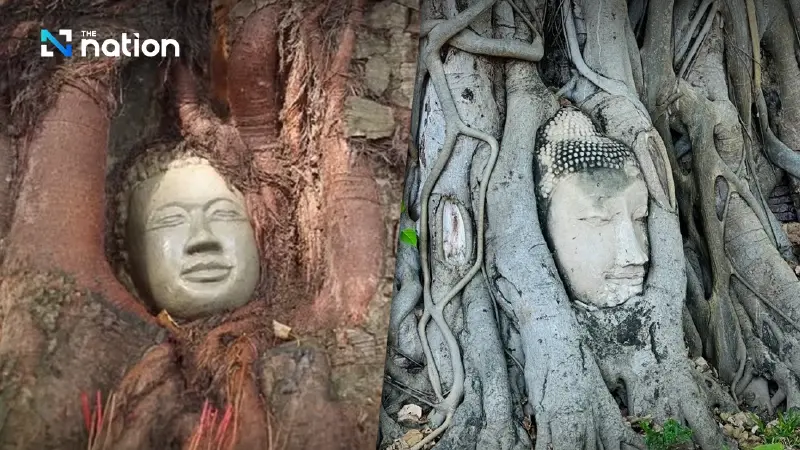


A storm has broken online after a Cambodian temple unveiled a new check-in spot featuring a “Buddha head in tree roots”, drawing comparisons with Wat Mahathat in Ayutthaya.
Images shared by several popular social media pages sparked debate on Tuesday (March 10) after revealing a temple in Cambodia that appeared to have created a photo spot resembling the famed “Buddha head in tree roots”, closely mirroring a signature landmark at Wat Mahathat in Ayutthaya Historical Park.
The images quickly triggered widespread criticism online.
Many social media users noted that the structure appeared to be newly built. Some pointed out that the cement around the base and the tree roots still looked not fully dry, while others criticised what they saw as an attempt to artificially recreate a natural ancient monument in the style of an Unseen Thailand attraction.

A reporter later visited Wat Mahathat in Ayutthaya Historical Park and found that large numbers of tourists continued to visit the ancient site, particularly the Bodhi tree with a Buddha head embedded in its roots, which remains one of the key attractions for both Thai and foreign visitors.
Many tourists stop to admire the site and take commemorative photographs on arrival, while tour guides provide historical background as well as advice on proper etiquette and suitable camera angles, to ensure respect is shown to the Buddha head enshrined within the Bodhi tree’s roots, a defining symbol of the historic attraction.
Wichian Charoensuk, a security officer at the Wat Mahathat, said he was from Ayutthaya and had previously sold souvenirs to tourists for more than 30 years. He said the ancient monument at Wat Mahathat was likely around 495 to 500 years old, while the Buddha head in the tree was probably more than 50 years old.
During a major restoration of the site, debris from the ruins had been collected and arranged, and the Buddha head had been placed upright among them. Over time, the roots of the Bodhi tree expanded and gradually enclosed the head.
Tourists later began taking photographs and sharing them, earning admiration for the beauty of art existing in harmony with nature and turning it into a major Thai landmark.
Natchathaphong Thiapkaew, a tour guide who brings visitors to Wat Mahathat, said attempts to copy the landmark were unlikely to have any real impact on tourism. He said tourists choose where to travel based on many factors, including a country’s historical story, whether it is safe, and how visitors are welcomed and looked after.
He said the Buddha head in the roots of the Bodhi tree at Wat Mahathat derived its value from the combination of the head itself, the tree and the beauty of the surrounding ancient monument, all of which carried a story.
It was not something created in a single day. He added that it had not attracted much attention at first, as it does today.
Over time, tourists were drawn not only to its beauty, but also to the care shown to visitors, the safety measures in place and the convenience provided. As officials explained its significance, Thai people showed it respect, and tourists in turn treated it with reverence.
That impression spread by word of mouth and later through social media, making it increasingly difficult for any imitation to win the same level of popularity.
He added that a large and beautiful image of the Buddha head is displayed at a UNESCO office, and many tourists are determined to see it. When they arrive in Thailand, they often show him the photograph and ask where it is because they want to visit it so much.

Sompong Ramma-et, 65, a tuk-tuk driver from Ayutthaya, said he provides transport services for both Thai and foreign tourists, most of whom ask to be taken to Wat Mahathat to see the Buddha head.
He said that after seeing the imitation image, he felt that no matter how hard they tried, it could never look the same or as natural as Thailand’s. He said the cement looked freshly poured and the tree had been cut back until the wood appeared red.
He insisted that the original was unique to Thailand and should not be copied and then claimed to be the same as Thailand’s.
Kallayanee Juprang, also known as “Pa Ayutthaya”, a leader of a group defending the monarchy, said Cambodians were brazenly making baseless claims. She said Wat Mahathat in Ayutthaya had stood for more than 500 years, and claimed that during that period Khmer history was still under Ayutthaya’s rule.
She said it was impossible for something Thai to belong to Cambodia. Anyone wanting to know which was real and which was fake should come to Thailand and see that it had belonged to Thailand for hundreds of years.
She said something newly built could not truly imitate something ancient, because a new creation could never replicate an old original.
