
How Peylaa Phuket Is Redefining Branded Residential Living in Asia Pacific


As global investors shift their gaze from Dubai to the Andaman, Capstone Asset's Titiwat Kuvijitsuwan explains why Phuket was the only destination that made sense — and why the Marriott’s brand they chose, Autograph Collection, was the only one that could be "exactly like nothing else"
- Peylaa Phuket is the first Autograph Collection Residences in the Asia Pacific region, a 408-unit development by Capstone Asset located in Bang Tao.
- It utilizes the Marriott Autograph Collection brand, chosen for its "exactly like nothing else" ethos, allowing for a unique project identity rather than a rigid brand template.
- The project features a fully integrated model where Marriott's hotel team manages the residences, providing hotel-level operational standards, services, and amenities.
- It is designed to cater to a post-COVID shift in demographics, targeting the growing market of international buyers and long-stay residents in Phuket.
- Strong pre-sales and interest from global investors, including those shifting from Dubai, signal its success in capitalizing on Phuket's rise as a prime residential investment hub.
As global investors shift their gaze from Dubai to the Andaman, Capstone Asset's Titiwat Kuvijitsuwan explains why Phuket was the only destination that made sense — and why the Marriott’s brand they chose, Autograph Collection, was the only one that could be "exactly like nothing else".
Phuket has long seduced travellers with its beaches and hospitality, but something more structural is quietly taking shape behind the coconut palms and beach clubs of Bang Tao.
The island is cementing its position not just as a world-class holiday destination, but as one of Southeast Asia's most compelling residential investment markets — and with it, a new generation of branded residence projects is rapidly raising the bar.
Leading that charge is Peylaa Phuket, Autograph Collection Residences: the first Autograph Collection Residences in Asia Pacific, developed by Bangkok-based lifestyle developer Capstone Asset. Scheduled for completion in the fourth quarter of 2027 and priced from 7.2 million baht (approximately USD 220,000), the 408-unit development is set within the coveted Bang Tao and Cherngtalay corridor, nestled behind Laguna Golf Course just 1.9 kilometres from the island's longest sandy coastline.

"It was clear in terms of demand," says Titiwat Kuvijitsuwan, Chief Executive Officer of Capstone Asset. "Phuket still attracts global demand. And after Covid, that relocation trend to destinations like Phuket has been a catalyst — you see a very fast-changing customer demographic coming onto the island."
For Capstone, that demographic shift was decisive. The company had previously built several projects in Bangkok, where the buyer pool, even on projects targeting international clientele, remained roughly 75% domestic Thai.
Phuket, Titiwat observes, is almost the exact inverse — international buyers now account for approximately three quarters of purchasers.
"For us, when we see this global trend, accelerated further following Covid, we are convinced that Phuket is the destination best suited to offer a luxury lifestyle product."

A Name Built From Two Worlds
The project's name — Peylaa — carries a deliberate duality. In Thai, pela means time, evoking timelessness and permanence. In Spanish and Italian, perla means pearl, a word long associated with Phuket's reputation as the Pearl of the Andaman.
"The way we see this word," Titiwat explains, "is as a joint between what we value most as Thai — that timeless nature — and the pearl, which is the best representation of the natural beauty of what Phuket is all about."
That philosophy was then brought to life through a collaboration with Gensler International, the world's largest design and architecture firm, which has worked previously on Autograph Collection properties, together with Marriott International's own design and technical services teams.

The result is a contemporary tropical aesthetic that draws on the textures, colours, and coastal rhythms of Cherngtalay — a name meaning "at the edge of the sea" — woven into everything from carpet patterns that mirror sand and rippling water to lighting fixtures with Portuguese-influenced craftsmanship.

Why Autograph — and What That Actually Means
When Capstone began exploring hotel brand partnerships, the criteria were precise: they wanted not just a name but international distribution for rental programme purposes, operational expertise, and a brand identity that could flex around their own project narrative rather than impose a rigid template.
"When we describe to them the product we had in mind, Autograph Collection stood out very clearly as the brand of choice," Titiwat recalls. "The ethos for Autograph Collection is 'exactly like nothing else'. When you have that ethos matching really well with our 'one project, one brand' philosophy, it immediately clicked."
The distinction matters because, as Titiwat is at pains to point out, branded residences exist across a wide spectrum. At one end, fashion-house brands lend their aesthetic without the operational infrastructure — buyers receive design cachet but not hospitality management, distribution networks, or after-sales support.

At the other end sits Peylaa: a fully integrated co-located model where Marriott International's hotel team manages not only the adjacent Autograph Collection resort (expected to open in 2030) but also the residential facilities, the rental programme, and the day-to-day operations of the condominium itself.
"The synergy doesn't come from sharing facilities — it comes from operation," Titiwat says. "The residences have entirely separate facilities from the hotel. But the same people, with that hotel-level expertise, operate both."


In practice, that means residents have access to hotel-trained property management staff, an all-day dining operation with a buffet line inside the residential building, hotel-standard fire and life safety systems including point-addressable smoke detection, UV water filtration, backup power infrastructure, and maid storage on every floor.
"This is not a typical condo standard — it's a hotel standard," he says. "Marriott just makes it special because the management team is hotel-trained, not just a typical condominium management team."
Through Marriott's ONVIA platform — an owner-exclusive tier above the standard Bonvoy loyalty programme — Peylaa residents will also gain access to elevation of status within Marriott Bonvoy for Residence Owners, preferred room rates at Marriott’s hotels, owner-exclusive curated events, late check-out, complimentary upgrades subject to availability, and preferential access and signature amenities for Ritz-Carlton yacht experiences.

The Numbers Behind the Momentum
Right after the launch of the Sale Gallery in January, Capstone announced in February that pre-sales had surpassed 250 million baht, and Titiwat confirms that March performed comparably.
Sales momentum, he says, has been building through word of mouth from early buyers and an expanding network of international property agents — including, notably, brokers from Dubai and the wider Middle East.
Excluding the US, Thailand ranks second globally—behind only Dubai—for total branded residential properties, according to data from Savills and CBRE. This suggests that investors already familiar with the model in the Gulf represent an increasingly relevant buyer pool.
"We're starting to see early signs of a shift of investment from Middle Eastern countries into Asia, and particularly into Phuket," Titiwat says.
He adds that the weakening of the Thai baht has made the proposition even more attractive to foreign buyers in dollar- or euro-denominated markets, partially offsetting concerns about rising global construction costs linked to ongoing geopolitical instability.
Completion remains on schedule for Q4 2027, with construction costs — rather than the timeline — the area of greatest focus.
"We're more worried about construction costs at the moment, to be honest," Titiwat acknowledges. "We're planning to adjust pricing very soon because we're already seeing some impact from that side."
He is nonetheless sanguine about the broader picture, noting that Thailand's stability and appeal as a safe haven for capital has, so far, outweighed the headwinds.

Location as Competitive Advantage
Peylaa's site — sitting just 600 metres from Boat Avenue, the commercial and dining hub of Bang Tao, yet backed by the tranquil greens of Laguna Golf Course — was chosen with deliberate care.
Titiwat notes that available land in the area is rapidly diminishing, with the majority of developable plots controlled by just two large established landowners: the Laguna group and the prominent local family.
"We bought the land when pricing was still much lower," he says. "To buy around where we are now would cost at least double what we paid."

That land scarcity, confirmed by Knight Frank Thailand's managing director, who notes that prime western coastline plots in Laguna, Cherngtalay, and Bang Tao are increasingly constrained, supports long-term capital appreciation even beyond the project's rental income potential.
Industry data from CBRE and Colliers suggests Phuket's prime locations currently generate rental yields of between 7% and 11% per annum — a figure that stands in marked contrast to Bangkok's cooling market.
The density within Peylaa has also been kept deliberately low: at an average of 40 units per rai, it sits at roughly half the density of several competing projects in the area.
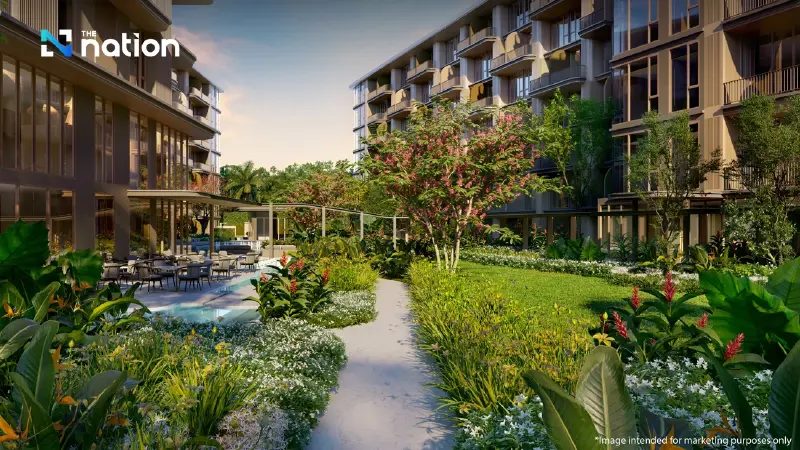
Seven-storey low-rise buildings look inward across a series of interconnected landscaped courtyards, with three 25-metre pools, a full-size tennis court, ice bath facilities, and a jogging track — amenities that Titiwat describes as a direct response to the post-pandemic lifestyle shift he observed reshaping Phuket's demand profile.


A New Standard for Branded Living
Titiwat is candid that the product was conceived with exactly that lifestyle evolution in mind: not merely a holiday home or a straightforward investment unit, but something that could serve the growing long-stay market — medical tourists, digital nomads, international school families, and wellness-focused travellers — who now seek service-apartment-level amenity without sacrificing residential privacy.
"We designed this project with that in mind," he says. "We already saw the change since Covid. The product was actually meant to cater to that new lifestyle."
With Phuket welcoming over 10 million international tourists in 2025 alone — generating nearly 546 billion baht in tourism revenue — and the island's infrastructure continuing to grow, including a Phase 2 airport expansion targeting 18 million annual passengers, the backdrop for Peylaa's ambitions looks robust.
Whether the project ultimately redefines the benchmark for branded residential living in Asia Pacific, as its developer intends, will become clearer when the first residents take the lift to the seventh floor sometime in late 2027.
But if the early sales momentum is anything to go by, the market appears to agree with Titiwat's thesis: that Phuket is ready for something exactly like nothing else.
