
EGAT unveils unmanned underwater vehicle for safer hydro-floating solar inspections
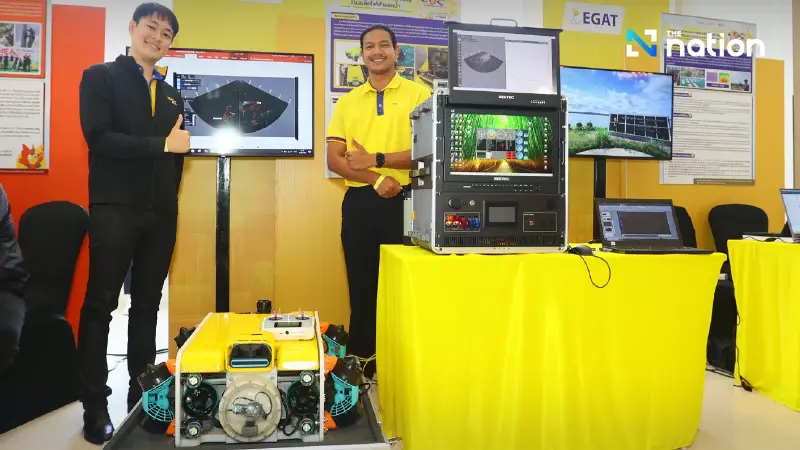


The unmanned underwater vehicle (UUV) developed by the Electricity Generating Authority of Thailand (EGAT) for monitoring hydro-floating solar panels has been designed to reduce risks faced by divers tasked with inspecting cables and floating buoys.
- The Electricity Generating Authority of Thailand (EGAT) has developed an Unmanned Underwater Vehicle (UUV) to improve the safety of inspecting its hydro-floating solar panel mooring systems.
- The UUV replaces the need for human divers to perform dangerous underwater inspections of cables and buoys, reducing occupational risks and saving over 100,000 baht per mission.
- Developed in-house to avoid the high cost of foreign models, the vehicle can operate at depths of 30 metres for up to eight hours, transmitting real-time video via a tethered cable.
- EGAT plans future enhancements for the UUV, including wireless operation, lighter components, and self-repair capabilities such as robotic arms to perform minor adjustments.
The event “Show and Share Innovation for the Better Life 2025” at Centara Grand and Bangkok Convention Centre at CentralWorld served as a platform to showcase innovations highlighting progress in smart electricity services, efficient energy use, renewable energy management, and responses to rapidly changing consumer behaviour in the digital era and low-carbon society.
This year’s event featured a wide range of activities, including exhibitions and outstanding works from Thailand’s three electricity authorities, with the aim of inspiring younger generations to pursue innovations that support future sustainability.

Among the highlights was EGAT’s UUV for hydro-floating solar mooring system monitoring. The technology addresses the challenges of inspecting cables and floating buoys, which are vulnerable to damage from large branches or other debris carried by tidal currents. Such currents can also shift the floating solar panels, reducing power generation efficiency.
Traditionally, divers had to conduct underwater inspections of the cables and buoys. However, this work carries significant risk. In emergencies, divers positioned beneath floating solar panels might not be able to surface quickly enough.
Based on this concept, inventors from EGAT’s hydro power plant and renewable energy department, mechanical maintenance division, initially explored importing UUVs from abroad.
However, due to the high costs of foreign technology, they decided to develop their own UUVs that could perform at a level comparable to international models while being tailored to actual operational requirements.

By combining divers’ expertise with unmanned vehicles, EGAT has been able to reduce occupational risks through technology. The innovation also shortens working time and lowers costs, saving more than 100,000 bath per inspection mission.
The UUV can operate at depths of up to 30 metres and cover distances of up to 200 metres. Equipped with 12 propellers, it can move forward, backward, rotate, and tilt, mimicking human movement.
It can operate for up to six to eight hours and is fitted with GPS and a mechanical sonar detection system, enabling long-distance navigation and real-time video transmission via tethered cable. The vehicle also features underwater lighting and is currently undergoing tests for wireless operation.
While the UUV already reduces risks and improves efficiency, EGAT plans further enhancements.
These include upgrading signal terminals to address interference issues, improving propellers and battery systems for lighter weight without sacrificing power, and adding self-repair features. A future version could, for example, cut away obstructive branches or use robotic arms for minor adjustments.
As the UUV is already being used at Laem Chabang Port in Chonburi, EGAT also plans to expand floating solar projects at dams such as Srinagarind, Bhumibol, Rajjaprabha, and Bang Lang, creating further opportunities to deploy the UUV for maintenance.

EGAT embraces innovation for digital energy era
The Show and Share Innovation for the Better Life 2025 event brought together innovators from Thailand’s three electricity authorities, alongside policymakers, regulators, research institutions, academics, and members of the public.
In addition to showcasing innovations and technologies, the event featured a panel discussion on “Innovation for Power System Security”, aimed at inspiring the younger generation to pursue innovations that address future sustainability challenges.
Speakers at the discussion included Warit Rattanachuen, Assistant Governor for Research, Innovation and Business Development at EGAT; Kasem Sratonghug, Assistant Governor for Power System Planning and Innovation at the Metropolitan Electricity Authority (MEA); and Somchai Songsiri, Assistant Governor for Planning and Engineering at the Provincial Electricity Authority (PEA).
The session was moderated by Thai IT presenter and content creator, Pongsuk Hiranprueck.

Warit said EGAT is modernising, strengthening, and making the national power system more sustainable to enhance Thailand’s competitiveness and achieve its goal of net-zero carbon emissions. This, he explained, will accommodate the growing share of renewable energy and the circular economy.
He stressed that innovation has been embedded in EGAT’s vision for nearly a decade. “When innovation is part of our vision, it means every strategic and operational plan must integrate innovation,” he said.
EGAT has introduced grid modernisation measures to enhance energy security. These include new, flexible power purchase agreements to better manage generation capacity and reduce system volatility.
The initiatives also cover the installation of battery energy storage systems (BESS) and pumped-storage hydropower plants, along with the development of a Demand Response Control Centre (DRCC) and a Renewable Energy Forecasting Centre (REFC) to improve planning and system management.
The authority is also pushing forward sustainability initiatives, such as renewable energy certificates (RECs), hydro-floating solar power projects, electric vehicle (EV) integration and smart charging platforms through EleXA and BackEN EV, urban mining and effective management of used batteries, and green procurement alongside sustainability-linked bonds.

While recognising the growing importance of wind, solar, and hydrogen power, Warit highlighted that nuclear energy remains unmatched in delivering clean, reliable electricity around the clock.
He added that innovation must extend beyond technology to encompass regulatory frameworks, assessment processes, and energy management systems — particularly battery management.
Warit noted that these efforts aim to strengthen national competitiveness, support economic growth, and enhance quality of life over the long term.
#ShowandShareInnovationforthebetterlife2025 #Innovation #MEA #PEA #EGAT
