
Thailand Immigration Bureau Goes Digital to Cut Border Queues
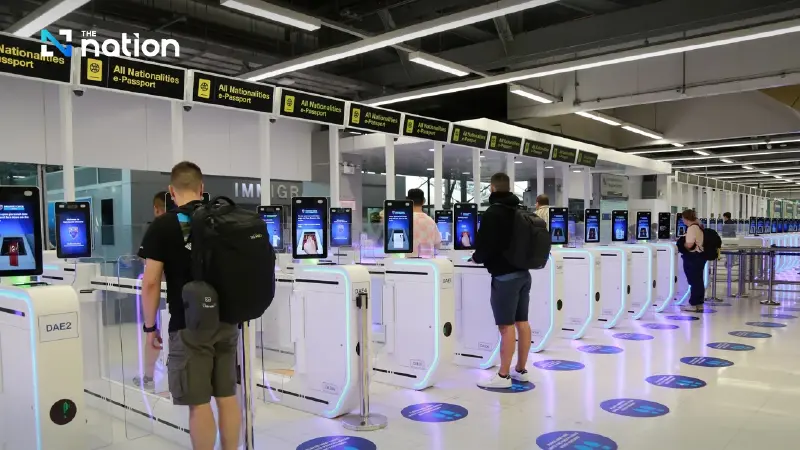


Thailand's Immigration Bureau is deploying a cloud-native mobile app to slash border wait times for 30 million annual visitors while tightening security
- Thailand's Immigration Bureau has launched a new mobile app, THIM, to allow international visitors to complete their arrival cards digitally before landing.
- The app aims to reduce border processing times to under three minutes by using AI-powered passport scanning for a one-time registration, requiring only minimal updates on future trips.
- Built on a local AWS cloud platform, the system is designed to enhance national security and keep traveler data within Thailand, as required by law.
- The bureau plans to expand the app's features to include visa extensions, 90-day reporting for foreign residents, and eventually, automated border clearance for more nationalities.
Thailand's Immigration Bureau is deploying a cloud-native mobile app to slash border wait times for 30 million annual visitors while tightening security.
Thailand's Immigration Bureau has launched a digital overhaul of its border entry process, unveiling a cloud-based mobile application designed to reduce arrival registration to under three minutes — without sacrificing the security screening that the bureau considers non-negotiable.
The Thailand Immigration Management System, known as THIM, was developed by Digital Identity Co., Ltd in partnership with the Immigration Bureau and is built on Amazon Web Services infrastructure hosted within the AWS Asia Pacific (Bangkok) Region.
The application, now available for download on both Apple and Android platforms, allows international visitors to complete their arrival card digitally before they land — a first for Thailand's immigration system.
Security and convenience, by design
The announcement was made at AWS Summit 2026 in Bangkok on Thursday and came with an explicit assurance from senior officials that faster processing would not come at the expense of border security.
Pol Maj Gen Pratya Prasarnsuk, deputy commissioner of the Immigration Bureau, framed the initiative in terms of a balance the bureau is obligated to strike.
"Thailand's immigration system serves approximately 30 million international tourists annually, and it is our responsibility to ensure that every traveller's experience at our borders reflects the modern, welcoming nation we are," he said. "By embracing cloud technology, we have reduced processing times significantly while strengthening our national security capabilities."

The bureau handles an estimated 30 to 33 million international arrivals per year, and Thai law requires every visitor to submit personal and travel data upon entry for national security purposes.
Until mid-2025, that process relied on paper-based forms — costly in both budget and time. A subsequent digital upgrade introduced the Thailand Digital Arrival Card (TDAC), a web-based form that allowed visitors to pre-register via QR code or a dedicated website. However, the system required travellers to re-enter their full details on every trip.
THIM addresses that friction directly. Under the new model, a visitor registers once — using AI-powered optical character recognition to scan their passport, which reads all three data layers, including the machine-readable zone, the biographical page, and the embedded chip — and submits their personal profile to the Immigration Bureau.
On subsequent visits, only a handful of fields need updating, reducing the process to roughly one to two minutes. When the traveller presents their passport at the immigration counter, officials can immediately see that a digital registration has been completed, removing any need to cross-reference a separate QR code.
Built on sovereign cloud infrastructure
A central reason for building on AWS Thailand's local region, officials said, was the requirement to keep personally identifiable information within the country's borders under Thai law.
The platform's architecture is deployed across three pillars: AI-assisted document verification, scalable compute and container orchestration using Amazon EC2 and Amazon EKS, and a security stack built around Amazon GuardDuty, AWS Security Hub, and end-to-end encryption via AWS Key Management Service.

Vatsun Thirapatarapong, country manager for AWS Thailand, described the deployment as evidence that speed and security are not competing objectives.
"THIM is a proof point that when you pair visionary leadership with world-class cloud technology, you can deliver outcomes that once seemed mutually exclusive: a seamless traveller experience and stronger national security, achieved together."
The local infrastructure also delivers a tangible performance advantage. AWS officials noted that response latency when connecting to servers in Thailand is now well below 10 milliseconds — compared to 20 to 30 milliseconds when routing through the nearest regional data centre in Singapore — which is critical for the real-time verification workflows that immigration processing demands.

Towards a digital immigration super-app
Beyond arrival processing, the bureau has signalled ambitions to expand THIM into a broader digital services platform for foreign nationals residing in Thailand.
Planned features include appointment booking, visa extension applications (e-Extension), and the electronic issuance of certification documents — changes that could eliminate the need for repeat in-person visits to immigration offices, where long queues remain a persistent complaint among long-term residents and frequent visitors alike.
Foreign nationals are currently required by law to report their address to immigration authorities every 90 days. Officials indicated this obligation could eventually be fulfilled through the app, alongside other routine interactions with government agencies, such as obtaining proof of lawful stay to register a Thai SIM card.
The bureau is also working towards automated border channel clearance — allowing eligible travellers to pass through passport-scanning gates without encountering an officer — a capability currently available only to Thai nationals, Singaporeans, and holders of Hong Kong travel documents. Officials said expansion to more nationalities would be phased in progressively.
Natakorn Tanachaihirun, chief executive of Digital Identity, said the app's underlying technology draws on years of experience building know-your-customer systems for the financial sector.
"The border is Thailand's front door," he said. "We built THIM to make sure it's wide open and secure at the same time."
The app currently supports four languages — English, Russian, Japanese, and Chinese — with a target of 15 languages by the end of the year.
A version compatible with Chinese domestic app stores, which operate on a separate ecosystem from Google Play, is in progress. Officials said the project is expected to be fully delivered before the end of October, barring unforeseen delays.
