
Durian prices fall as imports and summer fruit supply surge in China
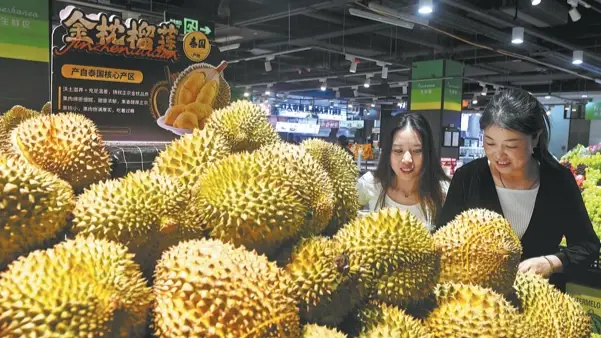


Cheaper Monthong durians from Thailand and Vietnam are helping Chinese shoppers inch closer to “durian freedom” as logistics improve and seasonal fruit supply floods the market.
- Durian prices in China have fallen, with some varieties dropping 10-20% compared to last year and Vietnamese wholesale prices decreasing by over 30% year-on-year.
- The price drop is driven by a surge in import volumes, particularly from Vietnam, and is supported by improved logistics and quicker cold-chain transport links.
- A seasonal influx of other summer fruits, such as cherries and lychees, is also contributing to the overall downward pressure on premium fruit prices.
Durian is becoming easier on the wallet for Chinese consumers, as larger import volumes, quicker transport links and a seasonal influx of fruit push prices lower across the market.
Wholesale market figures and retailers show that some durian varieties are now 10 per cent to 20 per cent cheaper than they were a year ago. In certain markets, fruit that previously cost 300 yuan ($44) to 400 yuan each is being sold for under 100 yuan, sparking online talk of “durian freedom”, a term Chinese consumers use to describe “unlimited” access to foods that were once considered expensive.
At Beijing Xinfadi wholesale market on Tuesday, Thailand’s Monthong durian, the leading variety in China, was priced at an average of 24.15 yuan per 500 grams. That level was broadly unchanged from a year earlier, but 14 per cent lower than in early April.
Vietnamese Monthong durians have fallen more sharply. Wholesale prices have dropped to about 18 yuan per 500 grams, down by more than 40 per cent from the previous month and more than 30 per cent year on year, according to market data.
Retailers have begun reflecting the lower wholesale prices on store shelves. Membership chains, including Sam’s Club, are offering Thai Monthong durians at around 199 yuan for 3 to 3.75 kilograms.
“Overall sales volume has definitely increased by more than 20 per cent year-on-year,” said He Huaxin, head of community group buying at Beijing Xinfadi wholesale market. “Durian from multiple countries is now entering the market, with Vietnamese varieties showing particularly strong growth momentum.”
China remains the world’s biggest importer and consumer of durian, making up an estimated 82 per cent of global consumption. Strong demand for the fruit, often known as the “king of fruits”, has led producing countries across Southeast Asia to accelerate cultivation and export growth.
Analysts said the price decline also points to stronger logistics and distribution networks in China, especially the expansion of cold-chain transport linked to government efforts to build a more integrated domestic market.
The fall in durian prices is also part of a wider adjustment in China’s premium fruit sector as summer harvests pick up. Cherry prices have almost halved from earlier this year, while lychee prices have also dropped steeply as supply rises.
Price-tracking data from Chinese resale platform Dewu.com showed that 1,000-gram packs of Grade 3 domestic cherries were selling for about 189 yuan in early March. By May, when the harvest reached its peak, the same product had fallen to around 108 yuan, a drop of nearly 45 per cent.
In Hainan province, a key lychee-growing area, daily outbound shipments have repeatedly topped 10,000 metric tons. Since late March, cumulative shipments had reached nearly 88,000 tons as of May 8, up almost 289 per cent from a year earlier. Sam’s Club has priced a 2.5-kilogram box of lychees at 66.6 yuan.
China Daily
