
Thailand tightens durian standards in THB150bn export push
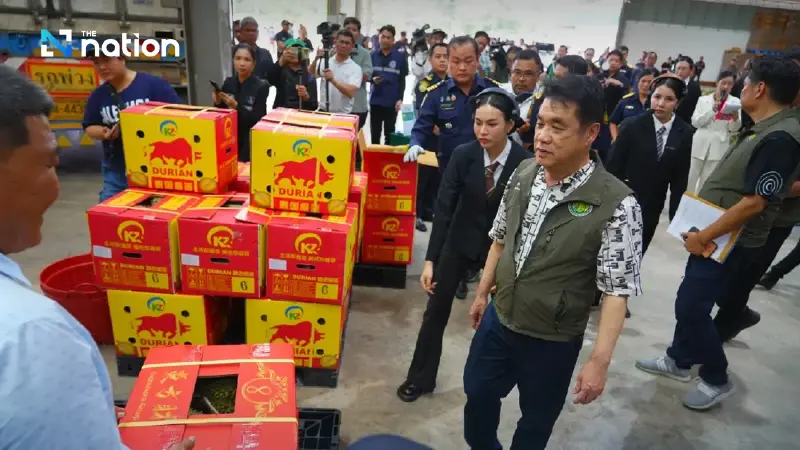


Suriya Juangroongruangkit says tighter checks and 24-hour export support aim to tackle export-rights misuse and residue risks.
- Thailand is implementing stricter quality controls for durian exports with the goal of achieving over THB150 billion in revenue, primarily by maintaining confidence in its main market, China.
- The new measures address key trade risks such as immature fruit, pests, and chemical residues through a "four noes" policy (no immature fruit, no pests, no misuse of export rights, no residues).
- To enhance food safety and traceability, the government is upgrading the entire export system by improving digital tracking, enhancing lab testing, and promoting a "quality durian orchard" model to reduce chemical use.

The Ministry of Agriculture and Cooperatives is moving to raise Thai durian standards for the global market after facing challenges on several fronts.
Minister Suriya Juangroongruangkit has ordered stricter measures to support durian exports to China around the clock, aiming to tackle export-rights misuse and residue problems while showcasing a quality durian orchard model and targeting revenue of more than THB150 billion this year.
Suriya visited Chanthaburi province on Sunday (May 16, 2026) to monitor the durian export situation and fruit quality-control measures, as part of efforts to raise Thai durian standards amid intensifying competition in the global market.
The government aims to push the value of Thai durian exports this year to more than THB150 billion, viewing “quality and confidence” as decisive factors in maintaining China, Thailand’s main export market.
Suriya said competition among exporting countries was no longer measured only by price, but also by food safety standards, traceability systems and product credibility. “Thai durian is not merely an agricultural product, but a key economic driver that links farmers’ income, exporters, logistics and the image of Thai food in the global market,” he said.

Latest data showed Thailand had exported more than 28,500 shipments of fresh durian, with a total volume of more than 460,000 tonnes and a value of more than THB52.5 billion, reflecting continued foreign market demand for Thai durian.
However, the Agriculture Ministry acknowledged that immature durian, pest detections, residues and Basic Yellow 2 (BY2) remain major risks to trading partners’ confidence, especially in the Chinese market, where standards have become stricter.
Instructions have been issued to the Department of Agriculture to intensify quality-control measures under the “four noes” policy: no immature fruit, no worm infestation, no misuse of export rights and no residues, alongside 24-hour export facilitation.
Key measures include increasing staff to support goods inspection and release, accelerating links between the e-Phyto and TAS-License systems to improve traceability, reduce duplication and ease goods held up at checkpoints, and upgrading residue-testing laboratories in line with China’s recommendations.


At the same time, the Agriculture Ministry has launched a model plot, the “quality durian orchard”, aimed at reducing the use of chemical fertilisers and agricultural chemicals by promoting biofertilisers, biological products and organic fertilisers, to raise Thai fruit standards in line with food safety requirements and green global market trends.
Rapibhat Chandarasrivongs, Director-General of the Department of Agriculture, said the department was accelerating the upgrade of the entire export fruit management system, from packing houses and laboratories to digital systems, so that Thai fruit exports have standards, transparency and speed.
On this occasion, the Minister of Agriculture and Cooperatives also visited the operations of a learning centre for a large-plot durian farming group under the safe agriculture system.
The Land Development Department has supported the excavation of a 1,260-cubic-metre on-farm pond as a reserve water source for the dry season, as well as soil analysis, land conditioning and compost-making support, with all knowledge continuously passed on to farmers in the network.
