
Thailand cracks down after ‘fallen durian’ claim hits Chinese market
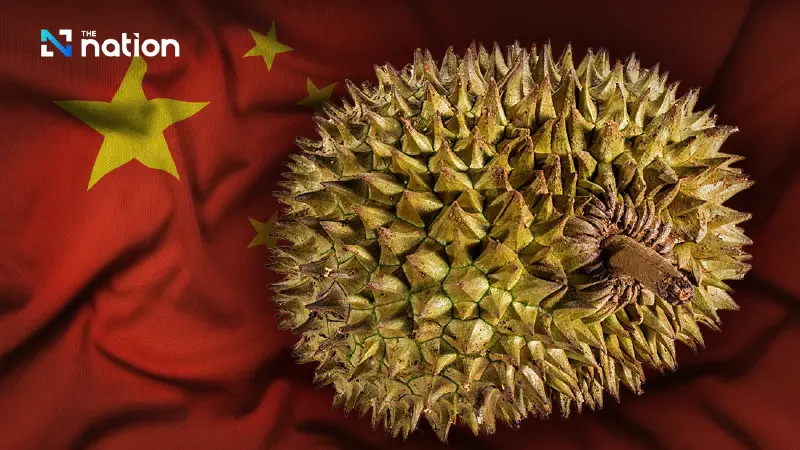


Thailand’s Department of Agriculture is probing a Guangzhou durian complaint and warning packers over the alleged misuse of GAP certification.
Thailand’s Department of Agriculture has ordered an urgent investigation after claims that suspected “fallen durians” from Thailand reached a market in Guangzhou, China, warning that legal action will be taken if any packing house is found to have misused a farmer’s Good Agricultural Practices (GAP) certification.
The case followed a Facebook post showing a complaint from a durian trader in Guangzhou, who reportedly bought 60 crates of durians, with six fruits in each crate, at 790 yuan per crate, or about 237,000 baht in total.
According to the complaint, the durians were substandard, with bruised thorns and brown impact marks on the flesh. The damage was described as resembling that of “fallen durians”, or fruit that had dropped from trees before being collected for sale.
The shipment was identified as having been exported on April 26, 2026, from a packing house in Tha Mai district of Chanthaburi province.

Department defends Thai durian standards
Rapibhat Chandarasrivongs, director-general of the Department of Agriculture, immediately instructed local officials to inspect the packing house in question and establish the facts in detail.
The department said those responsible would be identified, punished and prosecuted to the fullest extent of the law if wrongdoing was confirmed.
He also ordered the shipping company and exporters linked to the shipment to explain the matter without delay.

Rapibhat stressed that Thailand’s overall durian standards this season remained strong, urging farmers and consumers to maintain confidence in the country’s export control system.
He said Thailand had already exported more than 450,000 tonnes of durians this season, equivalent to about 168 million fruit, while the complaint involved only 30 fruit.
More importantly, he said China’s General Administration of Customs (GACC) had not issued any warning this season over immature durians, BY2 contamination, or durian fruit borers in any shipment.
A check of the farm source listed on the boxes found that the durians were linked to the orchard of a farmer named Khanang in Khao Kaeo subdistrict, Tha Mai district, Chanthaburi.
Khanang strongly denied any involvement in the alleged fallen-durian shipment, insisting that no storm had hit his orchard and that he had never sold fallen durians.
He said he harvested and sold 1.5 tonnes of durians on April 18, 2026. The fruit had passed dry-matter checks by the Kaeng Hang Maeo District Agricultural Office, with dry-weight readings of 34% and 36%, both above the required standard.

However, on the day buyers came to purchase durians at his orchard, they asked for a copy of his GAP certificate, claiming there was no need to include details of the transaction. Khanang has since filed a police report as evidence that his orchard was not involved in the alleged shipment of fallen durians.
The Department of Agriculture said its proactive response showed its determination to protect the reputation of Thai durians.
If the investigation finds that a packing house misused a GAP certificate or deliberately exported substandard fruit, the department said it would take decisive legal action to prevent one bad operator from damaging confidence in the wider industry.

ACFS to enforce mandatory standards
The National Bureau of Agricultural Commodity and Food Standards (ACFS) has also moved to close loopholes and prevent similar problems through mandatory standards on inspection and acceptance practices for durian collection centres and packing houses, aimed at controlling quality and keeping immature or substandard durians out of the export system.
Following the latest case, the Department of Agriculture’s director-general urgently coordinated with ACFS to inspect packing houses registered under the mandatory standard. ACFS will now use its legal authority under the Agricultural Standards Act BE 2551 (2008) to inspect and regulate packing houses more strictly.
Any packing house found to have violated the mandatory standard could face legal penalties, including imprisonment, fines, and the immediate suspension or revocation of its licence.
The coordinated action between the Department of Agriculture and ACFS is being framed as a strong warning to operators seeking to take advantage of consumers.
Officials stressed that the government was ready to pursue legal action to protect the national economy, safeguard Thai durian growers and preserve confidence in Thailand’s fruit exports.
