
Bangkok telecom summit puts Thailand’s AIoT future in focus
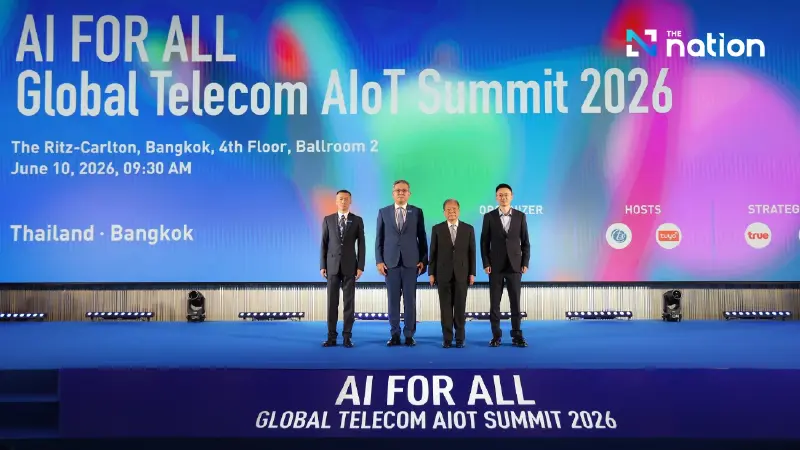


Global Telecom AIoT Summit 2026 in Bangkok highlights Thailand’s push to become a regional AIoT hub as telecom operators move beyond connectivity.
The Global Telecom AIoT Summit 2026 placed Thailand’s digital ambitions in the spotlight as government leaders, regulators, telecom operators and global technology firms gathered in Bangkok to discuss how artificial intelligence and the Internet of Things are transforming telecoms, smart living and digital services.
Held at The Ritz-Carlton, Bangkok, on Wednesday (June 10), the summit brought together technology companies, academic experts and AIoT ecosystem partners under the theme “AI for All”.
The event was jointly hosted by the Telecommunications Association of Thailand under the Royal Patronage (TCT), T3 Technology and Tuya Smart. It focused on Thailand’s growing role as a regional hub for AI-powered living, with practical AIoT deployment across homes, enterprises, buildings and smart cities among the central themes.

Thailand pushes AI for All and digital inclusion
Chakkrit Urairat, President of TCT, opened the summit by noting that the event was being held for the second year, following its debut last year, at a time when the world is entering a major turning point in digital technology.
He said technology was no longer merely a tool to support work, but was becoming a driving force for the economy, society and the quality of people’s lives.
Artificial intelligence and the Internet of Things, he explained, are now core technologies linking data, devices, services, systems and people, while creating new opportunities for industry, business and future smart cities.
“TCT has partnered with T3 Technology and Tuya Smart to organise the Global Telecom AIoT Summit 2026 as an international platform for exchanging knowledge, visions and experience, while promoting cooperation among the public sector, industry and technology partners,” he said.
The aim, he added, was to support the development of the telecom industry from the era of connectivity towards a stronger digital foundation, helping Thailand prepare for future economic and social growth and build the foundations for a secure and sustainable AI economy.
Chakkrit outlined two key missions for TCT. The first is to promote and develop Thailand’s digital ecosystem through cooperation among businesses, government agencies, academic institutions and technology partners. This includes developing the infrastructure, innovation and standards needed to support the country’s digital economy.
The second mission is to reduce the digital divide through digital inclusion, ensuring that people from all groups can learn about and benefit from digital technology and artificial intelligence equally.
“I hope the summit will become another important step in linking cooperation between Thailand and the global technology community, ensuring that AI and IoT bring genuine benefits to the economy, society and people’s quality of life,” he concluded.

Telecoms move from connectivity to intelligent services
Nick Wang, Founder and Chairman of T3 Technology and Vice President of TCT, told the summit that the telecom industry was entering a new stage.
For many years, he noted, telecoms connected people, homes, enterprises and cities. However, the rapid development of AI, IoT, cloud technology, edge computing and intelligent devices is changing the role of telecoms.
“The future is no longer only about connecting everything. The future is about understanding everything and turning connectivity into intelligent service,” Wang said.
He added that AIoT would become an important infrastructure of the AI era, bringing intelligence into homes, offices, schools, factories, communities and cities, while making AI more practical, localised and valuable in people’s daily lives.
For Thailand, Wang described this shift as a major opportunity. He pointed to the country’s strong telecom infrastructure, advanced broadband network, active mobile services, dynamic digital economy and strategic location in ASEAN.
With the right cooperation among government agencies, regulators, operators, technology companies and ecosystem partners, Thailand has the potential to become a leading AIoT hub in the region, he noted.
Wang also shared T3 Technology’s vision for AI-powered living, arguing that the true value of AIoT is not simply about connecting more devices, but about enabling homes and services to understand people, respond to their needs and create meaningful value in everyday life.
He described AIoT as a new service infrastructure for telecom operators rather than just a new product category. Operators, he explained, already have customer trust, broadband access, service channels, installation teams, billing systems and long-term operational capabilities, making them a natural foundation for AIoT services.
However, Wang stressed that no company could build this future alone. AIoT requires an open ecosystem combining policy direction, telecom capability, AI technology, IoT devices, cloud platforms, applications, content and local services.
“This is the purpose of today’s summit — to bring everyone together to share vision, exchange ideas and explore practical cooperation,” he said.
“Together, we can make Thailand not only a user of AIoT technology but also a regional centre for AIoT innovation, deployment and service operation.”
Leo Chen, President of Tuya Smart, also highlighted the rapid evolution of AI, saying the industry was once again standing at a critical moment.
He said it was time for software to define hardware and for AI to boost industries, adding: “We believe that the era of AIoT is getting closer and closer to us.”
Chen recalled that Thailand introduced the concept of Digital Thailand and relevant development plans 11 years ago, in 2015. Since then, he noted, the country had achieved significant progress.
He also cited Thailand’s 16% digital economy growth last year and described Southeast Asia’s digital economy as having recorded one of the strongest compound annual growth rates globally in recent years.
Chen said this direction was closely aligned with Tuya’s mission to promote global intelligence. He noted that T3 Technology had been a close partner of Tuya, with the two companies jointly providing comprehensive AIoT solutions for leading telecom companies and industrial groups in Southeast Asia.
Looking ahead, he said Tuya would continue working with partners across industries including smart homes, smart security and smart energy to create more value for partners, customers and society.

NBTC highlights infrastructure, inclusion and trust
Clinical Professor Sarana Boonbaichaiyapruck, Chairman of the National Broadcasting and Telecommunications Commission (NBTC), delivered a special address, describing the summit as an important forum reflecting the future direction of global communications and digital technology.
He said artificial intelligence was becoming a transformative force across the economy and society.
“Today, the world is entering the era of AIoT, where artificial intelligence and the Internet of Things converge to become a key driver of the next-generation economy. Everywhere we go, AI will be there,” Sarana said.
He added that the transformation was already shaping industries from manufacturing, healthcare and education to transport and the development of future smart cities.
However, Sarana stressed that this technological shift requires robust telecommunications infrastructure that is efficient, resilient, secure and capable of supporting the massive data connectivity requirements of billions of intelligent devices.
As Thailand’s regulator for broadcasting, television and telecommunications services, the NBTC views strong telecom infrastructure as a critical enabler of future technologies, including 5G Advanced, 6G, cloud infrastructure, edge computing, AI and AIoT.
These technologies are expected to become major engines of Thailand’s digital economy over the coming decade.
Sarana noted that Thailand has significant potential to apply AIoT across smart homes, smart healthcare, smart industry and smart cities. Such innovations, he said, can improve quality of life, increase business efficiency and strengthen the country’s long-term competitiveness.
From a policy perspective, Thailand supports the development of practical AIoT solutions tailored to local contexts, including language, culture and lifestyle. Achieving this goal will require close cooperation between the public and private sectors to build a comprehensive digital ecosystem.
Sarana also emphasised that technological progress must go hand in hand with inclusive access, ensuring benefits for all segments of society, including persons with disabilities.
He expressed hope that the summit would help deepen collaboration among government agencies, private enterprises, telecom operators, technology developers and international partners.
“Together, we can shape the future of the digital industry and advance Thailand’s aspiration to become a regional hub for digital innovation and technology,” he concluded.

Summit showcases AI home, smart services and data security
The morning session featured presentations from industry leaders on the future of AIoT and telecom innovation.
Leo Yu, CEO of T3 Technology, outlined how the company is helping telecom operators move beyond connectivity by building AI-powered services around smart homes, connected devices, AI agents and digital lifestyle platforms. He said T3’s AI Living Infrastructure is designed to help operators become providers of smart living services in the AI era.
Will Yu, Chief Scientist of AI at Tuya Smart, discussed how generative AI, edge intelligence and connected devices can work together to create smarter, more responsive home services. He highlighted AIoT’s potential to improve user experiences while increasing operational efficiency.
Other speakers included Julian Gorman, Head of APAC at GSMA, who examined how 5G can drive growth in the consumer and SME smart economy, and Prof Wu Sai of Zhejiang University, who shared insights into AIoT architecture and edge intelligence.
Telecom executives from Thailand and across the region also explored AIoT business opportunities. Nuttawit Surittikul of National Telecom discussed AIoT-driven digital services, while Ekaluk Prasurtkaew of Advanced Info Services (AIS) and Patchara Vanthongkam of True Corporation shared perspectives on ecosystem development and connected home platforms.
The morning session concluded with the signing of a memorandum of understanding between True, VNPT, T3 Technology and Tuya Smart to support the rollout of Hey Ami in Southeast Asia and strengthen regional AI Home collaboration.
Regional operators explore AI Home opportunities
In the afternoon, attendees joined an AI innovation showcase and live demonstration by Rutchapol Sangsurichai, Head of AIoT Business Development at T3 Technology, featuring smart home control, intelligent device interaction and AI-powered living services.
Dr Teeradet Dumrongbhalasitr, Chief Business Officer of True, discussed how operators can use AIoT to expand consumer and enterprise offerings. Regional operators, including Hoang Quoc Huy of VNPT Technology and Nazri Bin Edham of Telekom Malaysia/unifi, also shared strategies for AI Home and smart IoT development.
Kevin Guo, Deputy CEO and Head of International Business at T3 Technology, introduced the Tino Living Model, a localised AI framework built around voice, vision, context and services to deliver more natural and relevant AI Home experiences across different markets.
A panel discussion, “AI-Native Telcos: AI as the New Growth Frontier for Operators”, explored how telecom companies can evolve into AI-driven service platforms, focusing on new business models, AI Home commercialisation, customer engagement and ecosystem partnerships.
The summit also hosted the Global Telecom AIoT Promotion Initiative Ceremony, which called for stronger collaboration among governments, operators, technology firms, developers and research institutions to accelerate AIoT adoption and innovation.
Later sessions expanded the discussion to smart buildings, enterprise applications and digital infrastructure. Evan Liu of Konec Solutions Australia examined smart buildings as a new revenue opportunity for telecom operators, while Harry Hartono of Vector Green Singapore shared insights on energy savings through IoT-enabled building management.
Pattaranan Teeramaswanich, Telco Lead at Amazon Web Services Thailand, highlighted the role of cloud infrastructure in delivering scalable and secure AI services.
The summit concluded with a panel on “AI Trust, Security & Governance” and the Thailand Data Security Certification Joint Initiative Ceremony, underscoring the importance of data protection, responsible AI development and trusted governance frameworks as AI becomes more deeply integrated into everyday life and business operations.

Thailand positioned as regional AI living platform
The Global Telecom AIoT Summit 2026 demonstrated that AIoT is no longer a future concept, but an emerging growth engine for telecom operators, technology companies and national digital economies.
By bringing together regulators, operators, AI platforms, cloud providers, academic institutions and ecosystem partners, the summit positioned Thailand as a key regional platform for AI living innovation.
T3 Technology reaffirmed its commitment to working with telecom operators and partners across Southeast Asia to bring AI Home, AI Living Infrastructure and the Tino Living Model into more markets, helping AI move from the cloud into real homes, real businesses and everyday services.
