
Thailand Launches First National AI Readiness Index to Boost Business Competitiveness
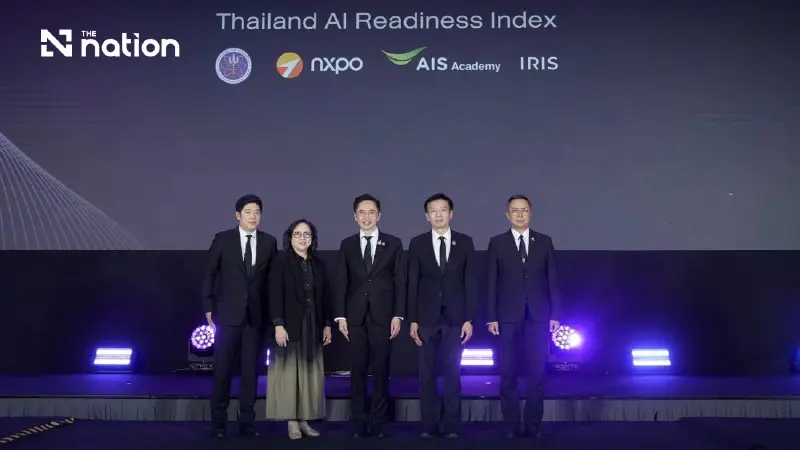


MHESI, AIS Academy and IRIS Consulting unveil "TARI," a framework to help Thai organisations measure and improve their AI adoption across people, data and processes
- Thailand has launched its first national AI readiness assessment framework, the "Thailand AI Readiness Index (TARI)," a collaboration between the government (MHESI/NXPO), AIS Academy, and IRIS Consulting.
- The TARI framework is designed to help Thai organizations measure their AI capabilities across eight key dimensions, including strategy, data, technology, and skills, to identify areas for improvement.
- Its primary goal is to provide a benchmark for businesses to compare their AI readiness against industry peers and national standards, helping them plan their digital transformation more effectively.
- Data gathered from the index will be used by the government to inform national AI policy, develop tailored workforce training, and support the country's shift from a technology consumer to a creator.
MHESI, AIS Academy and IRIS Consulting unveil "TARI," a framework to help Thai organisations measure and improve their AI adoption across people, data and processes.
Thailand has launched its first national AI readiness assessment framework on Thursday, aimed at helping local organisations benchmark their capabilities and accelerate adoption of artificial intelligence across the economy.
The Ministry of Higher Education, Science, Research and Innovation (MHESI), through the Office of National Higher Education Science Research and Innovation Policy Council (NXPO), unveiled the Thailand AI Readiness Index (TARI) in partnership with AIS Academy and IRIS Consulting.
The tool is designed to give Thai businesses a practical way to assess their current AI capabilities, pinpoint priority areas for improvement, and plan their transformation more effectively.
A National Push Towards an AI-Driven Economy
Speaking at the launch, Deputy Prime Minister and Minister of Higher Education, Science, Research and Innovation Prof Dr Yodchanan Wongsawat framed the initiative under a vision of "AI for All," arguing that Thailand must shift from being merely a buyer of technology to becoming a creator of it.
He likened AI readiness to using a salinity meter when cooking: without a clear measurement tool, organisations cannot tell whether their capabilities are sufficient compared with global benchmarks.
He also stressed the importance of Thailand developing its own foundational technology — including data centres, semiconductors and satellites — to maintain independence amid global "tech wars" and safeguard its data sovereignty.

While AI technology evolves rapidly, he added, basic sciences such as physics, chemistry and mathematics remain the unchanging foundations of true innovation, and government training programmes work best when driven by genuine demand from the private sector.
Prof Dr Supachai Pathumnakul, MHESI permanent secretary, pointed to the earlier "Thailand i4.0 Index" as a precedent, noting that the data it generated allowed the ministry to design curricula and workforce programmes tailored to industry needs.
He said TARI would similarly help universities understand gaps in the private sector, enabling them to offer better research support and academic services to both SMEs and large corporations.
Business and Policy Rationale
Kantima Lerlertyuttitham, deputy chief executive officer and chief corporate officer at AIS, said Thailand's central challenge is no longer whether AI will replace jobs but how to prepare people, organisations and the country to use AI to boost productivity and economic growth.
She noted that many organisations invest heavily in technology while neglecting to prepare their staff, warning that tools quickly become obsolete if employees lack the skills to use them.
She described TARI as a "health check" or "thermometer" that allows organisations to gauge their current capabilities before committing to expensive investments.
Kantima also confirmed that AIS itself will not store any of the data collected; it will instead be held by NXPO as the government's data governor to protect the privacy and security of participating companies.

She further announced the upcoming AIS ACADEMY for THAIs 2026 annual seminar, scheduled for this September under the theme "Mastering AI Beyond Borders".
Serving as the academy's premier upskilling event, the seminar will explore fresh global perspectives and emerging opportunities in artificial intelligence. The initiative remains free and accessible to the general public.
Dr Surachai Sathitkunarat, president of NXPO, said one of the biggest obstacles to developing effective AI policy has been the lack of reliable, systematic data on how ready Thai organisations actually are.
He outlined five core objectives for TARI: systematically assessing AI readiness, creating national benchmarks, supporting strategic development, informing national policy, and fostering collaboration between the public and private sectors.
NXPO, he said, will act as the "data governor," managing the information collected and using it to shape national AI strategy. He confirmed that the first major nationwide survey will begin in December, with results expected to provide a comprehensive picture of the country's AI readiness by the end of the year and that the assessment is intended to be repeated twice yearly to track progress.
Boriwat Pinpradab, chairman of IRIS Consulting, which is serving as the project's management office, said many executives are keen to adopt AI but remain uncertain where to start or how to measure progress beyond simply purchasing memberships or tools.
He said the project team studied international frameworks from UNESCO, the OECD and Stanford University to ensure TARI meets global standards while still being designed specifically for the Thai context.
The index, he added, is built to assess multiple levels within an organisation — from executive leadership to functional staff — rather than applying a one-size-fits-all survey.
How TARI Works
TARI evaluates organisational readiness across eight dimensions: AI strategy and leadership; data management; technology and infrastructure; people and AI skills; governance and risk; AI use cases and business value creation; organisational culture and change management; and AI implementation and realised impact.
The initiative will be rolled out in three stages:
Measure — helping organisations understand their AI readiness and identify strengths, gaps and priority areas.
Benchmark — allowing organisations to compare their capabilities against industry peers and national standards.
Activate — translating assessment results into practical action plans covering workforce development, process improvement, technology adoption and the creation of a tailored AI ecosystem.
Scale and Next Steps
More than 40 leading organisations across various industries have already expressed interest in joining a pioneer group to help develop the index.
The initiative will later expand to small and medium-sized enterprises and supply chain businesses, with organisers targeting at least 5,000 participating organisations in the first year, rising to more than 20,000 in the next phase.
Organisations interested in taking part can register at thailand-tari.ai or follow updates through the official channels of NXPO, AIS Academy and IRIS Consulting.
