
Fresh durian exports jump 67% as Thailand tightens China checks
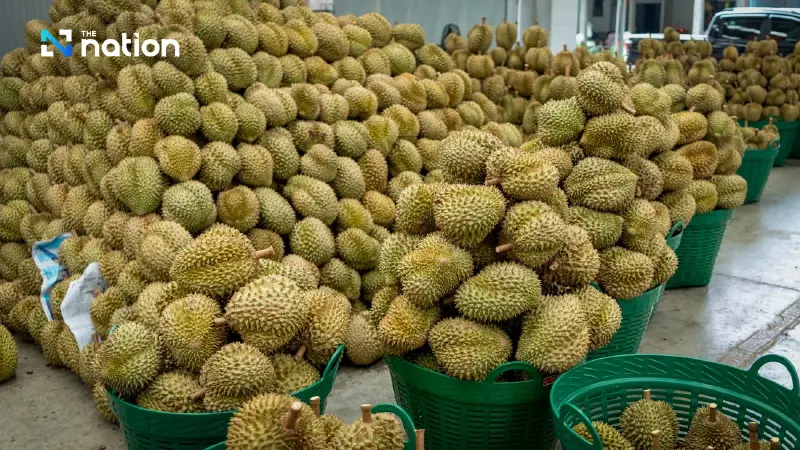


Fresh durian exports surged to 10,316 million baht in January 2026, while frozen durian exports fell sharply to 439 million baht, Commerce Ministry data show. The Department of Agriculture says it is aligning inspection procedures for shipments to China to prevent import suspensions and tougher trade measures.
Fresh exports surge, frozen durian slumps in January
The Ministry of Commerce reported that fresh durian exports in January 2026 were worth 10,316 million baht, an increase of 67.05% from January 2025, when exports were valued at 6,175 million baht. Full-year fresh durian exports in 2025 were valued at 125,737 million baht.
Exports of frozen durian in January 2026 were worth 439 million baht, down 66.88% year-on-year from 1,326 million baht. Full-year frozen durian exports in 2025 were valued at 17,118 million baht.
Department of Agriculture aligns China inspection procedures for 2026 season
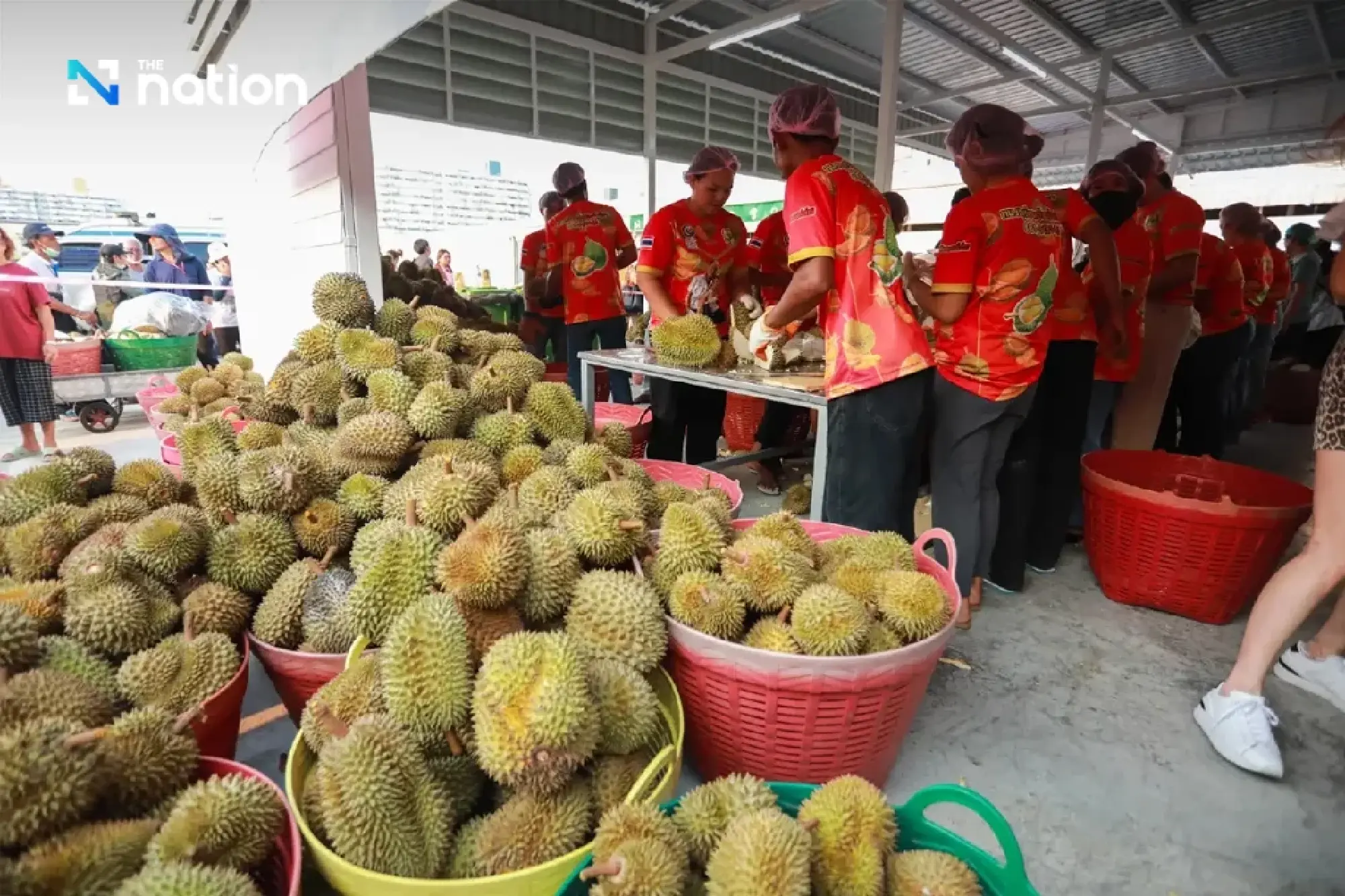
Priyanut Thippayawat, deputy director-general of the Department of Agriculture, said the department had briefed plant quarantine inspectors and relevant agencies on operational guidelines for inspecting durian exports to the People’s Republic of China for the 2026 export season.
She said the aim was to ensure a single, consistent approach to inspection procedures and criteria—covering pest inspection, chemical residue control, phytosanitary certification, and measures to handle non-compliance—so as to prevent import suspensions or tighter measures by trading partners.

Immature durian, residues and pests remain key risks
Priyanut said challenges that remain include immature durian, chemical residues, and pest detections, which could affect Thailand’s image and market confidence.
2025 China shipments rise, reflecting market confidence
Exports of Thai durian to China have continued to expand. In 2025, Thailand recorded 58,072 shipments to China, totalling 939,892.34 tonnes, with a combined value of 150,278.59 million baht, up from the previous year—reflecting confidence in the quality of Thai durian.
Chaisak Rinkluen, director of the Office of Agricultural Regulation under the Department of Agriculture, said the office oversees durian exports across the supply chain—from pre-export pest checks and container sealing inspections, to issuing phytosanitary certificates, and following up on problems flagged by trading partners—under the Plant Quarantine Act B.E. 2507 and its amendments, as well as requirements under the Thailand–China protocol and departmental measures.

Output timeline and 2026 supply forecast
For the 2026 production season, output in the eastern region is expected to begin entering the market from April, peaking in May–June. In the South, output is expected to continue entering the market from June onwards, with agencies monitoring supply to support market planning and distribution.
Peeraphan Korthong, secretary-general of the Office of Agricultural Economics (OAE), said total bearing area nationwide in 2026 is expected to reach 1,391,421 rai, up from 1,265,778 rai in 2025—an increase of 9.93%—as farmers expand durian planting.
Output is projected at 1,781,019 tonnes, up 15.71%, supported by weather conditions expected to favour flowering and fruit set, alongside improved orchard management.
China competition intensifies; rail route offers speed but at higher cost
OAE said overseas demand is expected to remain steady, while the government is promoting exports and market diversification to reduce reliance on a single market. However, Thailand may face tougher competition on both price and market share, particularly from Vietnam, after China approved imports of fresh durian from Vietnam in mid-2022, with imports trending higher.
Other competitors in China include Malaysia, the Philippines, and Cambodia, which became the fifth country approved to export fresh durian to China in April 2025. China can also grow durian domestically in Hainan, which has not yet affected Thailand in the short term due to limited output, but could pose longer-term risks.
Since the Laos–China railway began operations in 2022 under the Belt and Road Initiative (BRI), OAE cited research indicating rail transport to Kunming is around two days faster than the R3A road route, with more stable delivery times and better temperature-controlled containers that help reduce damage during peak seasons.
However, rail transport costs remain about 10–15% higher than road transport, and Thailand still faces infrastructure constraints, including reliance mainly on single-track rail, shortages of 15-metre containers, and limited availability of high-traction locomotives.
