
57% plunge — Iran war hammers Thai exports to Middle East
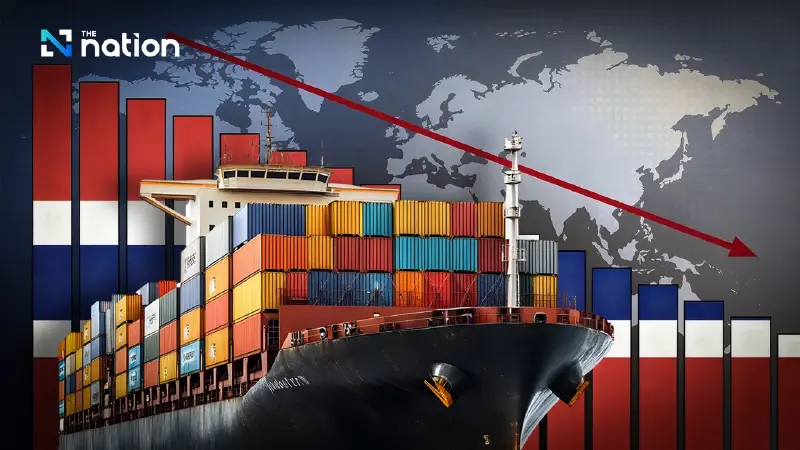


Thailand’s exports to the Middle East slumped 57% as the Iran conflict disrupted shipping routes, forcing Bangkok to seek alternative markets
Thailand’s hopes of turning the Middle East into a new export growth engine are facing mounting pressure as the conflict involving Iran begins to ripple through global trade routes and supply chains.
The region had been identified by the Commerce Ministry as one of Thailand’s key alternative markets amid rising global economic uncertainty and escalating trade tensions among major economies. Expanding trade with the Middle East was also seen as part of a broader strategy to reduce Thailand’s heavy reliance on traditional export markets such as the United States and China.
But the worsening geopolitical situation in the region has now emerged as a fresh risk factor for Thai exporters, particularly through indirect impacts on shipping routes, freight costs and regional economic confidence.
Nantapong Chiralerspong, director of the Trade Policy and Strategy Office under the Commerce Ministry, said tensions escalated sharply in late February 2026 after the United States and Israel jointly launched attacks on strategic targets inside Iran.
The conflict disrupted maritime routes and airspace across the region, creating immediate uncertainty for global logistics networks.
He explained that the war initially had limited impact on Thai exports to the Middle East in February because most shipments had already cleared customs and been dispatched before the attacks took place. Some deliveries were delayed, but exports to the region still expanded by 19.4% during the month.
However, the situation deteriorated rapidly in March after the closure of the Strait of Hormuz and broader supply chain disruptions began affecting regional trade flows.
Thai exports to the Middle East plunged 57.1% in March as exporters struggled to deliver goods on schedule. Shipping operators were forced to reroute vessels around the Cape of Good Hope while congestion at ports further delayed cargo movements. At the same time, demand weakened as buyers across the region paused orders amid the uncertainty caused by the war.
Despite the sharp contraction in the Middle East market, the overall impact on Thailand’s export performance remained limited because the region accounts for only a small share of total exports.
Thailand’s overall exports in March still grew 18.7%, supported by strong demand from other major markets including the United States, Japan, Europe, South Asia and Australia. Nevertheless, the conflict continued to push up freight costs and extend shipping times on several trade routes.
Exports to the Middle East accounted for 1.6% of Thailand’s total exports in March, down significantly from 3.7% in 2025.
Among the region’s key markets, exports to the United Arab Emirates fell 67.1%, while shipments to Turkey dropped 20.5% and exports to Saudi Arabia declined 55.5%.
The downturn affected almost every major product category.
Exports of vehicles, equipment and auto parts dropped 53.5%, while gems and jewellery fell 67.5%. Air-conditioners and related components declined 41.4%, rubber products dropped 55.1%, and canned and processed seafood exports contracted 47.5%.
Officials expect exports to the Middle East to remain under pressure at least through the second quarter unless the conflict eases, consumer confidence in the region recovers and shipping through the Strait of Hormuz returns to normal.
Nantapong warned that if the conflict drags on, broader risks to Thailand’s export sector could intensify even if current headline export figures remain relatively resilient.
He said prolonged supply chain disruptions would continue driving up shipping and energy costs, feeding into global inflation and forcing major economies to delay interest-rate cuts or maintain tighter monetary policy for longer.
That, in turn, could weaken global demand and purchasing power, creating additional pressure on Thailand’s export outlook.
The warning aligns with the International Monetary Fund’s latest downgrade to global growth forecasts for 2026. The IMF now expects the global economy to expand by 3.1%, down from the previous estimate of 3.3% before the conflict intensified.
Several of Thailand’s key trading partners also saw growth forecasts revised lower, including the United States at 2.3%, the European Union at 1.1%, China at 4.4% and Japan at 0.7%.
In response to the growing geopolitical uncertainty, the Commerce Ministry has adjusted its strategy to focus on both protecting existing markets and accelerating expansion into new ones.
Short-term measures include working with Thailand’s commercial attaché network to identify alternative logistics routes and new distribution hubs, while also compiling databases of alternative raw material suppliers to help Thai businesses manage rising energy and industrial costs.
The ministry is also pushing deeper into alternative markets that rely less on vulnerable maritime routes, including India, South Asia, ASEAN and Central Asia, while targeting second-tier cities in western and inland China.
At the same time, officials are encouraging exporters to adapt products and services to changing global demand patterns.
Thailand plans to leverage its reputation for food security to expand into markets seeking stable food supplies, while also promoting higher-value service industries less exposed to logistics disruptions, including digital content, gaming, film production, software, Thai restaurants, healthcare and wellness businesses.
Although Thailand’s direct exports to Iran remain relatively limited, officials said the greater concern lies in the wider indirect effects of the Middle East conflict through rising oil prices, transport costs and weakening global economic conditions that could eventually weigh more heavily on Thai trade.
