
Thailand steps up US trade talks as tariff pressure grows
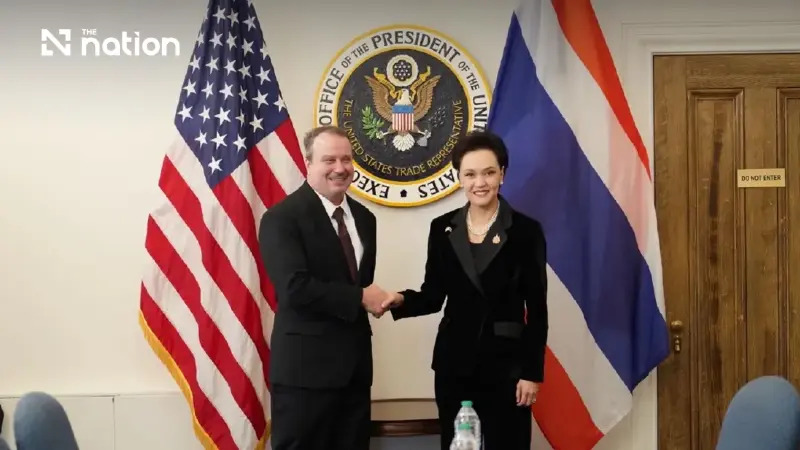


Thailand urges Washington to advance reciprocal trade talks as it seeks competitive tariffs and clarity over two US Section 301 investigations
- Thailand's Commerce Minister met with senior US officials to urge the acceleration of negotiations for the Thailand-US Agreement on Reciprocal Trade (ART).
- Thailand's primary goals are to secure a competitive tariff rate and gain clarity on two US Section 301 investigations concerning forced labor and manufacturing overcapacity.
- While Thailand has shown flexibility to address US demands, American officials stated they need more time to consider the proposals and close the remaining gaps in the negotiations.
Thailand has urged the United States to accelerate negotiations on a reciprocal trade agreement as Bangkok seeks a competitive tariff outcome and greater clarity over two US Section 301 investigations.
Deputy Prime Minister and Commerce Minister Suphajee Suthumpun held bilateral talks with three senior US officials in Washington, DC, on July 15 and 16.

They were White House Chief of Staff Susie Wiles, US Commerce Secretary Howard Lutnick and Deputy US Trade Representative Rick Switzer.
Suphajee said the main purpose of the visit was to secure as much progress as possible in negotiations on the Thailand-US Agreement on Reciprocal Trade, or ART.
The Thai delegation also followed up on the US Section 301 investigations and sought to strengthen economic and investment ties between the two countries.
US to consider Thailand’s latest proposals
Suphajee described the discussions as positive and congratulated the United States on the 250th anniversary of its Declaration of Independence.
Thailand emphasised its role as an important and trusted US partner in Southeast Asia and briefed the American officials on the progress of the ART negotiations.
She said Thailand had worked to address US demands and had shown as much flexibility as possible within the legal framework and policies of the current government.
The US officials thanked Thailand for clearly demonstrating its intention to bring the negotiations to a conclusion and acknowledged its efforts to rebalance bilateral trade.
However, Washington said it needed more time to consider Thailand’s proposals and narrow the remaining gaps between the two sides.
Further discussions are expected to be accelerated.
Thailand and the United States reached a framework for an Agreement on Reciprocal Trade in October 2025, with both sides agreeing to continue negotiations towards a final agreement. The framework included planned Thai purchases of US agricultural, energy and aviation products intended partly to support more balanced trade.
Thailand seeks mutually beneficial outcome
Thailand said it would continue defending the country’s rights and interests during the negotiations.
Investment commitments and increased imports of US products needed by Thailand would be used to help reduce the bilateral trade imbalance, in line with an earlier joint understanding between the two countries.
Suphajee said Thailand had carefully considered Washington’s demands during the continuing ART negotiations and had made every effort to propose solutions offering the best shared benefit.
She stressed that countries entered trade negotiations with different economic circumstances, levels of readiness, regulations, laws and public policies.
A single set of criteria should therefore not be used to judge the success of every negotiation, she said.
Instead, attention should be placed on the final package and whether both parties could achieve their objectives on the basis of shared interests.
Thailand faces two Section 301 cases
The discussions also covered two US investigations involving Thailand under Section 301 of the Trade Act of 1974.
One concerns structural excess capacity and production in manufacturing sectors, while the other examines the absence or ineffective enforcement of measures prohibiting imports of goods produced with forced labour.
USTR launched forced-labour investigations involving Thailand and 59 other economies in March 2026. It said the investigations would determine whether the failure to impose and effectively enforce import bans on forced-labour goods unfairly burdened or restricted US commerce.
Thailand is also among the economies examined in the separate investigation into structural excess capacity. Public hearings on that investigation were held in Washington in May.
The US measures have gained importance after the US Supreme Court ruled against the use of emergency economic powers as the legal basis for certain presidential tariffs, prompting Washington to rely more heavily on other trade-law mechanisms, according to the Thai Commerce Ministry’s account of the talks.
USTR proposes additional tariffs
USTR has completed its initial findings in the forced-labour investigation and proposed additional tariffs for public consideration.
Under the proposal, a 12.5% additional duty would apply to products from economies that had not introduced qualifying restrictions on imports produced with forced labour.
A lower additional rate of 10% would be proposed for economies that had imposed such a prohibition, committed to doing so under an Agreement on Reciprocal Trade, or adopted a partial system intended to prevent forced-labour goods from entering their markets.
The rates remain proposed measures rather than final tariffs. USTR held public hearings on the proposed action from July 7 to 9.
The Thai side said Washington was still considering the structural excess-capacity investigation.
Countries that failed to reach an agreement with the United States or implement their commitments could face comparatively high tariffs, according to the Commerce Ministry.
Thailand seeks competitive tariff treatment
Suphajee acknowledged that several negotiating issues remained difficult and would require more time.
Thailand nevertheless remained committed to reaching a mutually beneficial conclusion and would provide flexibility where possible under domestic law, internationally accepted standards and the public interest.
The objective was to secure an appropriate and competitive tariff rate comparable with the treatment obtained by countries that had already concluded ART negotiations with Washington.
The US officials acknowledged Thailand’s efforts and said they would examine its latest proposals on each outstanding issue as both sides sought to complete the negotiations as soon as possible.
“The discussions with senior US representatives show that Thailand has devoted its full effort through every available channel to advancing Thai-US relations across trade, investment and the ART negotiations for the greatest benefit of the country,” Suphajee said.
US remains Thailand’s second-largest trading partner
The United States was Thailand’s second-largest trading partner in 2025, with two-way trade valued at US$93.65 billion, according to figures provided by the Commerce Ministry.
Thai exports to the US were valued at US$72.51 billion, while imports from the United States totalled US$21.14 billion.
Thailand consequently recorded a trade surplus of US$51.36 billion with the United States.
