
How a 20-Year-Old Is Reimagining Thailand's Agricultural Future
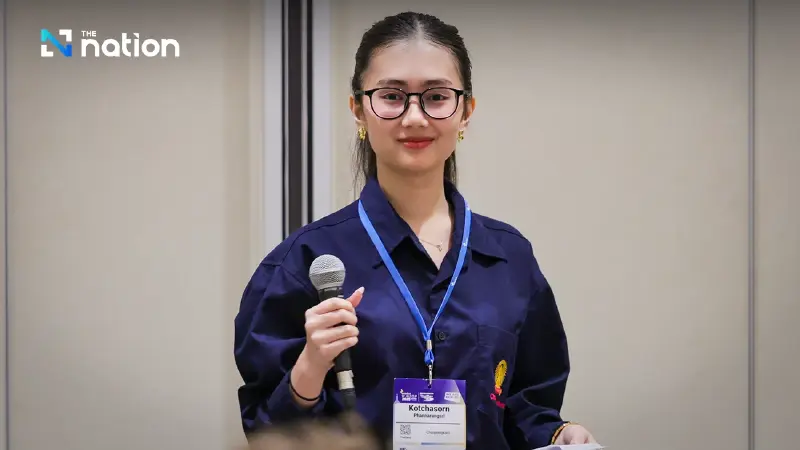


'Namwhan' Kotchasorn Phannarangsri transforms agricultural waste into opportunity, proving farming can be both sustainable and dignified
- 20-year-old student 'Namwhan' Kotchasorn Phannarangsri is applying circular economy principles to transform agricultural waste into valuable products.
- Her innovative projects include creating nutritious soup cubes from downgraded pumpkins and cattle feed supplements from cacao by-products that also reduce methane emissions.
- She believes innovation must be built on trust with farmers, focusing on small, gradual changes that reduce risk rather than imposing external solutions.
- Her ultimate goal is to restore dignity to farming by giving farmers more choices, knowledge, and direct market access to ensure they receive a fair share of value.
- Namwhan advocates for agriculture as a key frontier for young people, connecting it to technology, climate change, and social equality to attract new talent.
'Namwhan' Kotchasorn Phannarangsri transforms agricultural waste into opportunity, proving farming can be both sustainable and dignified.
When "Namwhan" Kotchasorn Phannarangsri travelled through the farmlands of North Carolina during her exchange year, a question began to form in her mind. Why couldn't the systems she witnessed there—farmers transforming waste into value, earning stable incomes, living with dignity—exist in her family's hometowns of Songkhla and Nakhon Si Thammarat?
That question has shaped the path of the 20-year-old Chulalongkorn University student, who now finds herself knee-deep in the agricultural realities of Nan Province, bridging the gap between innovation and tradition.
"It wasn't one dramatic moment," Namwhan recalls. "It was seeing farming treated as a professional, long-term business. Waste wasn't immediately thrown away—it was managed, reused, turned into value. There was planning behind every step."
The contrast was stark. In Thailand, her parents had left their farming roots behind to build a life in Bangkok, where opportunities seemed more abundant. The reason? Simple yet devastating: despite farming being called "the backbone of the nation," it couldn't sustain a family.

From Theory to Impact
That realisation has driven Namwhan to remarkable achievements in her young career. She claimed first place at Asia's Next Innovator Ideathon Thailand in the Agriculture category and reached the semifinals at PIM Inter Hackathon #5, focused on sustainable well-being.
Most impressively, she served as one of the pitching speakers representing Thailand at the Enactus World Cup 2025, where her team ranked among the top 16 out of 35 countries.

The projects she's contributed to demonstrate her commitment to circular economy principles: nutritious soup cubes created from downgraded pumpkins for elderly people with swallowing difficulties and cattle feed supplements made from cacao by-products that simultaneously improve livestock health, reduce methane emissions, and increase farmer income.
At the World Cup, her team presented a multi-stage project addressing inefficiencies across Thailand's cacao value chain. A judge from Ghana—one of the world's largest cacao exporters—told her the approach could work in his country too.
"I realised that the challenges we're trying to solve in Thailand aren't isolated," she reflects. "Agricultural waste and inefficiencies exist across borders, and solutions built from real problems can travel further than we expect."


The Reality Check
But Namwhan's time in Nan has taught her perhaps the most important lesson of all: innovation on the ground looks nothing like innovation in textbooks.
"One of the most humbling challenges has been realising how deeply farmers are tied to existing systems—not because they don't want to improve, but because change is risky when your livelihood depends on it," she explains. "A failed experiment doesn't just mean a bad result—it can mean debt, wasted land, or food insecurity."

This understanding has fundamentally shifted her perspective. Real innovation, she's learned, isn't flashy or disruptive. It's small, slow, and built on trust—adapting existing practices, reducing risk step by step, and working within farmers' realities rather than imposing solutions from outside.
When she encounters agricultural waste now, her first question isn't "what can this become?" but "why is this being wasted in the first place?" Often, the answer lies in deeper system gaps: limited market access, missing knowledge, or structures that don't reward farmers fairly.

Redefining Dignity
For Namwhan, the goal isn't simply to make farming profitable—it's to restore dignity to the profession.
"Income is part of it, of course," she says. "But dignity is also about having choices. A dignified farmer can decide what to grow, how to manage their land, and which markets to access, instead of being trapped by outdated systems."
She points to a fundamental inequality in Thailand's agricultural sector: farmers are called the backbone of the nation, yet they carry the heaviest burdens whilst receiving the smallest share of value.
Without access to information, infrastructure, or direct buyers, they're pushed into long chains of intermediaries where most profit is captured before it reaches the farm.
"True dignity means shifting this imbalance—giving farmers the knowledge, standards, and market channels needed to negotiate fairly," she insists. "When farmers are valued not only for what they produce, but for the knowledge and resilience they carry, the phrase 'backbone of the nation' becomes something they can truly live by."

Building Trust, Building Change
As a Bangkok-born student entering rural farming communities, Namwhan was acutely aware of being an outsider. Her approach has been one of humility and respect.
"Building trust wasn't about convincing farmers that I had better ideas but about showing respect for their knowledge and being sincere in my intention to help," she explains. "I'm there to work with them, not over them—to support their way of life, not replace it."
Her family's reaction to her agricultural pursuits has evolved from thoughtful questioning to active support. Her parents are now starting an oil palm plantation on the land they left behind years ago, viewing her knowledge as key to maximising its potential. Their trust, she says, motivates her to keep going when she feels tired or unsure.

A Message to the Next Generation
To Thai teenagers who view agriculture as boring or old-fashioned, Namwhan has a compelling counter-argument.
"Agriculture sits at the intersection of food, climate change, technology, health, and social equality," she argues. "Every issue people care about today—carbon emissions, waste, AI, biotechnology, circular economy, even global markets—starts with how we produce food. That means agriculture isn't behind the future; it's one of the places where the future is being built."

She emphasises that the system still needs constant improvement, creating room for innovation everywhere—from using sensors and data to reduce waste, to designing solutions that help farmers earn fairly whilst protecting the environment.
"If you want a field where your ideas can matter, where technology meets humanity, and where innovation can directly improve the world—agriculture is one of the most exciting frontiers you can choose," she insists.

With a year and a half still ahead in Nan Province, Namwhan sees this period as foundation-building—time to be truly present in farming communities, build trust, understand daily realities, and identify problems that matter to farmers themselves.
"Meaningful solutions cannot—or should not—be rushed, especially when they affect real communities and livelihoods," she reflects. "Creativity in the circular economy starts with patience, listening, and preparation—so that when solutions come, they're not imposed from the outside, but grown together with the people they're meant to serve."
It's a philosophy that encapsulates her entire approach: the next generation doesn't need to replace agriculture. They need to reimagine it—with farmers, not for them.
