
Breaking Boundaries: How Pup Tanyapat's Winning Artwork Challenges Our Relationship with AI
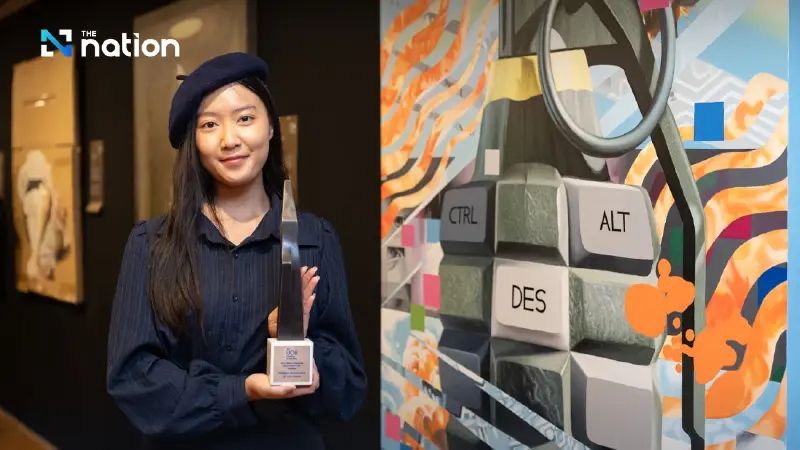


Young Thai artist captures technology's dual nature with thought-provoking bomb-and-keyboard composition
- Thai artist Pup Tanyapat won the "Most Promising Artist of the Year" award for her painting "Control + Alt + Destruct," which explores humanity's relationship with AI.
- The artwork juxtaposes a bomb and a keyboard to symbolize the dual nature of AI as both a powerful creative tool and a potential weapon of destruction.
- Tanyapat views AI as a "double-edged sword," arguing that it is a tool whose impact depends on the ethical intentions of its human user.
- She believes human craftsmanship remains essential, as AI lacks consciousness and relies on data originally created by human hands.
- The piece challenges viewers to think critically about their responsibility in using technology, framing the choice to build or destroy as a human one.
Young Thai artist captures technology's dual nature with thought-provoking bomb-and-keyboard composition.
When Tanyapat "Pup" Manasarakul placed a bomb beside a keyboard in her painting, she wasn't just creating art—she was asking a question that resonates across our increasingly digital world.
The 16th UOB Painting of the Year judges saw something remarkable in this juxtaposition, awarding the Chulalongkorn University student the Most Promising Artist of the Year (Thailand) title.
Her winning work, titled "Control + Alt + Destruct," is a clever play on the familiar computer command.
Where most would expect "Delete," Pup substitutes "Destruct," transforming a routine keyboard shortcut into a pointed commentary on artificial intelligence's potential for both creation and devastation.
"I saw AI becoming a huge part of our daily lives," Pup explains. "There was this wave of resistance against AI in art, but I see it differently. Technology exists in every aspect of our lives. AI is like a double-edged sword—it's both a weapon and a useful tool."
From National Gold to International Recognition
Pup's artistic journey has been marked by steady progression and technical excellence.
In 2019, while still a secondary school student, she claimed a national gold medal at the National Student Expo on Arts, Academics and Technology Competition. But it wasn't just about winning—it was about discovering her voice.
"Back then, I was more open-minded, still finding myself, just having fun with art," she reflects. "Over time, I found issues that genuinely interested me and studied them more deeply. That's when my work started developing its own identity."

Her experience extends beyond Thailand's borders. Through the Temasek Foundation Specialists' Community Action and Leadership Exchange (TF SCALE) programme in Singapore, she engaged in cross-cultural dialogue and witnessed firsthand how technology and innovation shape artistic practice in Southeast Asia's tech hub.
"Going to Singapore and seeing new innovations, exchanging ideas with Singaporean friends, learning about AI programmes and creative tools—it all helped me develop and refine these concepts," Pup says.
The Human Hand in an AI World
Studying at Chulalongkorn University's Faculty of Fine and Applied Arts has refined Pup's technical prowess. She's particularly drawn to collage techniques, which she's adapted to create layered, compositionally complex paintings.
"I learned collage techniques—cutting and pasting images to create fresh, unusual compositions," she explains. "I developed these skills and applied them to my painting work, adding interesting elements and layers."
But as AI tools become increasingly sophisticated, Pup remains convinced that human craftsmanship retains irreplaceable value.
"AI is just a tool, without thought or consciousness," she argues. "It depends on the intention of the person using it. We need to use it ethically and morally, creatively—not in ways that cause harm to others."
She sees a nuanced future where traditional skills and new technologies coexist.
"AI helps break down certain limitations in human capabilities. But human craftsmanship remains essential because AI generates work from old data created by human hands. So human skill is still crucial," she noted.

Vibrant Vision, Contemporary Edge
Despite tackling weighty themes, Pup's artistic signature remains playful and energetic. Her work retains the vivid colours she's always favoured, but now channels them through more sophisticated concepts.
"My older work used bright, vibrant colours, and I've kept that playfulness," she says. "But I've developed it into something with sharper, more contemporary ideas while maintaining that sense of fun."
When asked to define her artistic signature, Pup laughs: "I'm still in the process of finding myself, honestly. But if I had to describe it, I'd say it's about fun, playfulness, and a bit of mischief."

Advice for Aspiring Artists
For young artists hesitating to pursue their dreams, Pup offers reassurance rooted in personal experience.
"Failure doesn't really exist as long as we keep learning and developing. Failure is like an experiment, a stepping stone to success. The more we fall, the more we learn. As long as we stay determined, work diligently, and have passion and love for what we do, we can definitely reach our dreams," she said.
She encourages emerging artists to embrace both tradition and innovation.
"We should develop new concepts to stay contemporary, but keep our traditional skills. Take those skills and experiment with different media and techniques."
Looking at Thailand's art scene, Pup sees promising evolution.
"When we think of Thai artists on the world stage, we might think of Thawan Duchanee or Chalermchai Kositpipat with their mystical work. But now we have Thai artists gaining recognition in Singapore doing contemporary work with really innovative concepts."
She cites artists like Korakrit Arunanondchai and Pratchaya Phinthong as examples of Thais making international impact while exploring diverse themes from environmental issues to contemporary social commentary.
"It's opened up new perspectives about Thai artists—we're not inferior to any nation. We have contemporary work too."

The Command to Break Through
When asked what "command" she'd press to move Thai art forward, Pup doesn't hesitate: "I want a 'break' button—to break through, to demolish walls of thinking. To create something fresh and offer flavours and ideas that are unique and innovative, advancing Thai art to be cutting-edge and go further."
With her UOB award now behind her and potential exhibitions in Hong Kong and Jakarta on the horizon, Pup continues to create art that challenges viewers to think critically.
"I want to make art that elevates creative thinking for the world and society," she says simply.
For this young artist, the keyboard and the bomb remain in perfect tension—a mirror reflecting our own choices about how we'll shape the future.
The question isn't whether technology will change art; it's whether we'll use it to build or to destroy. And that decision, Pup reminds us, rests entirely in human hands.
