
Govt dilemma over lese majeste pardon


Play
The government appears to be in a dilemma over whether to act on granting the royal pardon for eight lese majeste convicts who happen to be its red allies.
Should the pardon be granted, the government risks the wrath of royalists. If the pardon is denied, then the red shirts will be infuriated. To put it in a nutshell – they’ll be damned if they do, damned if they don't.
The eight convicts recently circulated an open letter, dated March 6 and addressed to Prime Minister Yingluck Shinawatra, calling for her intervention in paving the way for the royal pardon on their punishment for royal insult.
The eight are serving jail terms ranging from three to 15 years.
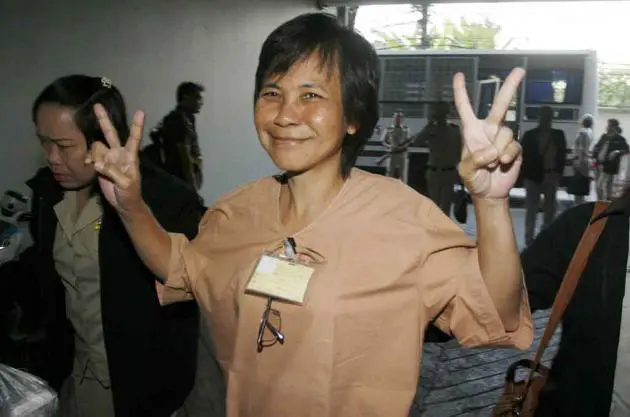
They include high-profile figures like Surachai Danwattananusorn or Sae Dan, Daranee Chanchoengsilapakul, aka Da Torpedo, Warawut Thanangkorn, aka Suchart Nakbangsai and Lerpong Wichaikhammat, aka Joe Gordon.
The other four are Suriyan Kokpuey, Satien Rattanawong, Wanchai Sae Tan and Nat Sattayapornpisut.
In the past, lese majeste offenders have opted to submit individual petitions seeking the royal pardon via the Justice Ministry.
After the vetting of petitions by relevant authorities, His Majesty the King would grant pardon to every case. Thai and alien offenders often walked out of prison within a month.
But the eight have chosen an unprecedented path to secure their pardon. Their open letter clearly indicates they are well aware of the normal channel to seek the King's clemency.
They prefer, however, to invoke a clause under Article 261 of the Criminal Procedural Code to back up their joint demand for the pardon process via the government and not the King.
Under the clause, the justice minister is authorised to deem it necessary to advise the King to grant the pardon regardless of the filing of individual petitions.
Article 261 is generally invoked as a basis for an executive decree to grant a pardon to inmates on good behaviour coinciding with auspicious occasions such as the King’s birthday.
Even if the government agrees to intervene and issue a pardon decree, the process will take months, perhaps even a year to complete.
Yet the eight have chosen to go through the long and uncharted route for their pardon. Furthermore, they want the government to intervene on their behalf. They specifically called attention to their letter two weeks after the government remained silent on the matter.
The government leaders have yet to step forward and react to the open letter. None of them want the political hot potato dumped in their lap. PM Yingluck appears clueless that the letter was addressed and sent to her.
The eight see themselves as political prisoners, hence their demand for the government's intervention to resolve their legal predicament. But the government is duty-bound to look beyond personal and political ties. Under domestic and international laws, the eight are convicts who can not be classified and treated as political prisoners.
If a pardon decree is granted as a one-off case for the eight, then the government will make a mockery of itself as enforcer of the lese majeste law.
Fortunately, the government still has time to ponder its decision because the eight are not in the mainstream of the red-shirt movement.
It is unlikely that the eight will agree to seek pardon directly from the King. This leaves the government with limited options, all of which will be controversial.
Abandoning the eight is tantamount to political suicide as the red shirts will condemn the government as ungrateful. But rescuing them will create a dangerous precedent and make it pointless to enforce the lese majeste law.
