
Suthep suggests national reconciliation referendum


Play
Insists public must decide on any package that includes amnesty for Thaksin; likens red shirts to Khmer Rouge
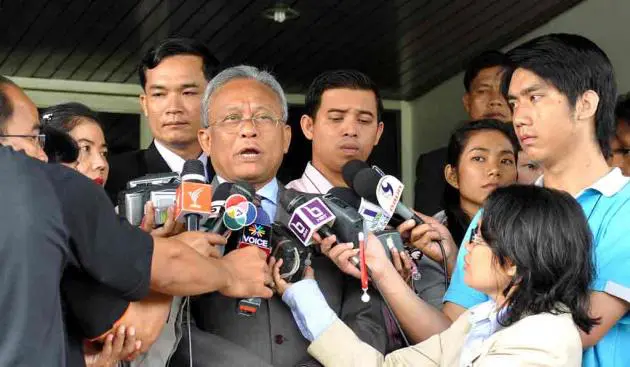
Suthep Thaugsuban, a senior Democrat Party MP, yesterday proposed a national referendum on any reconciliation package that included the scope and details of an amnesty for fugitive ex-premier Thaksin Shinawatra and others involved in the political conflict.
Day two of the House of Representatives debate on national reconciliation proposals based on King Prajadhipok’s Institute studies saw a continuation of unresolved differences as to whether to forward the reports to the government.
Suthep proposed, however, that a national referendum should be held on the scope and details of any amnesty for Thaksin and others.
“There will surely be peace if you can do it [hold such a referendum],” he said.
Suthep also endorsed the latest statement by King Prajadhipok’s Institute to defer the issue and have a wider public discussion on the best way to achieve national reconciliation.
“I’m all for national reconciliation,” he said. “But we must be clear as to whom we are reconciling with. Secondly, we must be clear why the contentious parties are angry with one another … All sides must also make sacrifices, but we must be clear as to what Pheu Thai or the Democrat Party and other institutions must sacrifice. We must listen to the voices of the people and see if they think it’s worth the sacrifice, and then hold a referendum,” he said.
ASSETS ISSUE
The issue of what to do with Thaksin’s confiscated assets must also be addressed, he added.
Suthep, who served as deputy prime minister in the previous government, yesterday blamed Thaksin for being the root cause of the political conflict.
He pointed to the many legal cases against the ex-premier and his political parties that resulted in his assets being confiscated and his parties being dissolved.
“I will reconcile with you when you play politics within the system. It should not be that you have a political party, the red-shirt movement, the red-shirt villages, and armed men. If these still exist, I will not reconcile with you,” he said.
The veteran politician also said Watana Muangsuk, a member of the House reconciliation panel, should not have sat on the committee due to a conflict of interest.
He pointed out that Watana, who was a member of Thaksin’s Cabinet, had faced many corruption allegations investigated by the post-coup Assets Examination Committee (AEC).
One proposal favoured by the House reconciliation panel is to expunge all the legal cases brought to court by the AEC.
The House debate, scheduled to end late last night, continued at the time of going to press.
However, there was no immediate response to Suthep’s referendum proposal from the ruling Pheu Thai Party’s MPs, as they took turns insisting that national reconciliation is an urgent issue that needs to be carried out as quickly as possible.
Jirayu Huangsap, for example, said Thailand was now lagging behind many neighbouring countries due to the prolonged and unresolved political rift.
“We must forget the past,” Jirayu told the House. “If you can’t get over the issue of Thaksin, we won’t get anywhere.”
Kusamawadee Sirikomut, Pheu Thai MP for Maha Sarakham province, accused the Democrat Party of thinking negatively and painting an image of the “devil” in their minds.
“When we talk, I want us to talk about the future more than about the past,” said the MP.
ACCUSATION AGAINST THAKSIN
Ignoring these comments, Suthep accused Thaksin of wanting to create a presidential system to replace the current system. He also compared the red shirt-movement to the Khmer Rouge.
The accusations led to many protests and counter-protests |until the House chair got both sides to agree not to intervene when one of them was addressing the chamber.
Other Democrat MPs, including Akom Engchuan, insisted that no amnesty could be given to those who had committed criminal acts, such as setting fire to CentralWorld or provincial halls.
“Don’t even cite [the notion of] transitional justice,” said Akom, who also warned Sonthi Boonyaratglin, the former 2006-coup-leader-turned-MP and now chairman of the House reconciliation committee, not to rush things through by using the majority vote.
Democrat MP Sathit Wongnong-taey accused Sonthi’s committee of wanting to whitewash Thaksin through absolution of the now-defunct AEC.
“Are you people rushing things through in order to present it as a gift to someone during Songkran [next week]?” Sathit said.
He added that more time was needed to discuss the issue and Parliament should, therefore, postpone the matter instead of rushing any proposals to the government.
Veteran MP Sanoh Thienthong of the Chart Thai Pattana Party said the reason reconciliation had not been achieved was all the bickering in Parliament.
“Others outside the House want reconciliation,” he said. “If we want to talk, let’s face one another and not talk about the past. We want the future, right?”
