
Jump in students doing vocational courses


Play
Institutes close to capacity as people hone their job chances
Getting a job or finding a better job in a time when tens of thousands of people are unemployed across the country and competing for work is not easy. Not surprisingly, many are equipping themselves with more advanced skills in their work fields, while others are seeking new fields for job opportunities
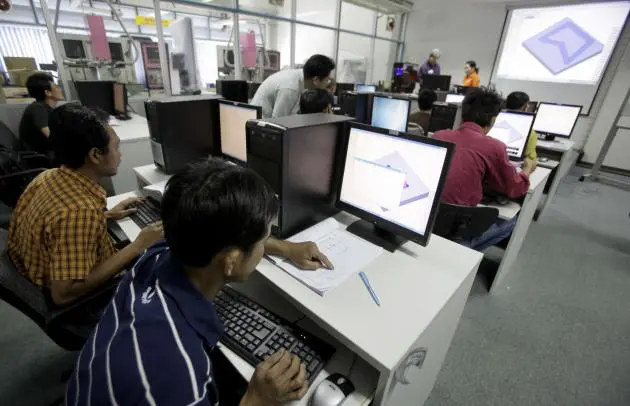
They see training as a good |solution to these challenges. Many courses provided by the National Institute for Skill Development in Samut Prakan are crowded with employees who’ve decided to turn their free time during weekends into learning time that makes |them more competitive and liable for promotion into new job opportunities.
The number of people joining courses related to industry and construction technologies and computer programmes, electricity and electronics, has increased by around 40-50 per cent over the past five years, according to Suphop Pingta, director of the institute.
He said most had graduated with bachelor’s degrees. The number of people attending courses in these fields in each round had almost reached the full capacity of the institute over the past four or five years. Five years earlier, it stood at about 50-60 per cent of capacity. Each round provides training for about 20 or 30 people, depending on classroom facilities available for each course.
Totally, 4,465 have been trained and some 3,988 have been able to complete training from 2009-2012, according to Suphop.
Suriya Nokpum, 25, a young engineer in a company producing parts of heavy equipment –like backhoe buckets – from Pathum Thani, was among the thousands of employees training at the institute. He took part in an industry-related course to learn about using computer programmes for CNC (computer numerical control) milling machines.
“There are many employees working with machines, but not many have the knowledge and understanding of the machines and technologies that relate to them. So I wanted to be trained to gain more knowledge about the technologies of the machines I used,” Suriya said.
He added that having more advanced knowledge in his working field, he would progress faster in his career and its high competition.
Samphan Phumatna, 30, who works for the safety department of a factory in Samut Prakan, is being trained in a course of construction or building design using a computer-aided design (CAD) programme.
“The design skills I’ve learned here will be used to help me protect other workers at my factory from harm – and also I can use the skill to earn more money from an extra job,” Samphan said.
“To keep the working environment safe for workers, I will need to understand the structure of all buildings in my factory. It’s important to take this course in which I’ll be able to [create a] safer environment in the workplace,” he said. “I also plan to attend other CAD courses because I want to design houses and home plans for sale. Perhaps, when I’m proficient enough in designing, I’ll change my full-time job from safety officer to home designer.”
He said the training helped him discover more job opportunities. “Technologies have become more and more crucial in people’s lives [and learning about] technologies will help us find a brighter future in our career.”
According to Skill Development Department director-general Praphan Montakarntiwong, more than 100 courses are offered to employees who want to upgrade their skills. Unemployed people could also take the courses to equip themselves with new skills and become more competitive.
There are 12 National Institutes for Skill Development in different regions, including the institute in Samut Prakan and development centres in 65 provinces that offer training courses. More than 3 million people from all education levels have taken the courses each year, he said.
Moreover, 12 advanced computer-technology training centres are in the process of being established. They will provide training for those who work in industry and need to acquire advanced technology skills.
The latest report of the National Statistical Office in May showed that 359,000 people were unemployed. The number increased by 155,000 when compared to the same period last year. Most of the unemployed, or up to 152,000, had graduated from higher education.
Praphan said to reduce the severity of unemployment, the Labour Ministry had worked together with the Federation of Thai Industries, the Thai Chamber of Commerce, tourism and hotel associations and employers to figure out the needs of entrepreneurs in terms of quantity and qualification of employees in each field. |This would help them recruit new graduates.
“They are also assisting the ministry to design new courses and adjust current ones and provide their professional personnel to be trainers for some courses to train workers that suit their demands,” he added.
Previous news reports said the ministry would also help match employers with bachelor-degree students before they graduate to ease the problem.
Lots of employees have tried different ways to upgrade their qualifications, so why shouldn’t students and new graduates do the same? Otherwise they will lag even farther behind employees with more work experience and qualifications.
BOX :
BY THE NUMBERS
- Over the year, 280,000 graduates from all education levels remain unemployed, while the labour market looks to recruit 250,000 workers annually.
- However, 70 per cent of the unemployed do not seek a job.
- 100,000 people aged less than 30 – working age people – have been detained in prisons.
- Latest report in May showed that 359,000 people were currently unemployed – an increase of 155,000 when compared to the same period last year.
- Many of the unemployed, |or up to 152,000 people, |have graduated from higher |education.
SOURCE: THAILAND DEVELOPMENT RESEARCH INSTITUTE AND NATIONAL STATISTICAL OFFICE
