
No charges in bomb-scanner case


Play
NACC says not enough evidence to pursue Thaksin, Suriya; will probe six top officials for malfeasance
The national anti-graft agency yesterday decided not to take legal action against the politicians implicated in the CTX bomb-scanner scandal, citing lack of evidence against them.
However, the National Anti-Corruption Commission will focus its investigation on six senior bureaucrats – all former members of the Airports of Thailand (AOT) executive board – for suspected malfeasance, said NACC member Vichai Vivitsevi.
He said the eight commissioners present at yesterday’s meeting had voted not to pursue the legal case against former prime minister Thaksin Shinawatra and ex-transport minister Suriya Juengrungruangkit.
“We found that there was insufficient evidence to prove without doubt that the accused had actually committed the alleged wrongdoing,” Vichai said.
Klanarong Chanthik, the other NACC member and the agency’s spokesman, was absent from yesterday’s meeting. He was a member of the post-coup Assets Examination Committee (AEC), which investigated and gathered information on the CTX scandal.
Vichai chairs the NACC subcommittee investigating the case involving alleged irregularities over the purchase of the US-made CTX-9000 bomb-scanners for Bangkok’s Suvarnabhumi Airport.
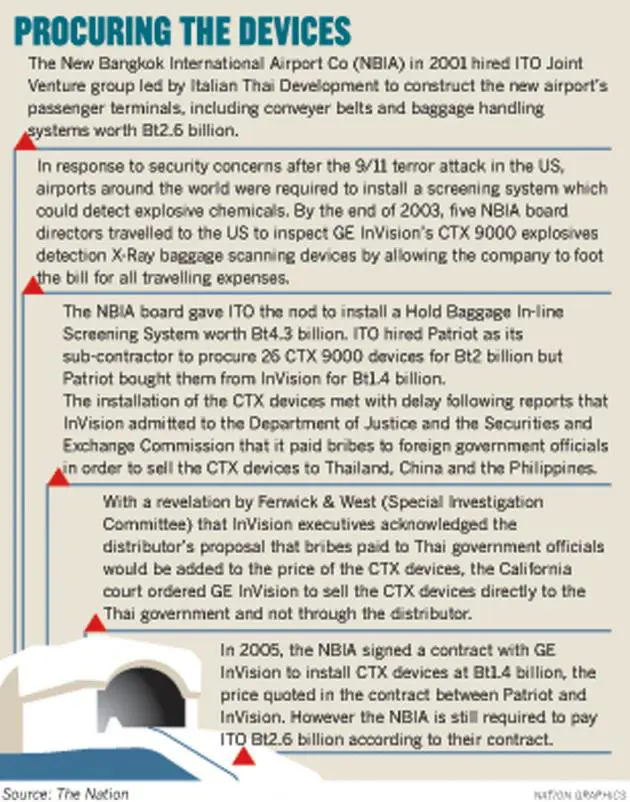
The scanners were said to have been purchased at inflated prices through a Thai-owned company, instead of the US producer. The AEC estimated that the irregularity had caused Bt1.7 billion in losses to taxpayers.
The case was transferred to the NACC after the term of the AEC, which had been established by the 2006 coup-makers, ended in 2008.
In 2005, the US Department of Justice and the US Securities and Exchange Commission investigated “foreign corrupt practices” by InVision, the manufacturer of CTX machines, with the alleged involvement of Thai officials.
US authorities reported at the time that Thai officials or politicians might have received more than US$10 million (now about Bt310 million) in bribes after purchasing the bomb-detectors for the new airport.
The NACC had obtained 560 pages of documents from the AEC and some 5,000 pages of documents from the US Federal Bureau of Investigation.
However, the NACC members still found there was insufficient evidence to prove without doubt that Thaksin and Suriya had been involved with the irregularities, Vichai said.
The anti-graft agency, nevertheless, found evidence against six senior bureaucrats who were board members of AOT, which runs Thailand’s key international airports.
They are former Transport Ministry permanent secretary Srisuk Chandrangsu (who then served as AOT board chairman), General Somchai Somprasong (former deputy board chairman) and four other ex-board members: former attorney-general Chaikasem Nitisiri, Therdsak Setthamanop, Suphadej Poonpipat and ACM Narongsak Sangkapong.
The six were found to have travelled to San Francisco on a trip paid for by the CTX distributor, said Vichai.
“Their air fares, hotel rooms and golf course fees were covered by the company. Some of them even brought their wives and family members,” he added.
This could be regarded as a violation of Article 149 of the Penal Code, which prohibits public officials from accepting personal benefits, said the graft-buster.
He said the AEC had overlooked the information against the six former AOT board members when it investigated the CTX scandal.
The NACC last week postponed its decision on the CTX scandal, saying it had found new evidence of high-ranking government officials being involved.
Vichai last Tuesday said that the agency had unanimously agreed on the delay, as more documents had been received from US prosecutors and justice agencies, and needed to be translated.
The documentation includes receipts and evidence of the procurement.
