
Fine Arts Dept loses conservation battle


Play
One historical building definitely to be demolished to make way for new Supreme Court office
The construction of the new Supreme Court office is going ahead despite a public uproar that the project will most likely endanger at least one of the two registered historical buildings nearby.
The Fine Arts Department has tried to prevent these two buildings from being brought down, but it seems one of them is definitely going to be demolished.
A visit to the construction site on Rajdamnoen Avenue showed that workers were removing parts of the roof and walls of an ancient building that previously housed the Southern Bangkok Criminal Court.
This building, according to the Fine Arts Department, should be con
served alongside the Office of the Judiciary, which stands behind the statue of late Prince Rabi Badhanasakdi. However, according to Court of
Justice spokesman Sittisak Wanachakit, only the oldest building in the compound will be conserved and that is the one standing directly behind the statue.
“Constructed in 1941, this building is a memorial to Thailand’s full judicial independence,” he said.
He also insisted that the other ancient building, which previously housed the Southern Bangkok Criminal Court, would be demolished because it had been built in 1943 and in a dilapidated state.
“We have already told the contractors that the building can be torn down,” Sittisak said yesterday. “We will also go ahead with the construction of the Supreme Court’s new office. It’s in line with a Cabinet resolution.”
He explained that the plan to build a new office for the Supreme Court, in fact, first emerged in 1973 and then again on July 19, 1988, when it was approved by the Cabinet.
“The new office building will not be higher than 32 metres,” he said.
Sittisak said the construction should be completed in three years, but added that since the court was late in deciding on the exact construction site, it might take up to five years.
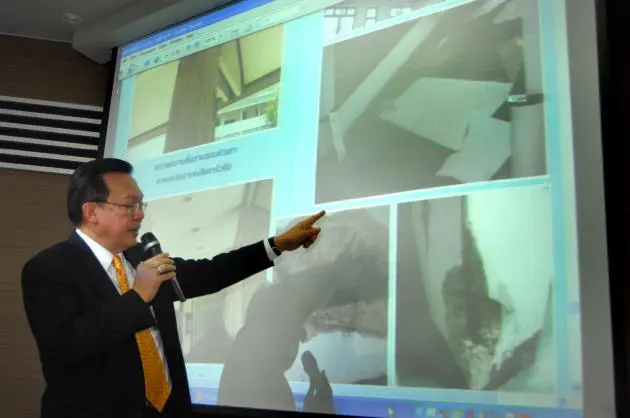
He spoke up after the Fine Arts Department and several other people raised concern about the construction of a new building near historically important structures.
Sahawat Naenna, the department’s director general, said yesterday the Fine Arts Department had already written to the Supreme Court, explaining that the two buildings had historical and architectural value and should therefore be conserved. “I plan to write to the Supreme Court again,” he said.
Sittisak, meanwhile, insisted that his office had already consulted the royal architect, Mitrarun Kasemsri, about the design. “Our focus is on conservation and development,” he said.
He said the building, designed by Chulalongkorn University’s Faculty of Architecture, features traditional styles. He added that the plan had undergone 14 rounds of opinion gathering. “The Fine Arts Department was also involved in the process,” Sittisak said.
