
New education strategy will be 'free of politics'
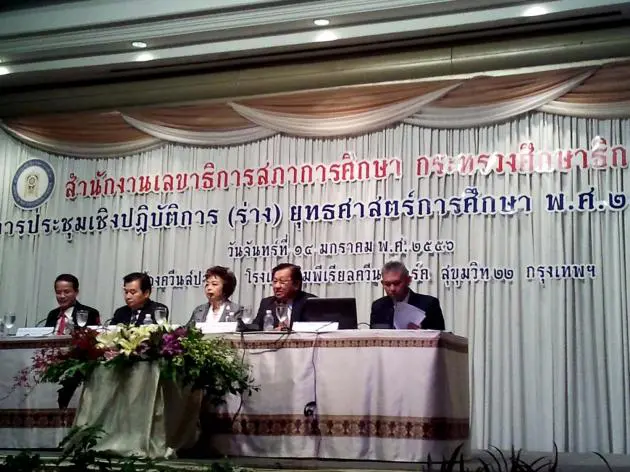


Phongthep commits to enhancing knowledge, boosting standards
Education Minister Phongthep Thepkanjana promised yesterday that he would not let politics interfere with the improvement of education in the country as his ministry was in the process of drafting a national education plan and strategy to enhance education and address current problems.
“Education has to be free from politics as it is used to strengthen citizens’ capabilities and develop the nation in the long run. We have to listen to everyone’s opinion no matter who they are or how their political standpoints are different from ours. We also have listen to children’s opinions,” he said at a meeting hosted by the Office of the Education Council (OEC) in which opinions were sought to shape the national education strategy 2013-2015.
He added he would take all recommendations into consideration, including those created for the second-decade education reform, initiated by the Democrat-led government.
Education experts, however, wondered if the strategy would be implemented seriously enough.
“Implementation of the strategy is the most worrying issue for me,” Assoc Prof Sukum Chaleisap, chair of advisory team for the president of Suan Dusit Rajabhat University said. “A manual that clearly tells teachers how to implement the strategy should be created and distributed naitonwide so teachers know how to follow the strategy correctly.”
Assoc Prof Sompong Jitradub, a lecturer from Chulalongkorn University’s Faculty of Education, said he wanted the OEC to provide more details on the implementation plan. “This should not just be comprised of the six sentences we see in the draft.”
According to Prof Phawit Thongroj, the strategy will focus on enhancing education; providing equal opportunities; reforming the teaching profession; boosting education at higher and vocational levels to meet market demand; using information technology; promoting research and development to boost the country’s intellectual capital; and enhancing competitiveness. The professor works as an adviser to the minister.
Phongthep said the strategy would help boost students’ achievements, which were not satisfactory at present, by encouraging teachers to change the way they teach and allow students to voice their ideas more. Hence, he said, they would start with changing the curricula.
“Some subjects do not require students to remember too many details, but require them to think more and analyse,” Phongthep explained.
Similar meetings would take place later in Chiang Mai, Nakhon Ratchasima, Kanchanaburi and Phuket to get recommendations from stakeholders.
