
'Outdated curriculum needs to focus on skills'


Our national curriculum is out of touch with the modern world and is failing to equip students with the skills demanded by the fast-changing 21st-century job market, a researcher has told Education Ministry officials.
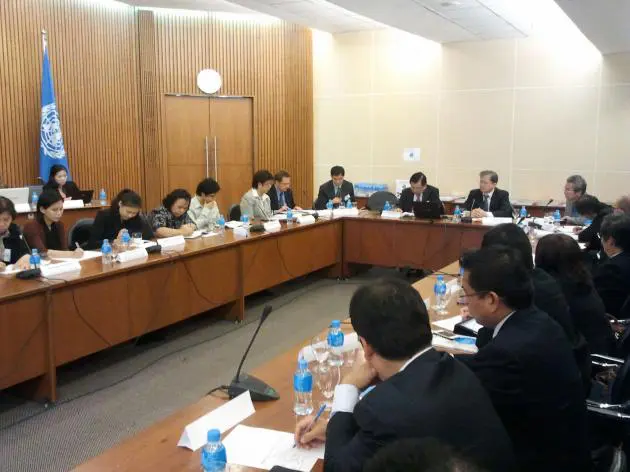
“The curriculum has no clear statement of the importance of skills in its vision and principles, and focuses on predetermined values rather than learning processes and skills,” said Thailand Development Research Institute (TDRI)’s Worapoj Wongkitrungruang. He was presenting his preliminary findings of an “Analysis of the Basic Education Core Curriculum and Reform in Line with 21st Century Skills” earlier this week at a Unesco-TDRI seminar. The seminar was attended by Education Ministry officials who are currently working on revamping the basic-education curriculum.
“The goals of the curriculum do not mention interdisciplinary 21st-century themes in the content design. The acquisition of necessary skills is mentioned, but their importance is relegated in favour of other goals focused on pre-determined values,” said Worapoj.
“At school, as well as local and national assessment levels, there is no stipulation of [performance-based] assessments that would support the measurement of 21st century skills.”
Worapoj said his research showed that the curriculum’s over-prescribed, content-oriented indicators at every grade-level made it difficult for teachers to understand “what to teach”, “how to teach” and “how to assess” students’ progress. It also denied schools the autonomy to design their own curricula, gave teachers no time for student-centred teaching techniques, diverted teacher’s attention from teaching skills because they are not measured, and made it difficult for schools to organise interdisciplinary or experience-based curricula.
The curriculum also indicated eight learning areas without mentioning alternative ways of organising learning, such as cross-curricular projects and experiences,” said Worapoj.
Although, the curriculum indicated five key competencies – communication capacity, thinking capacity, problem-solving capacity, capacity for applying life skills, and capacity for technological application – these were not as comprehensive as the P21 Framework (the Partnership for 21st Century Skills) used in America. Moreover, the Thai curriculum contained no statement about the importance of integrating skills development in teaching, said Worapoj.
He urged a switch to assessment methods that measure skills and knowledge application, such as performance-based assessment at classroom level, and literacy-based assessment (at the national level), and recommended that curriculum indicators be redesigned to measure skills and knowledge application.
He added that the list of skills for students to master should be made more comprehensive, and reorganised to make it easier for educators to understand. Stressing the importance of the key competencies, he said they should be integrated into every element of curriculum design, along with cross-curricular, experience-based and outcome-based learning that focused on skills required for working and living in the 21st century.
