
Art of survival a way of life for Tokyo residents


Play
From a very young age, Japanese residents in Tokyo attend the Tokyo Rinkai Disaster Prevention Park to learn basic survival skills.
From a very young age, Japanese residents in Tokyo attend the Tokyo Rinkai Disaster Prevention Park to learn basic survival skills.
By the time their training is over, they are expected to know how to survive for at least 72 hours in a disaster-stricken area. The experience, while useful, is also an enjoyable one.
Why is the 72-hour benchmark important? Despite efforts to get to disaster victims quickly, real assistance is not usually possible in a disaster area until a few days have already passed. So, regardless of their age, Tokyo residents are encouraged to equip themselves with skills that can help – not just themselves – but also others.
A video presentation at the park, for example, reveals the importance of attention to detail. It demonstrates that knowing where your loved ones were at the time of a disaster could be crucial to their survival. In the video clip, the life of a young boy is saved after his older brother reveals to adults that he remembered his brother saying – just before the earthquake hit – that he was going to get a drink of water. Because of the clue, they locate the boy trapped under a water cooler.
Located in Odaiba, the Tokyo Rinkai Disaster Prevention Park was launched in 2008. A number of concerned stakeholders contributed to construction of the expansive facility. Since the Great Hanshin earthquake, Tokyo has become acutely aware of its vulnerability to natural disasters and the impact they have on people’s lives.
While the experience-learning facility is a highlight for visitors, there are also many other important components. The centre also includes the Oka Core ide-area Disaster Prevention Base; a disaster prevention facility managed by the Cabinet Office; a helipad and an outdoor plaza. The plaza plays a crucial role in the event of emergencies, during which it is able to accommodate dozens of evacuees. It can also host evacuation drills and other related activities for Tokyo residents during normal times.
Mothers are often seen bringing their children to the centre, while teachers arrange regular educational trips to the centre for their students. Older children often make their own way to the centre. They discover that centre officials not only give lectures and stage demonstrations, they allow visitors to walk through the Disaster Prevention Experience-learning Facility, which includes simulated sessions. What if a big earthquake hits while the children are in an elevator? What if the floor shakes and the elevator screeches to an emergency stop? Park officials are on hand to guide the children on how to respond safely to such situations and how to get out of the elevator. In a real crisis, the safe area is not necessarily through the doors of the elevator – a point that is always emphasised in any training scenario.
REPEATED AFTERSHOCKS
In another situation, children are led to a corridor with no electricity. Visitors to the facility follow evacuation lights and emergency guidance procedures in search of the exit. In the dim light, children are advised to prod carefully and not to run, as they may stumble and injure themselves.
In the next scenario visitors experience repeated aftershocks created using sound, lighting and imagery effects. While they are asked to make their way to an evacuation area, they also interact with park officials using a portable game machine that lists questions for them to answer. At the Cinema Station, they will experience a simulated earthquake. When young visitors finally reach the safe evacuation zone, they are informed of their quiz results. The higher their scores the greater chance of their survival in a real-life situation.
Tokyo residents are advised to come back to the centre twice a year to brush up their skills. It is best to be well prepared as an emergency could strike at anytime.
For those children who live a long way from the Tokyo Rinkai Disaster Prevention Park, many can find similar centres close to their homes. In Tokyo, there are many such centres and all of them offer useful, interactive training and information.
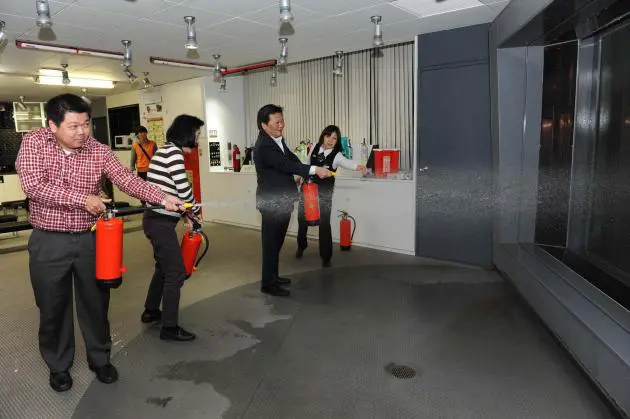
At the Ikebukuro Life Safety Learning Centre, children are told how to extinguish a fire and to provide first aid to those who need it. All sessions are very interactive, requiring participants to step into very life-like scenarios. Smoke appears when children are taught how to tackle fire and floors begin to shake when they take part in the earthquake sessions. In this scenario, children are told to look for cover by hiding themselves under tables and holding on tightly to the legs of tables to prevent them from slipping away. To make children aware of the dangers from falling items, giant screens show all kinds of stuff that can rain down during a seismic quake.
“Don’t think that it’s irrelevant to your daily life. An earthquake may strike anytime while fire often starts at home in the kitchen. The very first person who can respond to such emergencies is, of course, you. You have to know whether you tackle it alone or need to quickly seek help,” the centre’s administrator explained – adding that the centre was under the supervision of the Tokyo Fire Department.
