
Prawase urges all sides in health sector to join hands


Play
Respected social critic Prawase Wasi yesterday called on rural doctors and Public Health Minister Pradit Sinthawanarong to end their conflicts and start cooperating to improve the healthcare system.
Prawase said the system that is used to evaluate the performance of state doctors for the purpose of determining allowances should take communities’ input into account, rather than being based solely on the pay-for-performance, or P4P, scheme introduced by Pradit.
In his first three months in office, Pradit has set about adjusting the allowance for medical workers, especially doctors, by introducing the P4P scheme, as well as improving work efficiency and healthcare services at state hospitals.
But this policy has been strongly opposed by a large group of medical workers at rural hospitals and the Rural Doctors Society, who claim the new system would push doctors to work at private hospitals. They said it reduced their current allowance, which is based on the location and number of years the person has worked.
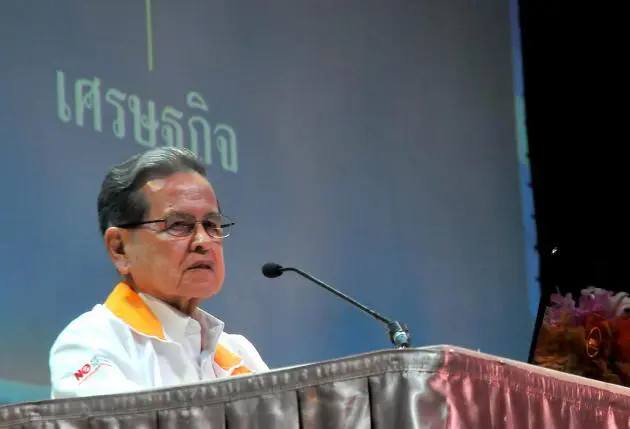
While giving a speech to mark the 12th anniversary of the Thai Health Promotion Foundation, Prawase said Pradit and members of the Rural Doctors Society should not quarrel, but should consult each other.
“I am old and I don’t want to see the two sides fight. I would like them to consult each other, because issues of healthcare must also take into account the [views of] communities,” Prawase said.
“To promote health and to evaluate performance, not only performance in hospitals but also communities’ input must be taken into account. So the public health minister and rural doctors should not fight, and should turn to talking.”
The Rural Doctors Society recently vowed to hold another demonstration on June 6 in front of Yingluck’s home, to submit their demand that the Cabinet drop the P4P policy.
Prawase said he did not want to comment on the planned protest because it was a political issue. He said the two sides should consult each other on how to improve the healthcare system.
Pradit was also accused of trying to destroy the Government Pharmaceutical Organisation (GPO) by having the Department of Special Investigation (DSI) probe irregularities into the procurement of precursor drugs to produce paracetamol, as well as delays in building a flu-vaccine factory and an HIV/Aids drug plant.
Prawase said he did not want to comment on the alleged interference in the GPO, but he called on the government to limit its role to making policy and to leave the day-to-day operations to the policy implementers.
