
No clear flood diversion plans from K-Water
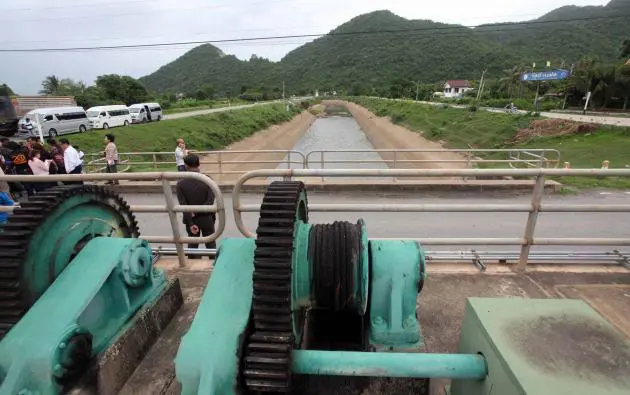


RID reveals possible channel locations
No one knows where the chosen constructor, Korea Water Resources Cooperation (K-Water), intends to lay down the counflood-diversion channels along the Chao Phraya River.
But the Royal Irrigation Depart-ment has already revealed its ideas for possible locations for the channels, their expected benefits and their possible adverse impacts.
The department has studied five alternatives for the western side of the Chao Phraya River and one for the eastern side. Last week, it had presented only two potential routes at a public forum in Nakhon Pathom.
All the alternatives have come from ongoing feasibility studies on how to prevent drought and flooding in the Chao Phraya River Basin.
The department commissioned three private consulting firms to study plans for creating the flood-diversion channel on the western side of the Chao Phraya River. Involved in the study are Tara Consultant and Sigma Hydro Consultant, and Asia Lab and Consultant Co Ltd.
Sigma Hydro Consultant’s president, Assoc Prof Viraphol Taesombut, said the consultants would spend 420 days drawing up potential locations for the flood-diversion channel on the river’s western bank.
“We started our work last August. It should be completed by October 23,” he said.
According to Viraphol, the study has already identified five possible locations for this flood-diversion channel. Each will have the capacity to drain more than 1,200 cubic metres from either the Chao Phraya River or its tributary, the Ping River.
Viraphol said the study had also identified the benefits and possible negative impacts of each location.
“We are now organising public forums to listen to the opinions of local people in each possible location for the flood-diversion channel,” he said.
He added that the study must address economic, social and environmental impacts as well as the engineering implications.
At this point, he believed two locations had good prospects.
The flood-diversion channels are key parts of the government’s Bt350-billion project to improve the country’s water-management and flood-prevention infrastructure once and for all.
The Cabinet has already approved the Water and Flood Management Commission (WFMC)’s choice of constructors for the expensive modules.
K-Water won the A5 module that entails the construction of flood-diversion channels on both sides of the Chao Phraya River under a budget of Bt150 billion.
Monthon Panupokin, managing director of K-Water Thailand, told The Nation earlier that he is confident his firm would be able to complete the tasks within a five-year timeframe.
According to K-Water’s tentative plan, Monthon said his firm would complete the surveys and health- and environmental-impact assessment reports in two years and two months. The construction would then take two years and 10 months.
In addition, K-Water is planning to hold public hearings before starting the project, listening to the concerns of all. Although many groups have different ideas and concepts, Monthon says the firm will be able to find common ground
The Royal Irrigation Department, meanwhile, has already worked out where the channel on the eastern bank of the Chao Phraya River should lie.
Asst Prof Komsan Maleesee of King Mongkut’s Institute of Techno-logy Ladkrabang’s Faculty of Enginee-ring said so far he did not think the flood-diversion channels would really be useful, whether they were on the eastern or the western banks.
“Geographically, the Chao Phraya River is flat at its last portion where it links to the sea. So, it’s not suitable for draining the water out,” he said.
He advised authorities against wasting money on building the flood-diversion channels, adding that creating water-retention areas along the Chao Phraya River would be better.
Somkiat Prajamwong, director of the Royal Irrigation Department’s Project Management Office, said the department will in October hand the full environmental and social impact assessment to the Water and Flood Management Commission, which will use it to study and compare the cost of construction with K-Water.
However, he said he was worried about the environmental impact from the massive amount of water that will drain through this channel around the mouth of the Gulf of Thailand at Samut Songkran, whose shores are home to many shell farms. “The massive amounts of fresh water that will flow via this flood channel will likely have an effect on the aquatic farms located along the sea shore and on the ecology in this area.”
